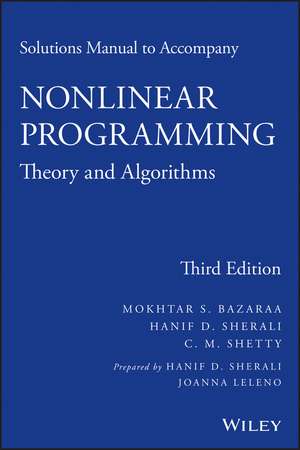
Solutions Manual to Accompany Nonlinear Programming
Autor Mokhtar S. Bazaraa, Hanif D. Sherali, C. M. Shettyen Limba Engleză Paperback – 24 iul 2013
Preț: 294.44 lei
Puncte Express: 442
Carte tipărită la comandă
Livrare economică 28 noiembrie-12 decembrie
Livrare prin curier în România Termenul estimat este afișat lângă disponibilitate.
Transport gratuit de la 400.00 lei Plată online sau ramburs, în funcție de opțiunile comenzii.
Retur gratuit în 14 zile Comandă securizată și suport în română.
Specificații
ISBN-13: 9781118762370
ISBN-10: 1118762371
Pagini: 176
Dimensiuni: 152 x 229 x 10 mm
Greutate: 0.25 kg
Ediția:3rd Edition
Editura: Wiley
Locul publicării:Hoboken, United States
ISBN-10: 1118762371
Pagini: 176
Dimensiuni: 152 x 229 x 10 mm
Greutate: 0.25 kg
Ediția:3rd Edition
Editura: Wiley
Locul publicării:Hoboken, United States
V-ar putea interesa
-
 A Modern Introduction to Dynamical SystemsRichard J. Brown-13%Preț: 276.79 lei316.91 lei
 -
 A Modern Introduction to Dynamical SystemsRichard Brown-24%Preț: 650.05 lei853.82 lei
 -
 Undergraduate Analysis: A Working TextbookAisling McCluskey-12%Preț: 308.64 lei350.03 lei
 -
 -18%Preț: 999.19 lei1218.52 lei
 -
 Linear Programming 4eBazaraa-9%Preț: 920.27 lei1011.29 lei
 -
 -27%Preț: 1061.50 lei1454.12 lei
 -
 -18%Preț: 1274.76 lei1554.59 lei
 -
 -9%Preț: 790.13 lei868.28 lei
 -
 Finite Math for DummiesMary Jane SterlingPreț: 147.73 lei
 -
 -9%Preț: 782.66 lei860.07 lei
 -
 The Book of Real-World NegotiationsJoshua N. WeissPreț: 166.40 lei
 -
 Preț: 434.10 lei
 -
 Preț: 216.54 lei
 -
 Preț: 358.03 lei
 -
 Foundations of OptimizationM. S. Bazaraa-15%Preț: 611.54 lei719.46 lei
 -
 Optimization with Disjunctive ConstraintsH. D. SheraliPreț: 367.85 lei
 -
 Problemlösen in der MathematikWolfgang SchwarzPreț: 284.81 lei
Public țintă
This ISBN is for the Solutions Manual that can accompany the main book in multiple markets: Primary market: as a textbook in departments of mathematics, engineering, and/or computer science for a one–semester upper–undergraduate or beginning–graduate level course in nonlinear programming (NLP) Secondary markets: as an ancillary textbook in departments of mathematics, engineering, and/or computer science for either a one– or two–semester upper–undergraduate or beginning–graduate level course in either linear programming (LP) and/or LP and NLP; as a resource for applied scientists who seek a refresher to NLP techniques; as a reference in academic librariesNotă biografică
Mokhtar S. Bazaraa and C.M. Shetty are Professors Emeriti at Georgia Institute of Technology. Hanif D. Sherali, the lead author, is a W. Thomas Rice Chaired Professor of Engineering in the Grado Department of Industrial and Systems Engineering at the Virginia Polytechnic and State University. He and Dr. Bazaraa are co-authors of a complementary best-selling book at Wiley on linear programming (LP). Solutions prepared by Joanna Leleno.
Cuprins
Chapter 1: Introduction 1
1.1, 1.2, 1.4, 1.6, 1.10, 1.13
Chapter 2 Convex Sets 4
2.1, 2.2, 2.3, 2.7, 2.8, 2.12, 2.15, 2.21, 2.24, 2.31, 2.42, 2.45, 2.47, 2.49, 2.50, 2.51, 2.52, 2.53, 2.57
Chapter 3: Convex Functions and Generalizations 15
3.1, 3.2, 3.3, 3.4, 3.9, 3,10, 3.11, 3.16, 3.18, 3.21, 3.22, 3.26, 3.27, 3.28, 3.31, 3.37, 3.39, 3.40, 3.41, 3.45, 3.48, 3.51, 3.54, 3.56, 3.61, 3.62, 3.63, 3.64, 3.65
Chapter 4: The Fritz John and Karush-Kuhn-Tucker Optimality Conditions 29
4.1, 4.4, 4.5, 4.6, 4.7, 4.8, 4.9, 4.10, 4.12, 4.15, 4.27, 4.28, 4.30, 4.31, 4.33, 4.37, 4.41, 4.43
Chapter 5: Constraint Qualifications 46
5.1, 5.12, 5.13, 5.15, 5.20
Chapter 6: Lagrangian Duality and Saddle Point Optimality Conditions 51
6.2, 6.3, 6.4, 6.5, 6.7, 6.8, 6.9, 6.14, 6.15, 6.21, 6.23, 6.27, 6.29,
Chapter 7: The Concept of an Algorithm 64
7.1, 7.2, 7.3, 7.6, 7.7, 7.19
Chapter 8: Unconstrained Optimization 69
8.10, 8.11, 8.12, 8.18, 8.19, 8.21, 8.23, 8.27, 8.28, 8.32, 8.35, 8.41, 8.47, 8.51, 8.52
Chapter 9: Penalty and Barrier Functions 88
9.2, 9.7, 9.8, 9.12, 9.13, 9.14, 9.16, 9.19, 9.32
Chapter 10: Methods of Feasible Directions 107
10.3, 10.4, 10.9, 1.012, 10.19, 10.20, 10.25, 10.33, 10.36, 10.41, 10.44, 10.47, 10.52
Chapter 11: Linear Complementary Problem, and Quadratic, Separable, Fractional, and Geometric Programing 134
11.1, 11.5, 11.12, 11.18, 11.19, 11.22, 11.23, 11.24, 11.36, 11.41, 11.42, 11.47, 11.48, 11.50, 11.51, 11.52
1.1, 1.2, 1.4, 1.6, 1.10, 1.13
Chapter 2 Convex Sets 4
2.1, 2.2, 2.3, 2.7, 2.8, 2.12, 2.15, 2.21, 2.24, 2.31, 2.42, 2.45, 2.47, 2.49, 2.50, 2.51, 2.52, 2.53, 2.57
Chapter 3: Convex Functions and Generalizations 15
3.1, 3.2, 3.3, 3.4, 3.9, 3,10, 3.11, 3.16, 3.18, 3.21, 3.22, 3.26, 3.27, 3.28, 3.31, 3.37, 3.39, 3.40, 3.41, 3.45, 3.48, 3.51, 3.54, 3.56, 3.61, 3.62, 3.63, 3.64, 3.65
Chapter 4: The Fritz John and Karush-Kuhn-Tucker Optimality Conditions 29
4.1, 4.4, 4.5, 4.6, 4.7, 4.8, 4.9, 4.10, 4.12, 4.15, 4.27, 4.28, 4.30, 4.31, 4.33, 4.37, 4.41, 4.43
Chapter 5: Constraint Qualifications 46
5.1, 5.12, 5.13, 5.15, 5.20
Chapter 6: Lagrangian Duality and Saddle Point Optimality Conditions 51
6.2, 6.3, 6.4, 6.5, 6.7, 6.8, 6.9, 6.14, 6.15, 6.21, 6.23, 6.27, 6.29,
Chapter 7: The Concept of an Algorithm 64
7.1, 7.2, 7.3, 7.6, 7.7, 7.19
Chapter 8: Unconstrained Optimization 69
8.10, 8.11, 8.12, 8.18, 8.19, 8.21, 8.23, 8.27, 8.28, 8.32, 8.35, 8.41, 8.47, 8.51, 8.52
Chapter 9: Penalty and Barrier Functions 88
9.2, 9.7, 9.8, 9.12, 9.13, 9.14, 9.16, 9.19, 9.32
Chapter 10: Methods of Feasible Directions 107
10.3, 10.4, 10.9, 1.012, 10.19, 10.20, 10.25, 10.33, 10.36, 10.41, 10.44, 10.47, 10.52
Chapter 11: Linear Complementary Problem, and Quadratic, Separable, Fractional, and Geometric Programing 134
11.1, 11.5, 11.12, 11.18, 11.19, 11.22, 11.23, 11.24, 11.36, 11.41, 11.42, 11.47, 11.48, 11.50, 11.51, 11.52