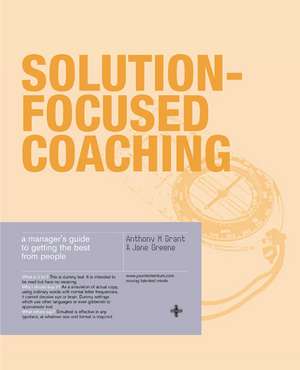
Solution-Focused Coaching
Autor Anthony Grant, Jane Greeneen Limba Engleză Paperback – 7 aug 2003
Ne-a atras atenția un fapt central în analiza autorilor: succesul organizațional modern nu mai depinde doar de procese, ci de capacitatea de a valorifica stresul și de a-l transforma în productivitate și satisfacție. Într-o eră în care granița dintre muncă și viața privată se estompează, Solution-Focused Coaching oferă un cadru riguros pentru liderii care doresc să navigheze prin ritmul furibund al schimbării. Găsim în această carte o tranziție necesară de la modelul de comandă și control la cel de facilitare, oferind managerilor strategii concrete pentru a construi o forță de muncă dinamică și creativă.
Structura volumului este una progresivă și logică. Autorii încep prin a răspunde la întrebarea fundamentală „De ce coaching acum?”, oferind o trecere în revistă socio-istorică, de la eficiența mecanică a Taylorismului până la nevoile complexe de astăzi, precum retenția talentelor și managementul cunoștințelor. Ulterior, aceștia explorează rădăcinile psihologice ale coaching-ului, oferind tehnici validate pentru îmbunătățirea comunicării și colaborării. Ca și Jerry W. Gilley în The Manager as Coach, autorul distilează experiență reală în principii acționabile, punând accent pe rezolvarea problemelor și securizarea rezultatelor prin dezvoltarea individuală a membrilor echipei. Suntem de părere că forța acestei lucrări rezidă în echilibrul dintre teoria psihologică de ultimă oră și instrumentele practice care pot fi aplicate imediat în mediul de afaceri. Spre deosebire de alte ghiduri pur teoretice, abordarea axată pe soluții a lui Anthony Grant și Jane Greene transformă coaching-ul dintr-un concept abstract într-o competență managerială de bază, esențială pentru oricine ocupă o poziție de conducere în resurse umane sau management general.
Preț: 137.75 lei
Carte disponibilă
Livrare economică 11-25 noiembrie
Livrare express 27-31 octombrie pentru 24.60 lei
Specificații
ISBN-10: 184304028X
Pagini: 208
Ilustrații: Illustrations
Dimensiuni: 170 x 210 x 12 mm
Greutate: 0.32 kg
Ediția:1. Auflage
Editura: Pearson Education
Locul publicării:Harlow, United Kingdom
V-ar putea interesa
-
 The Little Book of CoachingDon ShulaPreț: 67.80 lei
 -
 Coaching for Improved Work Performance, Revised EditionFerdinand Fournies-11%Preț: 113.49 lei127.92 lei
 -
 -12%Preț: 74.06 lei84.42 lei
 -
 Manager as Coach: The New Way to Get ResultsJenny Rogers-11%Preț: 95.73 lei107.27 lei
 -
 The Answer Is a QuestionLaura Ashley-TimmsPreț: 161.85 lei
 -
 Coach Your TeamLiz Hall-48%Preț: 61.64 lei118.40 lei
 -
 Brief Coaching for Lasting SolutionsInsoo Kim BergPreț: 233.07 lei
 -
 Preț: 156.25 lei
 -
 The Little Book of Big Coaching ModelsBob BatesPreț: 93.97 lei
 -
 Preț: 122.22 lei
 -
 Coaching PowerTom PrestonPreț: 170.55 lei
 -
 Preț: 173.19 lei
 -
 -32%Preț: 130.27 lei190.27 lei
 -
 The Work Smarter Guide for New Managers: Achieve Management MasteryMaria Morozova-Duthoit-29%Preț: 75.24 lei105.48 lei
 -
 Preț: 227.02 lei
 -
 Breakthrough CoachingMarcia Reynolds-27%Preț: 154.32 lei212.29 lei
 -
 It's the Manager: Moving From Boss to CoachJim CliftonPreț: 269.45 lei
 -
 HBR Guide to Coaching Employees (HBR Guide Series)Harvard Business ReviewPreț: 115.31 lei
 -
 -25%Preț: 92.07 lei123.39 lei
 -
 Preț: 147.59 lei
De ce să citești această carte
Această carte se adresează managerilor și profesioniștilor din resurse umane care doresc să treacă de la stilul autocratic la cel de mentorat. Veți învăța cum să gestionați stresul echipei și cum să folosiți tehnici de comunicare validate psihologic pentru a crește retenția talentelor. Este un ghid esențial pentru a deveni un 'manager coach' capabil să obțină rezultate într-un mediu de afaceri în continuă schimbare.
Despre autor
Anthony Grant și Jane Greene sunt experți recunoscuți în domeniul psihologiei aplicate și al coaching-ului executiv. Anthony Grant este considerat unul dintre pionierii cercetării științifice în coaching, contribuind semnificativ la validarea academică a acestui domeniu prin numeroase studii și publicații. Jane Greene aduce o vastă experiență practică în consultanță, ajutând organizațiile să implementeze strategii de leadership eficiente. Împreună, aceștia combină rigoarea academică cu pragmatismul necesar în mediul corporativ, transformând Solution-Focused Coaching într-o resursă de referință pentru managementul modern.
Notă biografică
Cuprins
Chapter headings
- 1 Why coaching? Why now?
Snapshot of today's corporate culture how we got here, brief socio-historic overview. Taylorism to now. Realities of today's workplace, pressure, stress, work/life balance, what people want from work. The blurring of the work/life divide
War for talent, retention issues, knowledge management.
Change forced upon us, but also we need to foster and promote change. Command and control, does it work? Yes sometimes. How to know when it won't work. What to do about it.
2 Where does coaching come from? How can it help?
Background in training, therapy, sports coaching, mentoring, but it is none of these. Increasingly managers need to facilitate enhancement of work and life. They need to help people to live a good, satisfying life and get more out of work. There are techniques that are proven. We need to use them. Coaching is not a fad, the name may change but people are the asset of an organisation, managers need to know how to get the best out of them.
3 The medium and the message
Dealing with social capital, networking, communication skills. The way we communicate is changing and fast. But the basic human needs do not change. We need to be appreciated, respected, stimulated, listened to, challenged. This is the same as it ever was. There is an argument that the internet is loosening the social fabric of society, making people more alienated from one another. How do we stop doing this? By not using the internet? No it's not going to happen , nor to we want it to. It is a fantastic tool we need use it. The rules of good communication are simple. They are the same whatever the medium.
- Have something to say,
- listen, engage in dialogue,
- be clear
- stay true to your needs and values,
- speak with conviction.
- 4 How do you do it? - Methods and models
Outline of coaching techniques and models developed at Sydney: Grow, House of change, etc.
5 Have you got what it takes to be a manager coach?
David Clutterbuck competencies, self-assessment, inventory of coaching skills Where are your strengths and weaknesses? Assess yourself, using a variety of tools. Getting feedback from colleagues, coachee etc.
6 What to do if you haven't
Based on feedback and assessment the chapter provides practical ways of enhancing personal competencies. Developing exercises, which are fun and motivating to do, have real application and will produce results.
7 Putting it into practice coaching others Cookbook of recipes dealing with specific situations. Typical workplace scenarios.
8 Dealing with difficult people
It's all very well but what do you do if you have to deal with a complete bastard. Emotional vampire, drama queen, Mr and Mrs Perfect, Its not my job, What do I care, its all too much. Typical personality types you might encounter and what to do about it. How to get them to do what you want. Setting boundaries . Uncovering needs and values. Keeping emotional distance, staying objective.
Good fences make good neighbours' Robert Frost
8 Make change in your own life
You can't possibly hope to help other people to create and maintain positive change, focus and direction on their own lives unless you can do it yourself. This chapter looks at self-coaching techniques, what they are, how to implement them and why they are important.