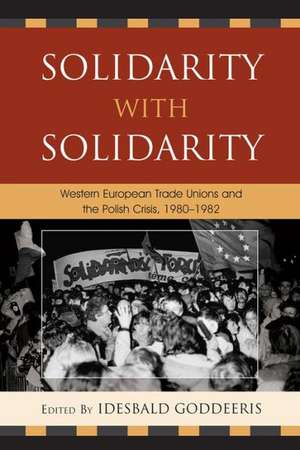
Solidarity with Solidarity: Western European Trade Unions and the Polish Crisis, 1980–1982: Harvard Cold War Studies Books (Paperback)
Editat de Idesbald Goddeeris Contribuţii de Nino De Amicis, Stefan Berger, Bent Boel, Friedhelm Boll, Sandra Cavallucci, Kim Christiaens, Andrzej Chwalba, José M. Faraldo, Frank Georgi, Norman LaPorte, Klaus Misgeld, Oliver Rathkolb, Malgorzata Swideren Limba Engleză Paperback – 27 noi 2012
This book analyzes reaction to Solidarnosc in nine Western European countries and within the international trade union confederations. It argues that Western solidarity with Solidarnosc was highly determined by its instrumental value within the national context. Trade unions openly sided with Solidarnosc when they had an interest in doing so, namely when Solidarnosc could strengthen their own program or position. But this book also reveals that reaction in allegedly reluctant countries was massive, albeit discreet, pragmatic, and humanitarian, rather than vocal, emotional, and political.

Preț: 354.08 lei
Preț vechi: 484.60 lei
-27%
Puncte Express: 531
Carte tipărită la comandă
Livrare economică 09-23 decembrie
Livrare prin curier în România Termenul estimat este afișat lângă disponibilitate.
Transport gratuit de la 400.00 lei Plată online sau ramburs, în funcție de opțiunile comenzii.
Retur gratuit în 14 zile Comandă securizată și suport în română.
Specificații
ISBN-13: 9780739150719
ISBN-10: 0739150715
Pagini: 307
Dimensiuni: 148 x 226 x 18 mm
Greutate: 0.48 kg
Editura: Bloomsbury Publishing
Colecția Lexington Books
Seria Harvard Cold War Studies Books (Paperback)
Locul publicării:New York, United States
ISBN-10: 0739150715
Pagini: 307
Dimensiuni: 148 x 226 x 18 mm
Greutate: 0.48 kg
Editura: Bloomsbury Publishing
Colecția Lexington Books
Seria Harvard Cold War Studies Books (Paperback)
Locul publicării:New York, United States
Cuprins
1 Introduction: Solidarity, Ideology, Instrumentality and Other Issues
2 Sweden: Focus on Fundamental Trade Union Rights
3 Spain: The Common Experience of Transition and a Military Coup
4 Italy: Diversity within United Solidarity
5 The ICFTU and the WCL: The International Coordination of Solidarity
6 Great Britain: Between Avoiding Cold War and Supporting Free Trade Unionism
7 The FRG: Humanitarian Support without Big Publicity
8 France: Exceptional Solidarity?
9 Denmark: International Solidarity and Trade Union Multilateralism
10 Belgium: the Christian Emphasis
11 Austria: an Ambivalent Attitude of Trade Unions and Political Parties
12 Abbreviations
13 About the Authors
14 Index
2 Sweden: Focus on Fundamental Trade Union Rights
3 Spain: The Common Experience of Transition and a Military Coup
4 Italy: Diversity within United Solidarity
5 The ICFTU and the WCL: The International Coordination of Solidarity
6 Great Britain: Between Avoiding Cold War and Supporting Free Trade Unionism
7 The FRG: Humanitarian Support without Big Publicity
8 France: Exceptional Solidarity?
9 Denmark: International Solidarity and Trade Union Multilateralism
10 Belgium: the Christian Emphasis
11 Austria: an Ambivalent Attitude of Trade Unions and Political Parties
12 Abbreviations
13 About the Authors
14 Index
Recenzii
This is a very important book about an under-research topic: How western European support for the Solidarity movement in Poland influenced that movement and the future of European politics. It is a must read for students of contemporary international history and the history of the Cold War.
Up to now, no one has systematically and comparatively studied the efforts made by Western trade unionists for the sake of Solidarity and the differences between particular unions. This highly successful book by Idelsbald Goddeeris, who for years has been studying this question, is based on meticulous source studies carried out by an international group of outstanding specialists. The reader is offered a lively and attractively written impression and contribution to the history of European syndicalism and the final disintegration of the post-Stalinist regimes, which signified the end of the Cold War.
Solidarity was a phenomenon of global significance, its impact felt wherever in the world people struggle for democracy, social justice, and civil rights. First and foremost, though, it was a trade union. The contributors to this excellent volume show that Solidarity and contemporaneous labor organizations in Western Europe cannot be understood apart from one another. So too, today's European Union has roots in the often contradictory interactions among social movements that receive long-overdue study here.
The explosive events of the Polish summer of 1980 aroused powerful immediate reactions and studied responses by labor strategists and tacticians as Solidarnosc, the independent Polish labor union federation, emerged and grew quickly. The task undertaken by editor Goddeeris and 14 other authors of 11 chapters is formidable, but they accomplish the mission with both forcefulness and subtlety. The labor federations of the nine Western European countries subject to the study receive detailed attention, as do international organizations such as the World Confederation of Labor and the International Confederation of Free Trade Unions. The authors also flesh out the environments of each organization, for some federations and unions had more complex constituencies and international relationships than did others, and all dealt with the actions and public rhetoric of political parties as well. Nonetheless, most labor unions outside the Eastern European bloc came to support Solidarnosc in diverse ways. That Solidarnosc emerged and survived was due in no small part to the efforts of the Western European unions, not only financially, materially, and educationally, but in their successful propagation of the conviction that workers' rights are basic to democracy, and that democracy sustains a high quality of material and cultural life for all. Summing Up: Recommended. Upper-division undergraduates and above.
Solidarity with Solidarity is an excellent international inventory of current national research on Western trade union support for Solidarnosc, providing scholars with a clear overview while at the same time qualifying a number of entrenched myths. Above all, it leaves us with more inspiring questions to answer and connections to analyze.
Throughout the book similarly fascinating examples of national responses are drawn out. For anyone with an interest in the history of Solidarity or solidarity movements more generally, this is a highly recommended book, bringing to light new and important archival material.
This book is, quite simply, an extraordinary contribution to historical scholarship, not only of twentieth-century Poland, but indeed of modern Europe tout court. Its editor, the Belgian historian Idesbald Goddeeris-a well-established scholar of East-West transnationalism in Europe-has performed a great service in designing a volume that brings together 14 contributors crosscutting nine different national historiographies as well as the scholarship on trade-union internationalism.
Up to now, no one has systematically and comparatively studied the efforts made by Western trade unionists for the sake of Solidarity and the differences between particular unions. This highly successful book by Idelsbald Goddeeris, who for years has been studying this question, is based on meticulous source studies carried out by an international group of outstanding specialists. The reader is offered a lively and attractively written impression and contribution to the history of European syndicalism and the final disintegration of the post-Stalinist regimes, which signified the end of the Cold War.
Solidarity was a phenomenon of global significance, its impact felt wherever in the world people struggle for democracy, social justice, and civil rights. First and foremost, though, it was a trade union. The contributors to this excellent volume show that Solidarity and contemporaneous labor organizations in Western Europe cannot be understood apart from one another. So too, today's European Union has roots in the often contradictory interactions among social movements that receive long-overdue study here.
The explosive events of the Polish summer of 1980 aroused powerful immediate reactions and studied responses by labor strategists and tacticians as Solidarnosc, the independent Polish labor union federation, emerged and grew quickly. The task undertaken by editor Goddeeris and 14 other authors of 11 chapters is formidable, but they accomplish the mission with both forcefulness and subtlety. The labor federations of the nine Western European countries subject to the study receive detailed attention, as do international organizations such as the World Confederation of Labor and the International Confederation of Free Trade Unions. The authors also flesh out the environments of each organization, for some federations and unions had more complex constituencies and international relationships than did others, and all dealt with the actions and public rhetoric of political parties as well. Nonetheless, most labor unions outside the Eastern European bloc came to support Solidarnosc in diverse ways. That Solidarnosc emerged and survived was due in no small part to the efforts of the Western European unions, not only financially, materially, and educationally, but in their successful propagation of the conviction that workers' rights are basic to democracy, and that democracy sustains a high quality of material and cultural life for all. Summing Up: Recommended. Upper-division undergraduates and above.
Solidarity with Solidarity is an excellent international inventory of current national research on Western trade union support for Solidarnosc, providing scholars with a clear overview while at the same time qualifying a number of entrenched myths. Above all, it leaves us with more inspiring questions to answer and connections to analyze.
Throughout the book similarly fascinating examples of national responses are drawn out. For anyone with an interest in the history of Solidarity or solidarity movements more generally, this is a highly recommended book, bringing to light new and important archival material.
This book is, quite simply, an extraordinary contribution to historical scholarship, not only of twentieth-century Poland, but indeed of modern Europe tout court. Its editor, the Belgian historian Idesbald Goddeeris-a well-established scholar of East-West transnationalism in Europe-has performed a great service in designing a volume that brings together 14 contributors crosscutting nine different national historiographies as well as the scholarship on trade-union internationalism.