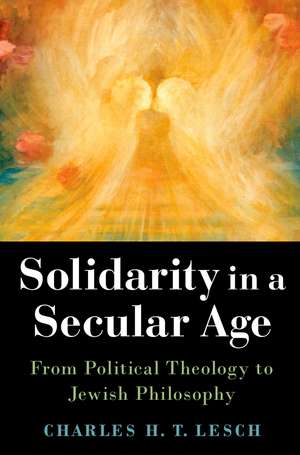
Solidarity in a Secular Age: From Political Theology to Jewish Philosophy
Autor Charles H.T. Leschen Limba Engleză Paperback – 20 oct 2026
Preț: 259.67 lei
Preț vechi: 327.84 lei
-21% Nou
Puncte Express: 390
Carte disponibilă
Livrare economică 10-16 decembrie
Livrare prin curier în România Termenul estimat este afișat lângă disponibilitate.
Transport gratuit de la 400.00 lei Plată online sau ramburs, în funcție de opțiunile comenzii.
Retur gratuit în 14 zile Comandă securizată și suport în română.
Specificații
ISBN-13: 9780197865323
ISBN-10: 0197865321
Pagini: 280
Dimensiuni: 157 x 236 x 20 mm
Greutate: 0.36 kg
Editura: Oxford University Press
Colecția OUP USA
Locul publicării:New York, United States
ISBN-10: 0197865321
Pagini: 280
Dimensiuni: 157 x 236 x 20 mm
Greutate: 0.36 kg
Editura: Oxford University Press
Colecția OUP USA
Locul publicării:New York, United States
Recenzii
Liberalism's problems with solidarity, with deep commitments to others, define its existential crises here and now. Charles Lesch, steeped in Western and Jewish thought, audaciously shows how key liberal ideas rest on theological stances liberalism doesnt know how to justify. But these insights, in his careful hands, rather than undo liberalism, result in deepening its foundations. His work is simply thrilling, deftly integrating intellectual history, philosophic acuity, and contemporary relevance. The pellucid clarity of his writing mirrors his sure grasp of ideas. If this is what he has accomplished at this early stage, I can only imagine what his future work may bring. This book marks the entry of a new voice into the front ranks of political theorists, and key debates of our time, and not a moment too soon.
Solidarity in a Secular Age is a beautifully crafted reworking of Jewish philosophy as a promising source to rebuild solidarity in a liberal secular societies riven with division and disillusionment. Erudite and learned at the same time as inspiring and hopeful, Charles Lesch has written a wonderful book that brings religious and secular traditions into dialogue in a completely new way.
This book is a gem of thoughtful reflection. Its tone – exploratory, experimental, probing – draws us into some of the deepest questions about the relation between ethical life, emotions and politics. At a time when destructive appeals to solidarity are growing, this book offers a welcome reminder of a more ethical alternative.
Lesch's political vision is compelling...Lesch's Solidarity in a Secular Age aims to inspire a transformation in how its readers see the relationship between God and politics, and in how they might see a better politics grounded in imitating divine chesed [kindness]...We need a Leschian [politics].
Provocative...Lesch's book offers a concrete model, drawn from Jewish thought, as to how liberalism can draw from...the nectar of solidarity while keeping out some of the poison that has always made liberalism wary of receiving religious support for its social and political order.
Does justice require a robust experience of solidarity? If so, can liberalism alone supply what is needed? Or must liberal rationality draw upon the resources of religious tradition that may or may not be available in a secular culture? It's hard to imagine questions more essential for political philosophy. Charles Lesch, with his capacious reading, deeply thoughtful reflectiveness, and gift for elegant writing, is wonderfully well-equipped to pose these questions and help us answer them.
A landmark book. Following Charles Lesch's well guided footsteps from Carl Schmitt, back to Rousseau and Kant and on to Habermas, Buber and Levinas, and with deep attention to George Eliot's prophetic and profound Daniel Deronda, serious readers will see decisively what is and will remain central in human and humane social and political thinking.
In this path-breaking book, Lesch advances the counter-intuitive claim that Jewish thinkers such as Levinas and Buber illuminate the path to solidarity in a secular age. Why do we need solidarity? Liberal theories of justice can tell citizens what to do, but often fall short when it comes to motivating them to discharge their duties. Lesch's erudite study focuses attention on the not-fully rational elements of our psychology and how they can foster justice-enhancing forms of social cohesion. This is the book on solidarity that political theorists have been waiting for.
Does solidarity depend on religion? Even in their convincing rejection of disastrous forms of political togetherness, liberals might have to embrace their own version of its religious foundations, Charles Lesch shows in this intrepid and remarkable book. Demonstrating the persistence of religion in secular thought, and the secular relevance of religious thought, Lesch's fine study achieves calm urgency as liberals face another era of turbulence.
In his impressive first major work, Charles Lesch argues for a version of liberal solidarity that draws lessons from religious life without the metaphysical and religious commitments central to most religious communities. While Lesch's account offers new ways to think about issues of concern to political theorists and philosophers, it should inspire anyone who is concerned with the fragmentation of contemporary society that increasingly reduces all to friend or foe. A welcome and important addition not just to the academic literature, but to urgent, pressing issues currently threatening to undermine liberal democratic societies.
This important monograph explores why previous political philosophers have been unable to answer Carl Schmitt's challenge that "liberalism needs solidarity, but solidarity is exogenous to liberalism" (p. 3). In short, liberalism "sustains itself on a dwindling supply of religious resources inherited from its history"... Lesch deserves praise for highlighting the role the nonrational plays in human psychology and for striving to overcome "contemporary political theory's...tin ear to forms of life and politics informed by religion and theology".
Notă biografică
Charles H. T. Lesch is Associate Professor of Political Science at the Hebrew University of Jerusalem. A political theorist who focuses on the intersection of religion and democracy, he is also the author of Maimonides and Jewish Theocracy: The Human Hand of Divine Rule (Cambridge University Press, 2024).