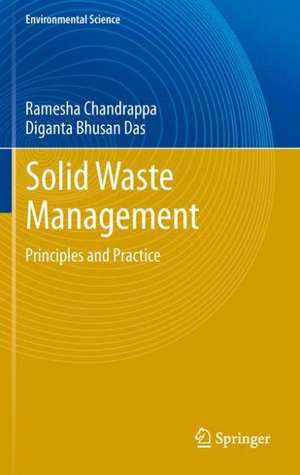
Solid Waste Management
Autor Ramesha Chandrappa, Diganta Bhusan Dasen Limba Engleză Hardback – iul 2012
There was tremendous industrial activity in Europe during the industrial revolution. The twentieth century is recognized as the American Century and the twenty-first century is recognized as the Asian Century in which everyone wants to earn ‘as much as possible’. After Asia the currently developing Africa could next take the center stage. With transitions in their economies many countries have also witnessed an explosion of waste quantities.
Solid waste problems and approaches to tackling them vary from country to country. For example, while efforts are made to collect and dispose hospital waste through separate mechanisms in India it is burnt together with municipal solid waste in Sweden. While trans-boundary movement of waste has been addressed in numerous international agreements, it still reaches developing countries in many forms. While thousands of people depend on waste for their livelihood throughout the world, many others face problems due to poor waste management.
In this context solid waste has not remained an issue to be tackled by the local urban bodies alone. It has become a subject of importance for engineers as well as doctors, psychologist, economists, and climate scientists and any others. There are huge changes in waste management in different parts of the world at different times in history. To address these issues, an effort has been made by the authors to combine their experience and bringtogether a new text book on the theory and practice of the subject covering the important relevant literature at the same time.
Preț: 1726.52 lei
Preț vechi: 2105.50 lei
-18%
Puncte Express: 2590
Carte tipărită la comandă
Livrare economică 30 noiembrie-14 decembrie
Livrare prin curier în România Termenul estimat este afișat lângă disponibilitate.
Transport gratuit pentru acest produs Plată online sau ramburs, în funcție de opțiunile comenzii.
Retur gratuit în 14 zile Comandă securizată și suport în română.
Specificații
ISBN-13: 9783642286803
ISBN-10: 3642286801
Pagini: 436
Ilustrații: XXII, 414 p.
Dimensiuni: 160 x 241 x 29 mm
Greutate: 0.77 kg
Ediția:2012
Editura: Springer
Locul publicării:Berlin, Heidelberg, Germany
ISBN-10: 3642286801
Pagini: 436
Ilustrații: XXII, 414 p.
Dimensiuni: 160 x 241 x 29 mm
Greutate: 0.77 kg
Ediția:2012
Editura: Springer
Locul publicării:Berlin, Heidelberg, Germany
V-ar putea interesa
-
 -23%Preț: 895.07 lei1162.44 lei
 -
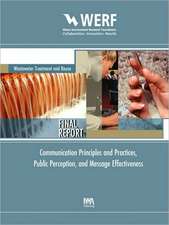
 Public CommunicationLinda Blankenship-18%Preț: 1024.23 lei1249.06 lei
 -
 -18%Preț: 1023.29 lei1247.91 lei
 -
 -18%Preț: 1013.90 lei1236.46 lei
 -
 -18%Preț: 1014.41 lei1237.08 lei
 -
 State of the ScienceJohn McCray-18%Preț: 1014.12 lei1236.73 lei
 -
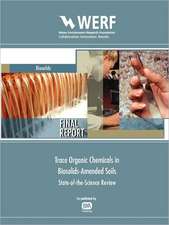 Trace Organic Chemicals in Biosolids-Amended SoilsHiggins, Christopher P.-18%Preț: 755.36 lei921.17 lei
 -
 -18%Preț: 1013.34 lei1235.79 lei
 -
 -18%Preț: 753.21 lei918.55 lei
 -
 -18%Preț: 1015.16 lei1238.01 lei
 -
 Nutrient ManagementDavid Clark-18%Preț: 753.99 lei919.50 lei
 -
 -18%Preț: 1013.46 lei1235.93 lei
 -
 Physics of Semiconductor DevicesV. K. Jain-24%Preț: 1888.00 lei2484.20 lei
 -
 Sustainable Air Pollution ManagementRamesha Chandrappa-18%Preț: 821.34 lei1001.64 lei
 -
 LuftreinhaltungGuenter BaumbachPreț: 327.35 lei
 -
 Umweltwissenschaften und UmweltmanagementTimothy O'RiordanPreț: 532.48 lei
 -
 -15%Preț: 665.89 lei783.39 lei
 -
 Coping with Climate ChangeRamesha Chandrappa-18%Preț: 923.08 lei1125.71 lei
 -
 Preț: 371.73 lei
 -
 Stadtklima und LuftreinhaltungAlfred Helbig-15%Preț: 523.64 lei616.05 lei
 -
 Geochemie und UmweltJörg MatschullatPreț: 467.99 lei
 -
 BodenkundeDavid L. RowellPreț: 478.71 lei
 -
 HütteKlaus Görner-15%Preț: 630.36 lei741.60 lei
 -
 -15%Preț: 482.43 lei567.57 lei
Public țintă
ResearchCuprins
Waste quantities and characteristics.- Storage and collection.- Materials recovery and recycling.- Disposal.- Biomedical waste.- Hazardous waste.- Waste from electrical and electronic equipment.- Waste from industry and commertial activity.- Radio active waste.- Health and safety issues.- Environmetal issues.- Issues in disaster affected area.- Solid waste and livelihood.
Textul de pe ultima copertă
Solid waste was already a problem long before water and air pollution issues attracted public attention. Historically the problem associated with solid waste can be dated back to prehistoric days. Due to the invention of new products, technologies and services the quantity and quality of the waste have changed over the years. Waste characteristics not only depend on income, culture and geography but also on a society's economy and, situations like disasters that affect that economy.
There was tremendous industrial activity in Europe during the industrial revolution. The twentieth century is recognized as the American Century and the twenty-first century is recognized as the Asian Century in which everyone wants to earn ‘as much as possible’. After Asia the currently developing Africa could next take the center stage. With transitions in their economies many countries have also witnessed an explosion of waste quantities.
Solid waste problems and approaches to tackling them vary from country to country. For example, while efforts are made to collect and dispose hospital waste through separate mechanisms in India it is burnt together with municipal solid waste in Sweden. While trans-boundary movement of waste has been addressed in numerous international agreements, it still reaches developing countries in many forms. While thousands of people depend on waste for their livelihood throughout the world, many others face problems due to poor waste management.
In this context solid waste has not remained an issue to be tackled by the local urban bodies alone. It has become a subject of importance for engineers as well as doctors, psychologist, economists, and climate scientists and any others. There are huge changes in waste management in different parts of the world at different times in history. To address these issues, an effort has been made by the authors to combine their experience and bring together a new text book onthe theory and practice of the subject covering the important relevant literature at the same time.
There was tremendous industrial activity in Europe during the industrial revolution. The twentieth century is recognized as the American Century and the twenty-first century is recognized as the Asian Century in which everyone wants to earn ‘as much as possible’. After Asia the currently developing Africa could next take the center stage. With transitions in their economies many countries have also witnessed an explosion of waste quantities.
Solid waste problems and approaches to tackling them vary from country to country. For example, while efforts are made to collect and dispose hospital waste through separate mechanisms in India it is burnt together with municipal solid waste in Sweden. While trans-boundary movement of waste has been addressed in numerous international agreements, it still reaches developing countries in many forms. While thousands of people depend on waste for their livelihood throughout the world, many others face problems due to poor waste management.
In this context solid waste has not remained an issue to be tackled by the local urban bodies alone. It has become a subject of importance for engineers as well as doctors, psychologist, economists, and climate scientists and any others. There are huge changes in waste management in different parts of the world at different times in history. To address these issues, an effort has been made by the authors to combine their experience and bring together a new text book onthe theory and practice of the subject covering the important relevant literature at the same time.
Caracteristici
Includes history, psychology, economics of solid waste Discusses variation in approaches to tackle solid waste over time and region Deals with biomedical waste, hazardous waste, disaster waste, waste from electrical and electronic waste, safety issues, radioactive waste and lively hood Includes supplementary material: sn.pub/extras
Notă biografică
Ramesha Chandrappa is an alumnus of the Indian Institute of Technology-Madras, and has done professional courses at The University of Manchester, Ecole Polytechnique Federation De Lausanne (EPFL), the United Nations Institute of Training and Research (UNITAR), UNESCO-IHE, and the United National Department of Economic and Social Affairs (UNDESA). He has extensive experience collaborating with leading multinational and government organizations, and he is currently Project Development Officer and Director Research (In charge) for the Environmental Management Policy Research Institute in Bangalore. His research interests include climate change, solid waste management, water and sanitation, and environmental education.
Dr Diganta Bhusan Das holds a personal title Reader in Porous Media in the Department of Chemical Engineering at Loughborough University, UK. He has the work experience at the University of Oxford (UK), Technical University of Delft (the Netherlands), and many other places in Europe, USA and Asia. Dr Das is currently the Deputy Lead for the Research Challenge on Changing Environment and Infrastructure at Loughborough University and Deputy Director of Doctoral Research in the School of Aeronautical, Automotive, Chemical and Materials Engineering at the University. He has taught a variety of courses relating to environmental pollution control, water engineering, fluid mechanics, reaction engineering, and mass transfer processes. Dr Das is a keen collaborator and team builder on a range of multidisciplinary porous medium topics such as (i) coupled free and porous flow (e.g., leakage in fluid distribution pipes, membrane separation), (ii) two-phase flow in porous media (iii) membrane water treatment (iv) chemical transport in porous tissues and tissue engineering bioreactors.
Descriere
Descriere de la o altă ediție sau format:
This book discusses solid waste management issues from global to local level. Furthermore, it contains updated information on topics such as toxicology, climate change, population pressure, urbanization, energy production, building and community design, and disaster preparedness in the context of solid waste management.
This book discusses solid waste management issues from global to local level. Furthermore, it contains updated information on topics such as toxicology, climate change, population pressure, urbanization, energy production, building and community design, and disaster preparedness in the context of solid waste management.