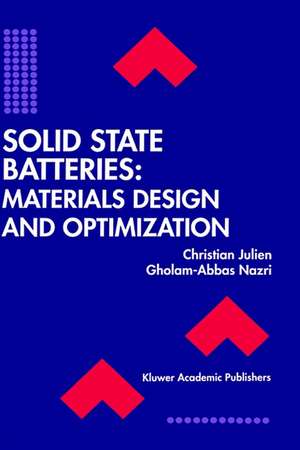
Solid State Batteries: Materials Design and Optimization: The Springer International Series in Engineering and Computer Science, cartea 271
Autor Christian Julien, Gholam-Abbas Nazrien Limba Engleză Hardback – 31 mai 1994
Din seria The Springer International Series in Engineering and Computer Science
- 18%
 Preț: 1263.85 lei
 - 18%
 Preț: 921.36 lei
 - 20%
 Preț: 633.65 lei
 - 20%
 Preț: 665.64 lei
 - 20%
 Preț: 662.69 lei
 - 24%
 Preț: 876.97 lei
 - 20%
 Preț: 663.58 lei
 - 20%
 Preț: 950.07 lei
 - 20%
 Preț: 665.12 lei
 - 18%
 Preț: 903.90 lei
 - 20%
 Preț: 950.72 lei
 - 18%
 Preț: 985.84 lei
 - 15%
 Preț: 621.23 lei
 - 18%
 Preț: 979.41 lei
 - 18%
 Preț: 907.54 lei
 - 18%
 Preț: 1173.85 lei
 - 15%
 Preț: 663.24 lei
 - 18%
 Preț: 976.26 lei
 - 18%
 Preț: 904.83 lei
 - 18%
 Preț: 904.83 lei
 - 20%
 Preț: 1325.05 lei
 - 20%
 Preț: 1725.82 lei
 - 20%
 Preț: 1326.15 lei
 - 20%
 Preț: 989.14 lei
 -
 Preț: 381.30 lei
 - 20%
 Preț: 635.71 lei
 - 18%
 Preț: 1193.58 lei
 - 20%
 Preț: 622.65 lei
 - 20%
 Preț: 1319.14 lei
 - 18%
 Preț: 974.15 lei
 - 20%
 Preț: 670.15 lei
 - 15%
 Preț: 664.58 lei
 - 18%
 Preț: 1179.97 lei
 - 15%
 Preț: 670.25 lei
 - 15%
 Preț: 663.36 lei
 - 20%
 Preț: 620.83 lei
 - 18%
 Preț: 990.04 lei
 - 15%
 Preț: 660.75 lei
 - 18%
 Preț: 1266.48 lei
Preț: 2060.23 lei
Preț vechi: 2512.47 lei
-18%
Puncte Express: 3090
Carte tipărită la comandă
Livrare economică 27 noiembrie-11 decembrie
Livrare prin curier în România Termenul estimat este afișat lângă disponibilitate.
Transport gratuit pentru acest produs Plată online sau ramburs, în funcție de opțiunile comenzii.
Retur gratuit în 14 zile Comandă securizată și suport în română.
Specificații
ISBN-13: 9780792394600
ISBN-10: 0792394607
Pagini: 644
Ilustrații: XIII, 629 p.
Dimensiuni: 160 x 241 x 39 mm
Greutate: 1.07 kg
Ediția:1994
Editura: Springer
Colecția The Springer International Series in Engineering and Computer Science
Seria The Springer International Series in Engineering and Computer Science
Locul publicării:New York, NY, United States
ISBN-10: 0792394607
Pagini: 644
Ilustrații: XIII, 629 p.
Dimensiuni: 160 x 241 x 39 mm
Greutate: 1.07 kg
Ediția:1994
Editura: Springer
Colecția The Springer International Series in Engineering and Computer Science
Seria The Springer International Series in Engineering and Computer Science
Locul publicării:New York, NY, United States
V-ar putea interesa
-
 The Story of SemiconductorsJohn W. Orton-20%Preț: 398.15 lei497.51 lei
 -
 Superconducting State: Mechanisms and PropertiesVladimir Z. Kresin-31%Preț: 934.21 lei1356.59 lei
 -
 Quantum Processes in SemiconductorsBrian K. Ridley-22%Preț: 499.23 lei639.67 lei
 -
 Materials for Lithium-Ion BatteriesChristian Julien-18%Preț: 1845.42 lei2250.51 lei
 -
 -9%Preț: 864.51 lei950.02 lei
 -
 Semiconductor Laser EngineeringEpperlein-9%Preț: 887.71 lei975.51 lei
 -
 New Trends in Intercalation Compounds for Energy StorageChristian Julien-18%Preț: 1247.11 lei1520.87 lei
 -
 Lithium BatteriesGianfranco Pistoia-18%Preț: 1901.85 lei2319.33 lei
 -
 Organic Light-Emitting Materials and DevicesZhigang Rick Li-18%Preț: 1647.23 lei2008.81 lei
 -
 Novel SuperconductivityStuart A. Wolf-15%Preț: 668.95 lei787.00 lei
 -
 Neutron Transmutation Doping of Semiconductor MaterialsRobert D. LarrabeePreț: 381.55 lei
 -
 Preț: 384.48 lei
 -
 Ion Implantation in SemiconductorsSusumu NambaPreț: 415.43 lei
 -
 High-Pressure and Low-Temperature PhysicsJ. A. WoollamPreț: 399.28 lei
 -
 -15%Preț: 677.62 lei797.20 lei
 -
 Preț: 383.75 lei
 -
 Preț: 383.38 lei
 -
 Lithium BatteriesChristian Julien-24%Preț: 1400.63 lei1842.93 lei
 -
 -18%Preț: 430.10 lei524.85 lei
Public țintă
ResearchCuprins
1. Design and optimization of solid-state batteries.- 1. Description of relations in battery operation.- 2. Quality criteria for thin-film materials.- References for chapter 1.- 2. Materials for electrolyte: Crystalline compounds.- 1. Mechanisms of transport in solid electrolytes.- 2. Anionic conductors.- 3. Cationic conductors.- 4. Composite electrolytes.- References for chapter 2.- 3. Materials for electrolyte: Fast-ion-conducting glasses.- 1. Fast-ion-conducting glasses.- 2. Conduction mechanisms in glasses.- 3. Silver-ion-conducting glasses.- 4. Sodium-ion-conducting glasses.- 5. Lithium-ion-conducting glasses.- 6. Glasses with mobile anions.- 7. Structure and optical properties of lithium-borate glasses.- 8. ac conductivity of lithium-borate glasses.- References for chapter 3.- 4. Materials for electrolyte: Thin films.- 1. Synthesis of thin-films of ionic conductors.- 2. Growth and properties of lithium-borate thin-films.- References for chapter 4.- 5. Polymer electrolytes.- 1. Structure and chemistry of polymers.- 2. Electrochemistry of polymers.- References for chapter 5.- 6. Materials for electrodes: Crystalline compounds.- 1. Introduction.- 2. Carbon-based electrodes.- 3. Inorganic chalcogenides.- 4. Inorganic oxides.- 5. Composite electrodes.- References for chapter 6.- 7. Materials for electrodes: Amorphous and thin-films.- 1. Amorphous cathodic materials.- 2. Thin-film cathodes.- References for chapter 7.- 8. Applications of solid-state ionic materials.- 1. Applications of solid-state ionics to batteries.- 2. Lithium metal-free rechargeable batteries.- 3. Microbatteries.- References for chapter 8.
Notă biografică
Dr. Christian M. Julien received his engineer degree in Physics from Conservatoire des Arts et Métiers, Paris and obtained his PhD in materials science from Université Pierre et Marie Curie, Paris. He has 35 years of research experience in the field of solid state ionics and materials for energy storage and conversion, and, has developed lithium microbatteries. He is especially well known for his contributions on vibrational spectroscopy of lithium intercalation compounds. He was director of NATO Advanced Study Institutes on intercalation compounds and materials for batteries. Presently, he joints the laboratory PHENIX at Université Pierre et Marie Curie where he is investigating cathode and anode materials for lithium-ion batteries. Dr. Julien is an active member of The Electrochemical Society and international editorial boards and editor of Journal of Materials.
Dr. Alain Mauger attended the University of Paris where he graduated in solid state physics, obtained the PhD degree in 1974, and Doctorat d'État in 1980. His work focussed on the theory of impurities in semi-metals, electronic structure of solids, and magnetic semiconductors. He left Paris to spend a year at the University of California, Irvine where he continued his work on magnetic semiconductors and optical properties of liquid crystals in collaboration with Professor D.L. Mills, and shared his time between the University of Paris and the University of California up to 1985. He went on to do research at the University of Paris 07 on spin glasses and statistical physics. Since 1992, he has been in university Paris 06, leading different groups on solid state and complex matter physics, before joining IMPMC in 2007 to work on the materials science for Li-ion batteries.
Dr. Ashok Vijh is Maître-de-recherche at the Institut de Recherche d'Hydro-Québec and, concurrently, invited Professor at the INRS of Université du Québec. Elected to The Royal Society of Canada in1985, he was President of its Academy of Science (2005-2007). He is an electrochemist and materials scientist who has published over 360 refereed papers and six books on various problems of charge transfers across electrified interfaces. His work has been awarded over 60 distinctions: prizes, medals, decorations, fellowships, honorary doctorates, named lectureships and professorships, academy memberships and international editorial boards.
Dr. Karim Zaghib received his Ph.D. from the Institut National Polytechnique de Grenoble in 1990 and undertook post-doctoral studies under a Saft-DGA contract (1990-1992). From 1992 to 1995, he was a guest researcher at the Japanese Ministry of International Trade and Industry (MITI) and at the Osaka National Research Institute (ONRI). In 1995, he joined Hydro-Québec, where he currently serves as Administrator of the energy storage and conversion unit. Dr. Zaghib is especially well known for his contributions to the development and understanding of lithium-ion battery materials, particularly through his collaborations on graphite anodes, and on olivine cathodes. In 1996, he was the first to propose the use of nano-scale LTO for lithium-ion batteries and hybrid supercapacitors.