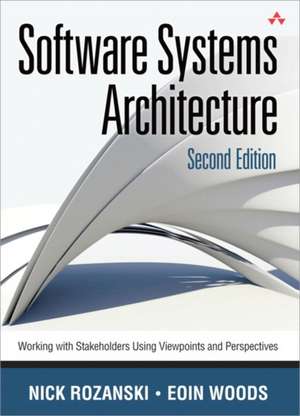
Software Systems Architecture: Working With Stakeholders Using Viewpoints and Perspectives: Working With Stakeholders Using Viewpoints and Perspectives
Autor Nick Rozanski, Eóin Woodsen Limba Engleză Hardback – 25 oct 2011
Notăm cu interes faptul că Software Systems Architecture: Working With Stakeholders Using Viewpoints and Perspectives adoptă o abordare eminamente practică, transformând conceptele abstracte de proiectare în instrumente de lucru zilnice pentru arhitectul de sistem. Considerăm că raportul dintre teorie și aplicabilitate este echilibrat prin utilizarea unui metamodel arhitectural riguros, unde accentul cade pe livrabile concrete și pe gestionarea relației cu stakeholderii. Abordarea diferă de Software and Systems Architecture in Action prin faptul că este mai puțin axată pe convergența disciplinelor de inginerie și mai mult pe un catalog aplicabil de puncte de vedere (viewpoints) care pot fi utilizate imediat în orice mediu enterprise. Remarcăm structura logică a celor 23 de capitole, care ghidează cititorul de la fundamentele procesului de definire a arhitecturii până la detalii tehnice specifice, precum punctele de vedere funcționale, informaționale sau de concurență. Un element distinctiv al acestei ediții este introducerea „Context Viewpoint” și explorarea modului în care arhitectura poate coexista eficient cu metodologiile Agile, oferind trasabilitate fără a sacrifica flexibilitatea. Spre deosebire de Software Architecture in Practice, care oferă o viziune academică și metodologică de ansamblu, lucrarea lui Nick Rozanski și Eóin Woods funcționează ca un ghid de teren, oferind liste de verificare, scenarii de utilizare și întrebări de discuție care facilitează luarea deciziilor în proiecte complexe, cu bugete și riscuri ridicate.
Preț: 417.13 lei
Preț vechi: 521.41 lei
-20%
Carte disponibilă
Livrare economică 16-30 noiembrie
Livrare express 31 octombrie-06 noiembrie pentru 71.49 lei
Specificații
ISBN-10: 032171833X
Pagini: 704
Dimensiuni: 183 x 238 x 43 mm
Greutate: 1.27 kg
Ediția:2. Auflage
Editura: Pearson International
Locul publicării:Upper Saddle River, NJ, United States
V-ar putea interesa
-
 SQL: A Beginner's Guide, Fourth EditionAndy Oppel-39%Preț: 217.40 lei357.98 lei
 -
 ReWorkDavid Heinemeier Hansson-28%Preț: 77.48 lei107.77 lei
 -
 -31%Preț: 230.40 lei332.99 lei
 -
 -20%Preț: 279.02 lei348.77 lei
 -
 -25%Preț: 101.85 lei136.71 lei
 -
 Accessory to WarAvis LangPreț: 205.29 lei
 -
 Introduction to Programming Using VISUAL C++ .NETT. Grandon Gill-18%Preț: 986.38 lei1202.91 lei
 -
 Information Theory, Inference and Learning AlgorithmsDavid J. C. MacKay-8%Preț: 494.67 lei537.68 lei
 -
 The Grand DesignLeonard Mlodinow-27%Preț: 79.15 lei109.17 lei
 -
 Designing Ux: PrototypingBen Coleman-20%Preț: 191.08 lei238.84 lei
 -
 The Future of Intelligence: Challenges in the 21st centuryIsabelle Duyvesteyn-15%Preț: 431.29 lei507.40 lei
 -
 Pro Spring SecurityCarlo Scarioni-20%Preț: 359.77 lei449.72 lei
 -
 The Enterprise Big Data LakeAlex Gorelik-20%Preț: 378.05 lei472.57 lei
 -
 Permanent RecordEdward SnowdenPreț: 128.25 lei
 -
 Attacking Network ProtocolsJames Forshaw-36%Preț: 283.27 lei440.27 lei
 -
 -37%Preț: 187.39 lei295.59 lei
 -
 World of Warcraft. The Official CookbookChelsea Monroe-CasselPreț: 244.13 lei
 -
 World of Warcraft Chronicle, Volume 2Blizzard EntertainmentPreț: 341.82 lei
 -
 World of Warcraft Chronicle Volume 3Blizzard EntertainmentPreț: 345.44 lei
 -
 Google Cloud Platform in ActionJohn Geewax-20%Preț: 365.88 lei457.35 lei
 -
 Architecture PrinciplesDanny Greefhorst-18%Preț: 1031.22 lei1257.59 lei
De ce să citești această carte
Recomandăm această carte arhitecților software și liderilor tehnici care au nevoie de o metodă sistematică de a comunica deciziile de design către diverse grupuri de interese. Cititorul câștigă un set de instrumente pragmatice (viewpoints și perspectives) pentru a documenta și evalua sisteme complexe, asigurând alinierea între cerințele de business și implementarea tehnică, indiferent de limbajul de programare sau platforma utilizată.
Despre autor
Nick Rozanski este un arhitect tehnic enterprise la Marks and Spencer, cu peste două decenii de experiență în integrare, baze de date relaționale și dezvoltare orientată pe obiecte în cadrul unor companii de renume precum Logica și Capgemini. Este, de asemenea, un instructor tehnic experimentat. Eóin Woods este consultant principal la Zühlke Engineering în Londra, specializat în arhitectură software pentru sisteme de tranzacționare. Experiența lor combinată oferă cărții o perspectivă rară, ancorată în realitățile comerciale și tehnice ale marilor corporații.
Notă biografică
Nick Rozanski has worked in IT since 1980 for several large and small systems integrators, including Logica, Capgemini, and Sybase, and end user organizations including Marks and Spencer and Barclays Global Investors. He has taken senior roles on a wide range of programs in finance, retail, manufacturing, and government. His technology background includes enterprise application integration, package implementation, relational database, data replication, and object-oriented software development. He is also an experienced technical instructor and certified internal project auditor. Eoin (pronounced "Owen") Woods is a lead system architect in the equities technology group of a major European investment bank with architecture and design responsibility for a number of the organization's key systems. Prior to this, he led the application architecture group at Barclays Global Investors and has worked as a software engineer for Group Bull, Sybase, InterTrust, and Zuhlke, as well as through his own consultancy company, Artechra.
Descriere
As systems grow increasingly large, complex, and costly, software architecture becomes ever more crucial. Software Systems Architecture, 2/e, is the leading practitioner's guide to designing and implementing effective information system architectures. Authors Nick Rozanski and Eoin Woods have systematically updated their highly-praised first edition, while retaining the clarity, accessibility, objectivity, and practical focus that have made it indispensable to working architects. Rozanski and Woods focus on real-world issues, superbly blend business and technical concerns, and offer insights that are relevant in all environments, regardless of methodology. Their extensive updates to this edition include:
- A new System Context Viewpoint, added to the authors' well-received architectural metamodel
- Expanded discussions of using architectural principles to provide traceability and expose decision-making rationales
- A discussion of how agile development and architecture can work together
- Updated, expanded description of enterprise architecture
- Expanded discussion of relationships between requirements and architecture
- New "Questions for Discussion"
- Updated bibliography and reading lists
Cuprins
- Chapter 1: Introduction
- Chapter 2: Software Architecture Concepts
- Chapter 3: Viewpoints and Views
- Chapter 4: Architectural Perspectives
- Chapter 5: The Role Of The Software Architect
- Chapter 6: Introduction to the Software Architecture Process
- Chapter 7: The Architecture Definition Process
- Chapter 8: Concerns, Principles, and Decisions
- Chapter 9: Identifying and Engaging Stakeholders
- Chapter 10: Identifying and Using Scenarios
- Chapter 11: Using Styles and Patterns
- Chapter 12: Producing Architectural Models
- Chapter 13: Creating the Architectural Description
- Chapter 14: Evaluating the Architecture
- Chapter 15: Introduction to the Viewpoint Catalog
- Chapter 16: The Context Viewpoint
- Chapter 17: The Functional Viewpoint
- Chapter 18: The Information Viewpoint
- Chapter 19: The Concurrency Viewpoint
- Chapter 20: The Development Viewpoint
- Chapter 21: The Deployment Viewpoint
- Chapter 22: The Operational Viewpoint
- Chapter 23: Achieving Consistency Across Views
- Chapter 24: Introduction to the Perspective Catalo
- Chapter 25: The Security Perspective
- Chapter 26: The Performance and Scalability Perspective
- Chapter 27: The Availability and Resilience Perspective
- Chapter 28: The Evolution Perspective
- Chapter 29: Other Perspectives
- Chapter 30: Working As A Software Architect
- Appendix: Other Viewpoint Sets