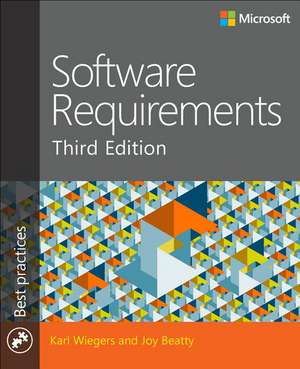
Software Requirements
Autor Karl Wiegers, Joy Beattyen Limba Engleză Paperback – 15 aug 2013
Descoperim în această a treia ediție a Software Requirements nu doar o actualizare a unui text clasic, ci un instrument de lucru care depășește sfera documentației oficiale prin integrarea unor tehnici testate pe teren. Subliniem faptul că, spre deosebire de ghidurile teoretice, abordarea autorilor Karl Wiegers și Joy Beatty se concentrează pe reducerea costurilor de dezvoltare prin diminuarea cererilor de schimbare (change requests) și creșterea satisfacției utilizatorului final. Notăm cu interes structura progresivă a volumului, care ghidează cititorul de la definirea rolului analistului de business până la tehnici avansate de modelare și validare. Cuprinsul reflectă o acoperire exhaustivă: primele capitole stabilesc fundamentul prin perspectiva clientului și bunele practici, urmate de secțiuni dense despre elicitare, documentarea prin diagrame („o imagine valorează cât 1024 de cuvinte”) și gestionarea riscurilor prin prototipare. Pe linia practică a volumului Software Requirements Essentials, această lucrare oferă un focus mult mai detaliat pe situații specifice de proiect, cum ar fi sistemele embedded sau automatizarea proceselor de business. În contextul operei sale, dacă în Pearls from Sand Karl Wiegers explora observațiile subtile ale vieții cotidiene, aici aplică aceeași rigoare observațională proceselor tehnice complexe. Cartea reușește să echilibreze rigoarea ingineriei cerințelor cu flexibilitatea necesară proiectelor moderne, alocând un capitol distinct metodologiilor Agile. Este o resursă esențială care transformă colectarea haotică de informații într-un proces disciplinat de specificație și management, esențial pentru orice arhitectură software robustă.
Preț: 244.80 lei
Preț vechi: 305.99 lei
-20%
Carte disponibilă
Livrare economică 06-20 noiembrie
Livrare express 23-29 octombrie pentru 63.50 lei
Specificații
ISBN-10: 0735679665
Pagini: 672
Ilustrații: black & white illustrations
Dimensiuni: 187 x 229 x 36 mm
Greutate: 1.13 kg
Ediția:3. Auflage
Editura: Microsoft Press
V-ar putea interesa
-
 Business Analysis Agility: Delivering Value, Not Just SoftwareJames Robertson-20%Preț: 251.13 lei313.91 lei
 -
 Mastering the Requirements ProcessAdrian Reed-20%Preț: 346.02 lei432.52 lei
 -
 -20%Preț: 197.12 lei246.41 lei
 -
 Principles of Computer HardwareAlan Clements-29%Preț: 602.71 lei846.14 lei
 -
 Writing Better RequirementsIan Alexander-20%Preț: 423.71 lei529.64 lei
 -
 Agile Software RequirementsDean Leffingwell-20%Preț: 362.06 lei452.57 lei
 -
 Windows Command Line Administration Instant ReferenceJohn Paul Mueller-20%Preț: 177.80 lei222.26 lei
 -
 Lessons Learned in Software Testing - A Context- Driven ApproachBret Pettichord-20%Preț: 258.03 lei322.54 lei
 -
 -20%Preț: 498.00 lei622.50 lei
 -
 -20%Preț: 627.14 lei783.93 lei
 -
 Modern Systems Analysis and Design, Global EditionJoseph Valacich-8%Preț: 606.91 lei659.70 lei
 -
 Agile Project Management For DummiesMark C LaytonPreț: 171.30 lei
 -
 -11%Preț: 541.01 lei607.88 lei
 -
 Requirements Management: A Practice GuideProject Management Institute-21%Preț: 209.43 lei264.54 lei
 -
 Business Analysis for Practitioners - SECOND Edition: A Practice GuideProject Management InstitutePreț: 136.85 lei
 -
 Requirements Engineering: Laying a Firm FoundationJames A. Crowder-18%Preț: 707.58 lei862.90 lei
 -
 Business Analysis Done RightKarolina Zmitrowicz-20%Preț: 381.96 lei477.46 lei
 -
 Requirements EngineeringJeremy Dick-20%Preț: 525.56 lei656.95 lei
 -
 Requirements EngineeringJeremy Dick-20%Preț: 341.54 lei426.92 lei
 -
 -20%Preț: 322.61 lei403.26 lei
De ce să citești această carte
Recomandăm această carte analiștilor de business și managerilor de proiect care doresc să treacă de la simpla notare a dorințelor clientului la o inginerie a cerințelor bazată pe date și validare. Cititorul câștigă acces la un set complet de tehnici pentru scrierea cerințelor funcționale și non-funcționale, asigurând o comunicare clară între stakeholderi și echipa de dezvoltare, indiferent dacă lucrează în Agile sau pe proiecte tradiționale.
Despre autor
Karl Wiegers este un expert recunoscut la nivel mondial în ingineria cerințelor și procese software, fiind autorul a numeroase cărți tehnice și articole de specialitate. Prin Software Requirements, el și-a consolidat reputația de a traduce concepte complexe în practici aplicabile. Joy Beatty, co-autoarea acestei ediții, aduce o vastă experiență în analiza de business și consultanță, contribuind la adaptarea metodologiilor clasice la nevoile contemporane ale industriei IT. Împreună, cei doi au instruit mii de profesioniști, experiența lor didactică fiind vizibilă în claritatea și structura pragmatică a textului.
Descriere scurtă
- Describes practical, effective, field-tested techniques for managing the requirements engineering process from end to end.
- Provides examples demonstrating how requirements "good practices" can lead to fewer change requests, higher customer satisfaction, and lower development costs.
- Fully updated with contemporary examples and many new practices and techniques.
- Describes how to apply effective requirements practices to agile projects and numerous other special project situations.
- Targeted to business analysts, developers, project managers, and other software project stakeholders who have a general understanding of the software development process.
- Shares the insights gleaned from the authors' extensive experience delivering hundreds of software-requirements training courses, presentations, and webinars.
Cuprins
- Introduction
- Acknowledgments
- Software requirements: What, why, and who
- Chapter 1: The essential software requirement
- Chapter 2: Requirements from the customer's perspective
- Chapter 3: Good practices for requirements engineering
- Chapter 4: The business analyst
- Requirements development
- Chapter 5: Establishing the business requirements
- Chapter 6: Finding the voice of the user
- Chapter 7: Requirements elicitation
- Chapter 8: Understanding user requirements
- Chapter 9: Playing by the rules
- Chapter 10: Documenting the requirements
- Chapter 11: Writing excellent requirements
- Chapter 12: A picture is worth 1024 words
- Chapter 13: Specifying data requirements
- Chapter 14: Beyond functionality
- Chapter 15: Risk reduction through prototyping
- Chapter 16: First things first: Setting requirement priorities
- Chapter 17: Validating the requirements
- Chapter 18: Requirements reuse
- Chapter 19: Beyond requirements development
- Requirements for specific project classes
- Chapter 20: Agile projects
- Chapter 21: Enhancement and replacement projects
- Chapter 22: Packaged solution projects
- Chapter 23: Outsourced projects
- Chapter 24: Business process automation projects
- Chapter 25: Business analytics projects
- Chapter 26: Embedded and other real-time systems projects
- Requirements management
- Chapter 27: Requirements management practices
- Chapter 28: Change happens
- Chapter 29: Links in the requirements chain
- Chapter 30: Tools for requirements engineering
- Implementing requirements engineering
- Chapter 31: Improving your requirements processes
- Chapter 32: Software requirements and risk management
- Epilogue
- Current requirements practice self-assessment
- Requirements troubleshooting guide
- Sample requirements documents
- Glossary
- About the authors