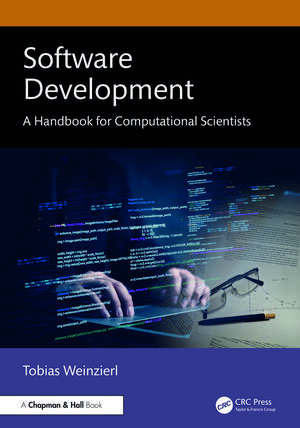
Software Development: A Handbook for Computational Scientists
Autor Tobias Weinzierlen Limba Engleză Paperback – 18 dec 2026
Developers must combine cutting-edge expertise from applied mathematics, computer science, high-performance computing and domain-specific knowledge, relying on small, highly specialised research groups and individuals from diverse career levels, to maintain codebases across generations of team members, often working asynchronously across the globe. These conditions demand bespoke development techniques tailored to the research environment.
This book presents a collection of best practices and lessons learned from the computational science community, offering critical observations on where mainstream development techniques struggle or fail in this specialised domain, or where mainstream software development technology is widely adopted yet might not be the best fit overall. The author challenges common recommendations for code development and suggests that there is a need to design and implement bespoke software development workflows that deliver research software capable of facilitating new insights in challenging research environments.
The discussion remains technically focused, avoiding high-level management theory, career development frameworks, and team dynamics discussions in favour of practical ideas that make day-to-day research code development more efficient, effective, and enjoyable.
The book is written specifically for practitioners who develop software as part of computational science research. It addresses techniques, recipes, and principles relevant to PhD students, research software engineers, postdoctoral researchers, and senior academics who mentor and instruct colleagues.
Preț: 373.30 lei
Preț vechi: 526.35 lei
-29% Precomandă
Puncte Express: 560
Carte nepublicată încă
Livrare prin curier în România Precomanda se expediază când titlul devine disponibil.
Transport gratuit de la 400.00 lei Plată online sau ramburs, în funcție de opțiunile comenzii.
Retur gratuit în 14 zile Comandă securizată și suport în română.
Doresc să fiu notificat când acest titlu va fi disponibil:
Se trimite...
Specificații
ISBN-13: 9781041274889
ISBN-10: 1041274882
Pagini: 300
Ilustrații: 52
Dimensiuni: 178 x 254 mm
Ediția:1
Editura: CRC Press
Colecția Chapman and Hall/CRC
ISBN-10: 1041274882
Pagini: 300
Ilustrații: 52
Dimensiuni: 178 x 254 mm
Ediția:1
Editura: CRC Press
Colecția Chapman and Hall/CRC
Public țintă
Professional Practice & Development, Professional Reference, and Professional TrainingCuprins
Part 1: The ecosystem 1. Context and environment Part 2: Principles and doctrines 2. Artefact organisation 3. Artefact quality 4. Behaviour Part 3: Techniques 5. Collaborate and communicate 6. Branching and merging 7. Code review 8. Debugging 9. Tests 10. Defensive programming 11. Ingredients of good documentation and architecture descriptions 12. How to write documentation and architecture documents Part 4: Structure and organisation 13. Workflows 14. Organise your day-to-day work 15. Interacting with stakeholders 15. Closing remarks. Bibliography. V Appendix A. Correlation of context, principles, and techniques B. Discussion of sources C. Further resources D. Chapter summaries Index.
Notă biografică
Tobias Weinzierl is Professor of High-Performance Computing (HPC) in the Department of Computer Science at Durham University in the UK, where he leads the Scientific Computing research group and serves as Director of Durham's Institute for Data Science (IDAS). After studying Computer
Science with a minor in Mathematics, Tobias earned a Dr. rer. nat. (PhD) as well as a habilitation in Computer Science from Technische Universität München (TUM). His research centres on the fundamental question of how to translate state-of-the-art algorithms - for example, multigrid, higher-order discontinuous Galerkin, and smoothed-particle hydrodynamics—into fast code that leverages modern architectures and pushes the frontiers of computational insight.
His publications bridge applied mathematics and theoretical computer science, with contributions
spanning multiple application domains. They are characterised by a strong methodological and
algorithmic focus, but all have a “cody” touch.
Like many academics in scientific computing, Tobias relies on a core set of open source codes
for his research. Together with his team, he has developed, curated, and extended these codes
over decades. Rather than following a masterplan or employing traditional large-scale software
engineering practices, the codes have evolved organically from research grant to research grant.
Through his work with multiple generations of graduate students, PhD candidates, postdocs, and
research software engineers—aswell as colleagues and collaborators from around theworld—Tobias
has witnessed scientific software development at its most successful and its most problematic. This
book is a collection of lessons drawn from these experiences. Having them written down and consolidated into a handbook, the author hopes they will help him make his own software development
more sustainable and form the foundation for future successful research, while also helping other
development teams reflect on their established processes and improve them incrementally.
Science with a minor in Mathematics, Tobias earned a Dr. rer. nat. (PhD) as well as a habilitation in Computer Science from Technische Universität München (TUM). His research centres on the fundamental question of how to translate state-of-the-art algorithms - for example, multigrid, higher-order discontinuous Galerkin, and smoothed-particle hydrodynamics—into fast code that leverages modern architectures and pushes the frontiers of computational insight.
His publications bridge applied mathematics and theoretical computer science, with contributions
spanning multiple application domains. They are characterised by a strong methodological and
algorithmic focus, but all have a “cody” touch.
Like many academics in scientific computing, Tobias relies on a core set of open source codes
for his research. Together with his team, he has developed, curated, and extended these codes
over decades. Rather than following a masterplan or employing traditional large-scale software
engineering practices, the codes have evolved organically from research grant to research grant.
Through his work with multiple generations of graduate students, PhD candidates, postdocs, and
research software engineers—aswell as colleagues and collaborators from around theworld—Tobias
has witnessed scientific software development at its most successful and its most problematic. This
book is a collection of lessons drawn from these experiences. Having them written down and consolidated into a handbook, the author hopes they will help him make his own software development
more sustainable and form the foundation for future successful research, while also helping other
development teams reflect on their established processes and improve them incrementally.
Descriere
This book presents a collection of best practices and lessons learned from the computational science community. For practitioners who develop software as part of computational science research, and also relevant to PhD students, research software engineers, postdoctoral researchers, and senior academics who mentor and instruct colleagues.