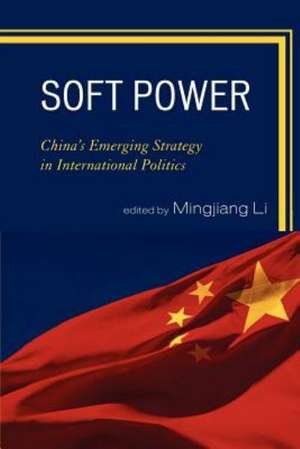
Soft Power: China's Emerging Strategy in International Politics
Editat de Mingjiang Li Contribuţii de Gang Chen, Jianfeng Chen, Xiaohe Cheng Xiaogang Deng, Yong Deng, Joshua Kurlantzick, Zhongying Pang, Ignatius Wibowo, Lening Zhang, Yongjin Zhang, Suisheng Zhao, Zhiqun Zhuen Limba Engleză Paperback – 7 feb 2011
Soft Power attempts to analyze the domestic and international views of China's soft power, the main strengths and weaknesses of China's soft power, and the application of soft power in China's international politics. It provides a comprehensive exploration of the soft power dimension in China's foreign relations by integrating views from various disciplines, such as history, education, culture, political economy, comparative politics, and philosophy. The book argues that soft power has become a very popular concept in China, that China is contemplating and exploring an innovative strategy in its rise and international politics, and that there have been quite a few notable elements of this in China's diplomatic practice, including softer rhetoric, promotion of the Chinese culture abroad, economic diplomacy, and image building. The book also argues that the limitations of China's soft power primarily stem from political values and China's own transitions, and reflects the reality that views and opinions regarding China's soft power are fairly diverse both in China and in the international arena.
Soft power is a useful and important perspective by which to understand Chinese foreign policy and the future evolution of China's role in international politics. This study is a pioneering work, providing a new perspective for the study of Chinese foreign policy and the rise of China that will appeal to scholars of Chinese foreign policy
Preț: 345.92 lei
Preț vechi: 484.18 lei
-29%
Puncte Express: 519
Carte tipărită la comandă
Livrare economică 28 noiembrie-12 decembrie
Livrare prin curier în România Termenul estimat este afișat lângă disponibilitate.
Transport gratuit de la 400.00 lei Plată online sau ramburs, în funcție de opțiunile comenzii.
Retur gratuit în 14 zile Comandă securizată și suport în română.
Specificații
ISBN-13: 9780739133781
ISBN-10: 0739133780
Pagini: 284
Ilustrații: black & white illustrations
Dimensiuni: 156 x 231 x 18 mm
Greutate: 0.44 kg
Editura: Bloomsbury Publishing
Colecția Lexington Books
Locul publicării:New York, United States
ISBN-10: 0739133780
Pagini: 284
Ilustrații: black & white illustrations
Dimensiuni: 156 x 231 x 18 mm
Greutate: 0.44 kg
Editura: Bloomsbury Publishing
Colecția Lexington Books
Locul publicării:New York, United States
V-ar putea interesa
-
 -23%Preț: 176.09 lei230.05 lei
 -
 The Palgrave Macmillan Dictionary of DiplomacyG. Berridge-18%Preț: 964.99 lei1176.82 lei
 -
 The Concept of the PoliticalHans J MorgenthauPreț: 428.75 lei
 -
 Preț: 157.19 lei
 -
 The New Muslim Brotherhood in the WestLorenzo VidinoPreț: 475.55 lei
 -
 -15%Preț: 439.93 lei517.56 lei
 -
 -18%Preț: 1293.77 lei1577.78 lei
 -
 Preț: 447.56 lei
 -
 Diplomatic Incidents: Memoirs of an (Un)diplomatic WifeCherry Denman-28%Preț: 65.38 lei90.68 lei
 -
 A History of DiplomacyJeremy BlackPreț: 206.26 lei
 -
 Causes of WarThomas LindemannPreț: 273.14 lei
Cuprins
Chapter 1. Introduction. Soft Power: Nurture Not Nature
Part 2 Part One. China's Soft Power: the Debates at Home and Abroad
Chapter 3 Chapter 2. Soft Power in Chinese Discourse: Popularity and Prospect
Chapter 4 Chapter 3. The Discourse of China's Soft Power and Its Discontents
Part 5 Part Two. Soft Power in China's Rising Strategy
Chapter 6 Chapter 4. The New Hard Realities: "Soft Power" and China in Transition
Chapter 7 Chapter 5. The Practice of the Mean: China's Soft Power Cultivation
Chapter 8 Chapter 6. Education: The Intellectual Base of China's Soft Power
Chapter 9 Chapter 7. China's Soft Power Dilemma: The Beijing Consensus Revisited
Chapter 10 Chapter 8. China's Cultural Exports and Its Growing Cultural Power in the World
Part 11 Part Three. Soft Power and China's International Politics
Chapter 12 Chapter 9. China's Soft Power in Africa
Chapter 13 Chapter 10. China's Warming Relations with South Korea and Australia
Chapter 14 Chapter 11. China's Soft Power and Neo-Liberal Agenda in Southeast Asia
Chapter 15 Chapter 12. China's Climate Diplomacy and Its Soft Power
Part 16 Part Four. Conclusion
Chapter 17 Chapter 13. The Prospect of China's Soft Power: How Sustainable?
Part 2 Part One. China's Soft Power: the Debates at Home and Abroad
Chapter 3 Chapter 2. Soft Power in Chinese Discourse: Popularity and Prospect
Chapter 4 Chapter 3. The Discourse of China's Soft Power and Its Discontents
Part 5 Part Two. Soft Power in China's Rising Strategy
Chapter 6 Chapter 4. The New Hard Realities: "Soft Power" and China in Transition
Chapter 7 Chapter 5. The Practice of the Mean: China's Soft Power Cultivation
Chapter 8 Chapter 6. Education: The Intellectual Base of China's Soft Power
Chapter 9 Chapter 7. China's Soft Power Dilemma: The Beijing Consensus Revisited
Chapter 10 Chapter 8. China's Cultural Exports and Its Growing Cultural Power in the World
Part 11 Part Three. Soft Power and China's International Politics
Chapter 12 Chapter 9. China's Soft Power in Africa
Chapter 13 Chapter 10. China's Warming Relations with South Korea and Australia
Chapter 14 Chapter 11. China's Soft Power and Neo-Liberal Agenda in Southeast Asia
Chapter 15 Chapter 12. China's Climate Diplomacy and Its Soft Power
Part 16 Part Four. Conclusion
Chapter 17 Chapter 13. The Prospect of China's Soft Power: How Sustainable?
Recenzii
At a conference in Singapore held in October 2007, several academics debated the rise of China. From these conference proceedings, Mingjiang Li edited a volume on Chinese soft power based on Joseph Nye's theory introduced in 1990. According to Nye, soft power is a strategy for a country to gain its objectives without coercion or payments, but with attraction founded on culture, political values, and legitimate and moral foreign policy.
Looking critically and carefully at the concept "soft power," this book pulls together the views of leading scholars to show the ways in which China can-and cannot-exercise soft power as it rises in Asia and the world. This is a really smart take on a complicated topic. Highly recommended.
Soft Power takes on one of the most important questions of this century: What is China's rightful place in the international system? This edited volume brings together essays by highly knowledgeable scholars, addressing key issues of China's emerging soft power. The contributors identify sources and constraints of China's soft power, while showing how China has perceived its soft power and how China's soft power has been perceived by other powers in Asia. It provides a unique angle to look into China's rise and its consequences.
This is the first systematic and scholarly evaluation of China's soft power-it is an informed and nuanced corrective to previous sensationalistic journalistic assessments. It is recommended reading for all interested in this important dimension of China's rise in world affairs.
Looking critically and carefully at the concept "soft power," this book pulls together the views of leading scholars to show the ways in which China can-and cannot-exercise soft power as it rises in Asia and the world. This is a really smart take on a complicated topic. Highly recommended.
Soft Power takes on one of the most important questions of this century: What is China's rightful place in the international system? This edited volume brings together essays by highly knowledgeable scholars, addressing key issues of China's emerging soft power. The contributors identify sources and constraints of China's soft power, while showing how China has perceived its soft power and how China's soft power has been perceived by other powers in Asia. It provides a unique angle to look into China's rise and its consequences.
This is the first systematic and scholarly evaluation of China's soft power-it is an informed and nuanced corrective to previous sensationalistic journalistic assessments. It is recommended reading for all interested in this important dimension of China's rise in world affairs.