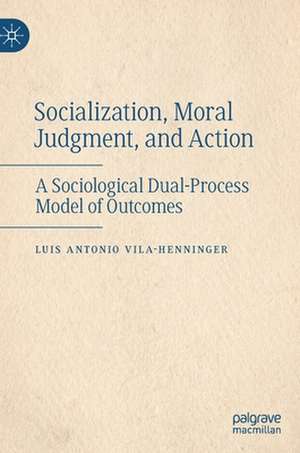
Socialization, Moral Judgment, and Action
Autor Luis Antonio Vila-Henningeren Limba Engleză Hardback – 30 noi 2021
This book contributes to the debate by first providing a critical overview of the literature that explains the limitations of the sociological dual-process model and subsequent scholarship—and especially work in sociology on “schemas”. It then develops a sociological dual-process model of moral judgment that formally explains Type I processes, Type II processes, and the interaction between Type I and Type II processes. The book also expands sociological dual-process models to include a temporal dimension—the "Sociological Dual-Process Model of Outcomes". Finally, the book integrates a theory of socialization into the sociological dual-process model and creates empirical indicators that confirm Vila-Henninger’s theorization and contribute to the literature on measures of dual-process models.
Preț: 661.73 lei
Preț vechi: 778.50 lei
-15%
Puncte Express: 993
Carte tipărită la comandă
Livrare economică 28 noiembrie-12 decembrie
Livrare prin curier în România Termenul estimat este afișat lângă disponibilitate.
Transport gratuit pentru acest produs Plată online sau ramburs, în funcție de opțiunile comenzii.
Retur gratuit în 14 zile Comandă securizată și suport în română.
Specificații
ISBN-13: 9783030882778
ISBN-10: 3030882772
Pagini: 208
Ilustrații: XIII, 193 p. 3 illus.
Dimensiuni: 153 x 216 x 16 mm
Greutate: 0.35 kg
Ediția:1st ed. 2021
Editura: Springer
Locul publicării:Cham, Switzerland
ISBN-10: 3030882772
Pagini: 208
Ilustrații: XIII, 193 p. 3 illus.
Dimensiuni: 153 x 216 x 16 mm
Greutate: 0.35 kg
Ediția:1st ed. 2021
Editura: Springer
Locul publicării:Cham, Switzerland
Cuprins
1. Introduction.- 2. Conceptual Foundations for Theory-Building.- 3. Background: Models of Action and Socialization.- 4. The Dichotomy and the Data.- 5. Theory: A Sociological Dual-Process Model of Outcomes.- 6. Analysis Using Forced-Choice Self-Report Survey Data (National Study of Youth and Religion Waves 1 and 4).- 7. Analysis of Schemas Using an Experiment.- 8. Conclusion.
Textul de pe ultima copertă
How does culture affect action? This question has long been framed in terms of a means vs ends debate—in other words, do cultural ends or cultural means play a primary causal role in human behavior? However, the role of socialization has been largely overlooked in this debate. In this book, Vila-Henninger develops a model of how culture affects action called “The Sociological Dual-Process Model of Outcomes” that incorporates socialization.
This book contributes to the debate by first providing a critical overview of the literature that explains the limitations of the sociological dual-process model and subsequent scholarship—and especially work in sociology on “schemas”. It then develops a sociological dual-process model of moral judgment that formally explains Type I processes, Type II processes, and the interaction between Type I and Type II processes. The book also expands sociological dual-process models to include a temporal dimension—the "Sociological Dual-Process Model of Outcomes". Finally, the book integrates a theory of socialization into the sociological dual-process model and creates empirical indicators that confirm Vila-Henninger’s theorization and contribute to the literature on measures of dual-process models.
Luis Antonio Vila-Henninger is Postdoctoral Fellow for the REACTOR grant in the Political Science department at Aarhus University, Denmark, and Scientific Collaborator with UCLouvain, Belgium. Luis’s research areas include the sociology of culture, sociological theory, economic sociology, political sociology, and qualitative methods. Luis’s work has appeared in The British Journal of Sociology, The Journal for the Theory of Social Behaviour, Sociology Compass, Sociological Inquiry, Sociological Perspectives, The Sociological Quarterly, and The Bulletin of Sociological Methodology. His first book, Social Justification and Political Legitimacy: How Voters Rationalize Direct Democratic Economic Policy in America, was published by Palgrave Macmillan in 2020.
This book contributes to the debate by first providing a critical overview of the literature that explains the limitations of the sociological dual-process model and subsequent scholarship—and especially work in sociology on “schemas”. It then develops a sociological dual-process model of moral judgment that formally explains Type I processes, Type II processes, and the interaction between Type I and Type II processes. The book also expands sociological dual-process models to include a temporal dimension—the "Sociological Dual-Process Model of Outcomes". Finally, the book integrates a theory of socialization into the sociological dual-process model and creates empirical indicators that confirm Vila-Henninger’s theorization and contribute to the literature on measures of dual-process models.
Luis Antonio Vila-Henninger is Postdoctoral Fellow for the REACTOR grant in the Political Science department at Aarhus University, Denmark, and Scientific Collaborator with UCLouvain, Belgium. Luis’s research areas include the sociology of culture, sociological theory, economic sociology, political sociology, and qualitative methods. Luis’s work has appeared in The British Journal of Sociology, The Journal for the Theory of Social Behaviour, Sociology Compass, Sociological Inquiry, Sociological Perspectives, The Sociological Quarterly, and The Bulletin of Sociological Methodology. His first book, Social Justification and Political Legitimacy: How Voters Rationalize Direct Democratic Economic Policy in America, was published by Palgrave Macmillan in 2020.
Caracteristici
Provides guidance on tools to use from cognitive science in sociological studies of culture and cognition Develops a framework incorporating neuroscience-influenced thinking into conventional sociological research Provides insights relevant to social theorists, quantitative sociologists, criminologists, and deviance scholars