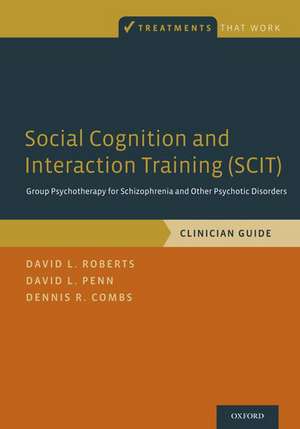
Social Cognition and Interaction Training (SCIT): Group Psychotherapy for Schizophrenia and Other Psychotic Disorders, Clinician Guide: Treatments That Work
Autor David L. Roberts, David L. Penn, Dennis R. Combsen Limba Engleză Paperback – 28 ian 2016
Din seria Treatments That Work
- 21%
 Preț: 465.99 lei
 - 25%
 Preț: 265.26 lei
 - 27%
 Preț: 156.72 lei
 - 22%
 Preț: 274.88 lei
 - 5%
 Preț: 711.87 lei
 - 15%
 Preț: 309.45 lei
 - 25%
 Preț: 206.04 lei
 - 25%
 Preț: 216.17 lei
 - 26%
 Preț: 202.55 lei
 - 17%
 Preț: 322.59 lei
 -
 Preț: 366.49 lei
 - 25%
 Preț: 126.44 lei
 - 22%
 Preț: 272.44 lei
 - 5%
 Preț: 343.70 lei
 - 22%
 Preț: 482.32 lei
 - 17%
 Preț: 344.41 lei
 - 17%
 Preț: 450.20 lei
 - 17%
 Preț: 384.06 lei
 - 14%
 Preț: 462.76 lei
 - 25%
 Preț: 387.98 lei
 - 17%
 Preț: 448.67 lei
 - 18%
 Preț: 304.66 lei
 - 18%
 Preț: 303.64 lei
 - 17%
 Preț: 383.54 lei
 - 17%
 Preț: 270.71 lei
 - 19%
 Preț: 275.39 lei
 - 18%
 Preț: 265.53 lei
 - 26%
 Preț: 146.10 lei
 - 18%
 Preț: 293.10 lei
 - 17%
 Preț: 270.91 lei
 - 5%
 Preț: 329.26 lei
 - 17%
 Preț: 347.01 lei
 - 17%
 Preț: 384.78 lei
 - 16%
 Preț: 327.86 lei
 - 13%
 Preț: 270.41 lei
 - 12%
 Preț: 347.33 lei
 - 18%
 Preț: 260.73 lei
 - 17%
 Preț: 478.92 lei
 - 26%
 Preț: 274.71 lei
 - 18%
 Preț: 270.77 lei
 - 17%
 Preț: 451.66 lei
 - 21%
 Preț: 436.21 lei
Preț: 503.27 lei
Preț vechi: 720.61 lei
-30%
Puncte Express: 755
Carte tipărită la comandă
Livrare economică 04-09 decembrie
Livrare prin curier în România Termenul estimat este afișat lângă disponibilitate.
Transport gratuit pentru acest produs Plată online sau ramburs, în funcție de opțiunile comenzii.
Retur gratuit în 14 zile Comandă securizată și suport în română.
Specificații
ISBN-13: 9780199346622
ISBN-10: 0199346623
Pagini: 256
Dimensiuni: 180 x 251 x 18 mm
Greutate: 0.41 kg
Editura: Oxford University Press
Colecția OUP USA
Seria Treatments That Work
Locul publicării:New York, United States
ISBN-10: 0199346623
Pagini: 256
Dimensiuni: 180 x 251 x 18 mm
Greutate: 0.41 kg
Editura: Oxford University Press
Colecția OUP USA
Seria Treatments That Work
Locul publicării:New York, United States
V-ar putea interesa
-
 -27%Preț: 1557.16 lei2118.78 lei
 -
 Emergent Forms: Origins and Early Development of Human Action and PerceptionEugene C. Goldfield-31%Preț: 664.55 lei962.30 lei
 -
 -21%Preț: 359.87 lei456.72 lei
 -
 Handbook of Psychotherapy IntegrationJohn C. Norcross-5%Preț: 564.17 lei593.86 lei
 -
 -28%Preț: 455.56 lei633.44 lei
 -
 -26%Preț: 369.24 lei497.08 lei
 -
 Social Cognition in Schizophrenia: From Evidence to TreatmentDavid L. Roberts-29%Preț: 930.78 lei1309.03 lei
 -
 Ethics for CounselorsSilvia L. Mazzula-5%Preț: 516.18 lei543.36 lei
 -
 This Business of TherapyFay, Jude-5%Preț: 88.06 lei92.70 lei
 -
 Beyond the ImprintO'Connell Lpc, Kate-5%Preț: 101.98 lei107.35 lei
 -
 Tales of a Modern Day AesopTasos Yacalis-5%Preț: 46.44 lei48.88 lei
 -
 Para El, Amala Hazla Feliz y Te Hara.Gomez, Basilio Segura-5%Preț: 125.29 lei131.88 lei
 -
 Para Ella Descubre El Gran Amor de Tu Principe AzulGomez, Basilio Segura-5%Preț: 124.33 lei130.88 lei
 -
 College Student Psychological AdjustmentJonathan F. Mattanah-5%Preț: 243.17 lei255.97 lei
 -
 A Psychotherapist's Sanctuaries from Soul-SadnessPeter A OlssonPreț: 68.01 lei
 -
 Meditation Interventions to Rewire the BrainJeff Tarrant-5%Preț: 161.59 lei170.10 lei
 -
 -5%Preț: 155.73 lei163.92 lei
 -
 -5%Preț: 332.35 lei349.84 lei
 -
 The Fictions of Dreams: Dreams, Literature, and WritingOtto M. Rheinschmiedt-5%Preț: 336.07 lei353.77 lei
 -
 You Are Not CrazyDavid Klow-5%Preț: 115.81 lei121.90 lei
 -
 -5%Preț: 245.60 lei258.53 lei
 -
 -5%Preț: 172.07 lei181.13 lei
Notă biografică
David L. Roberts, PhD, is an Assistant Professor in the Department of Psychiatry at the University of Texas Health Science Center in San Antonio. He specializes in the treatment of social dysfunction among people with schizophrenia and other psychiatric disorders.David L. Penn, PhD, is the Linda Wagner-Martin Distinguished Professor of Psychology at the University of North Carolina-Chapel Hill. His research is focused on social cognition and psychosocial treatment for schizophrenia.Dennis R. Combs, PhD, is an Associate Professor of psychology at the University of Texas at Tyler. He is also a licensed clinical psychologist in Texas. His research has primarily focused on understanding, characterizing, and remediating the various social cognitive deficits found in schizophrenia and paranoia.
Cuprins
- Chapter 1 Introductory Information for Clinicians
- Chapter 2 Overview of SCIT and Implementation Notes
- Phase I
- Chapter 3 Sessions 1 and 2: Introduction
- Chapter 4 Session 3: Emotions and Social Situations (Optional)
- Chapter 5 Session 4: Defining Emotions
- Chapter 6 Session 5: Guessing People's Emotions
- Chapter 7 Session 6: Updating Emotion Guesses
- Chapter 8 Session 7: Suspicious Feelings
- Phase II
- Chapter 9 Session 8: Jumping to Conclusions
- Chapter 10 Sessions 9 and 10: Strategy 1 - Think Up Other Guesses
- Chapter 11 Sessions 11, 12, and 13: Strategy 2 -Separate Facts from Guesses
- Chapter 12 Sessions 14 and 15: Strategy 3 - Gather More Evidence
- Phase III
- Chapter 13 Sessions 16 - 20: Checking-It-Out
- Appendix A Descriptions of Video and Photograph Stimuli
- Appendix B Homework Activities and Handouts
- Appendix C Practice Partner Handouts
- Appendix D SCIT Fidelity Scale
- References
- About the Authors