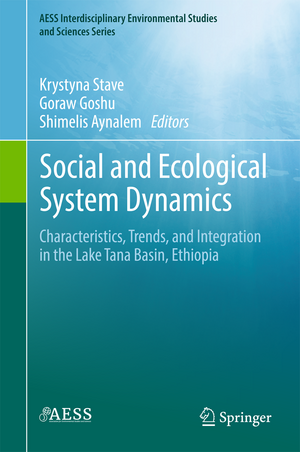
Social and Ecological System Dynamics: AESS Interdisciplinary Environmental Studies and Sciences Series
Editat de Krystyna Stave, Goraw Goshu, Shimelis Aynalemen Limba Engleză Hardback – 13 apr 2017
Editorii Krystyna Stave, Goraw Goshu și Shimelis Aynalem coordonează acest volum de referință, fundamentat pe o cercetare interdisciplinară riguroasă asupra unuia dintre cele mai critice ecosisteme africane. Autoritatea lor în domeniul managementului resurselor naturale este reflectată în modul în care au reușit să adune date complexe despre bazinul lacului Tana, punctul de origine al Nilului Albastru Superior, o regiune cu o importanță strategică națională și internațională. Putem afirma că lucrarea umple un gol informațional semnificativ, oferind pentru prima dată o analiză de sistem integrată a unei zone desemnate recent ca Rezervație a Biosferei UNESCO. Structura volumului este una progresivă, menită să ofere o imagine de ansamblu înainte de a detalia componentele specifice. Prima secțiune stabilește cadrul teoretic, utilizând dinamica sistemelor pentru a explica interacțiunea om-mediu, în timp ce a doua secțiune (Ecosystem Characteristics) disecă variabilele fizice și biologice: de la variabilitatea climatică și hidrogeologie, până la clasificarea solurilor și dinamica populațiilor de pești, păsări și mamifere. Găsim în această carte o rigoare științifică ce nu se rezumă doar la descriere, ci caută să identifice buclele de feedback care modelează viitorul sustenabil al regiunii. Cititorii familiarizați cu Nile River Basin de Assefa M. Melesse vor aprecia Social and Ecological System Dynamics pentru focalizarea sa microscopică și sistemică asupra bazinului Tana. Dacă lucrarea lui Melesse tratează provocările hidrologice la nivel de macro-bazin transfrontalier, volumul de față aduce o perspectivă nouă prin integrarea factorilor sociali locali cu datele ecologice granulare. Este o lectură complementară esențială pentru înțelegerea mecanismelor interne care alimentează întregul sistem al Nilului.



Preț: 1098.03 lei
Preț vechi: 1339.06 lei
-18%
Carte disponibilă
Livrare economică 11-25 mai
Specificații
ISBN-10: 3319457535
Pagini: 672
Ilustrații: XVII, 652 p. 95 illus., 73 illus. in color.
Dimensiuni: 160 x 241 x 39 mm
Greutate: 1.28 kg
Ediția:1st ed. 2017
Editura: Springer
Colecția AESS Interdisciplinary Environmental Studies and Sciences Series
Seria AESS Interdisciplinary Environmental Studies and Sciences Series
Locul publicării:Cham, Switzerland
V-ar putea interesa
-
 -33%Preț: 718.87 lei1077.38 lei
 -
 -12%Preț: 370.45 lei421.31 lei
 -
 Natural Resource and Environmental EconomicsRoger Perman-15%Preț: 664.82 lei782.14 lei
 -
 Decision Making Natural ResourMichael J Conroy-8%Preț: 653.79 lei710.64 lei
 -
 Oil, Water, and Climate: An IntroductionCatherine Gautier-11%Preț: 463.51 lei520.80 lei
 -
 The Big ThirstCharles FishmanPreț: 102.53 lei
 -
 Drilling DownJoseph A. TainterPreț: 203.54 lei
 -
 The Limits to Growth RevisitedUgo Bardi-15%Preț: 502.29 lei590.92 lei
 -
 Sowing Seeds in the DesertMasanobu Fukuoka-36%Preț: 86.68 lei135.65 lei
 -
 Water Utility Approaches & Responses to Climate Change VulnerabilityJames A. Williams-30%Preț: 815.05 lei1168.87 lei
 -
 -8%Preț: 605.80 lei658.49 lei
De ce să citești această carte
Această carte este indispensabilă specialiștilor în managementul resurselor și cercetătorilor care studiază dinamica sistemelor complexe. Cititorul câștigă o înțelegere profundă a modului în care factorii hidrologici, biologici și sociali interacționează într-un ecosistem vital. Este un instrument de lucru pentru fundamentarea politicilor de dezvoltare sustenabilă în regiuni de importanță globală, oferind date concrete despre un coridor economic emergent în Etiopia.
Despre autor
Krystyna Stave este profesor de politici de mediu și expert în dinamica sistemelor, specializată în aplicarea modelelor participative pentru rezolvarea problemelor de management al resurselor. Împreună cu Shimelis Aynalem și Goraw Goshu, experți locali cu o vastă experiență în ecologia acvatică și științele mediului în Etiopia, au reușit să sintetizeze datele necesare pentru a propune strategii de conservare în bazinul lacului Tana. Colaborarea lor reflectă o punte între expertiza academică internațională și cercetarea de teren specifică regiunii Nilului Albastru, fiind recunoscuți pentru contribuțiile lor în cadrul seriilor publicate de Springer.
Cuprins
Notă biografică
Textul de pe ultima copertă
The Lake Tana Basin is the most economically, historically, and environmentally important subbasin of the Upper Blue Nile River System. Three million people live in this headwater catchment area, most in rural areas but increasingly migrating to urban settlements, including the cities of Bahir Dar and Gondar. The region is experiencing significant population, economic, ecosystem, and social change. Urbanization, intensification of rural land use, environmental degradation, and climate change are some of the pressures that require research-based management and policy action to protect resources and promote healthy development.
There are many researchers and decision-makers focusing on the region. However, research efforts are fragmented and are often not visible or useful to decision-makers. This book addresses theneed for a coordinated approach to understanding and managing this complex social—ecological system.