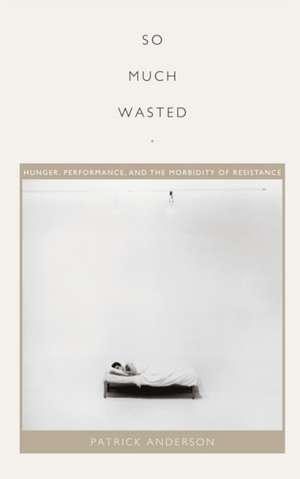
So Much Wasted
Autor Patrick Andersonen Limba Engleză Paperback – 25 oct 2010
Autorul Patrick Anderson, profesor și cercetător interesat de intersecția dintre politică și estetică, propune în So Much Wasted o analiză riguroasă a înfometării autoimpuse, tratată nu ca patologie, ci ca act deliberat de poziționare în spațiul public. Publicată de Duke University Press, lucrarea investighează cum refuzul hranei devine un instrument de argumentare politică în contexte variate: de la mediul clinic al anorexiei, la spațiul de expunere al galeriilor de artă și până la celulele deținuților politici. Ne-a atras atenția modul în care Anderson reușește să lege manifestări aparent disparate, precum performance-urile artiștilor Marina Abramović sau Ana Mendieta și grevele foamei din închisorile turcești, sub o singură umbrelă teoretică. Considerăm că forța acestui volum rezidă în fundamentarea sa pe concepte filosofice și psihanalitice solide, autorul apelând la Sigmund Freud, Martin Heidegger și Giorgio Agamben pentru a explica ceea ce el numește „politica morbidității”. Această structură narativă transformă corpul fragil într-o scenă unde viața și moartea, prezența și absența se întrepătrund pentru a contesta autoritatea statului sau a instituțiilor medicale. Textul completează perspectiva oferită de The Hunger Artists de Maud Ellmann, adăugând o dimensiune instituțională și ontologică mai vastă, care trece dincolo de fenomenologia literară către o critică socială aplicată. De asemenea, spre deosebire de Refusal to Eat – A Century of Prison Hunger Strikes de Nayan Shah, care oferă o istorie globală a grevelor foamei, lucrarea lui Anderson se concentrează pe mecanismul performativ al dispariției corpului ca formă de producție a subiectivității. Apreciem rigoarea cu care sunt analizate consecințele violenței și suferinței în aceste „puneri în scenă” radicale, oferind cititorului un cadru teoretic esențial pentru înțelegerea rezistenței prin negare.
Preț: 210.56 lei
Carte tipărită la comandă
Livrare economică 29 iunie-13 iulie
Specificații
ISBN-10: 0822348284
Pagini: 208
Dimensiuni: 147 x 233 x 17 mm
Greutate: 0.3 kg
Ediția:1
Editura: Duke University Press
V-ar putea interesa
-
 Preț: 79.07 lei
 -
 -19%Preț: 614.21 lei758.29 lei
 -
 Preț: 284.86 lei
 -
 PerformanceDiana TaylorPreț: 166.50 lei
 -
 The Self-Made ModelChristie GabrielPreț: 125.36 lei
 -
 Preț: 92.76 lei
 -
 Six Short Plays / One WomanAmy De BhrunPreț: 110.88 lei
 -
 Don't Say Anything, EverArthur LugauskasPreț: 99.74 lei
 -
 Majisty's Mime Made EasyMajisty E. DennisPreț: 71.15 lei
 -
 100 Cai Luong Viet NamMai NganhPreț: 138.23 lei
 -
 La Paraplegique AmoureuseM. Claude CognardPreț: 44.42 lei
 -
 One Bugging Bbb BeepZach RobertsPreț: 60.15 lei
 -
 The Actor's Tool KitArdencie Hall-Karambe Ph. D.Preț: 203.22 lei
 -
 Building Ballet Technique IIMarilyn Z. GastonPreț: 182.88 lei
 -
 The World's Most Famous BellydancersRoslyn S. ClarkPreț: 161.01 lei
 -
 Dancing, Playing and Bonding in Kala Vikash KendraDandavate, Dr RohiniPreț: 93.57 lei
 -
 Theater for Children Created by ChildrenGarcia, MaruPreț: 86.82 lei
 -
 Dickhead SeriesMcJody, QueeniePreț: 37.19 lei
 -
 BreakdanceIdan BoazPreț: 86.42 lei
 -
 My Name Is Martha Motherf***ing WashingtonDottie PrattPreț: 60.08 lei
 -
 Hip Hop, Ballet, BreakdanceIdan BoazPreț: 49.10 lei
 -
 Theatre Today '2018' Edition'Haridy, M. A.Preț: 214.59 lei
De ce să citești această carte
Această carte este esențială pentru studenții și cercetătorii din sociologie, studii culturale și arte vizuale. Cititorul câștigă o înțelegere profundă a modului în care vulnerabilitatea extremă a corpului poate fi transformată într-o formă de putere politică. Este un titlu recomandat celor care doresc să exploreze limitele rezistenței umane și modul în care absența și refuzul pot comunica mesaje mai puternice decât orice discurs articulat.
Descriere scurtă
Cuprins
Recenzii
"In this brilliant and important book, Patrick Anderson dramatically expands our understanding of anorexia by foregrounding its theatricality and reflexivity, and linking it to prison hunger strikes and certain kinds of endurance art. He shows us how central the self is to all of these practices, both as object, and as agent. Self-starvation is often the theatre of last resort, the stage on which a person performs when all others have been removed. It can also be a way of spitting out the poisonous images that one has been forced to incorporate. And even a well-balanced meal is not psychically nourishing when you are compelled to eat it, Anderson argues in the last and most compelling chapter of this book. Force-feeding does not support life; it promotes, rather, a living death."--Kaja Silverman, University of California, Berkeley "Patrick Anderson has written a wonderful book, one that will have a real impact on the field of performance studies. The topic that he has chosen is important and timely: The forced feeding of prisoners on a hunger strike at Guantanamo, the anorexia epidemic among young women (and now men), and the removal of Terri Schiavo's feeding tube are only some of the most recent and urgent questions that have surfaced around the practice and politics of starvation and who, ultimately, has the power over the individual body."--Diana Taylor, author of The Archive and the Repertoire: Performing Cultural Memory in the Americas