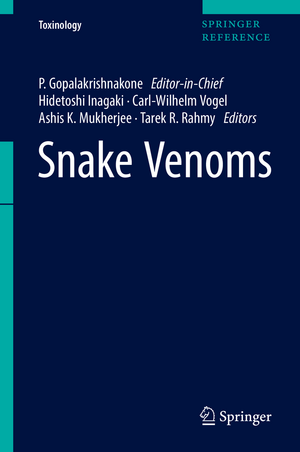
Snake Venoms: Toxinology
P. Gopalakrishnakone Editat de Hidetoshi Inagaki, Carl-Wilhelm Vogel, Ashis K. Mukherjee, Tarek R. Rahmyen Limba Engleză Hardback – 6 feb 2017
Contextul toxinologiei s-a transformat radical în ultimele două decenii, trecând de la analiza rudimentară a componentelor majoritare la o înțelegere de finețe a mecanismelor moleculare. Considerăm că această evoluție a fost propulsată de sensibilitatea crescută a dispozitivelor de laborator și de emergența tehnicilor de transcriptomică și proteomică, procese care fundamentează volumul Snake Venoms. Remarcăm o tranziție clară de la simpla clasificare a speciilor dominante către izolarea unor componente minoritare, dar cu funcții fiziologice cruciale.
Structura volumului reflectă o progresie logică, de la contextul geografic specific speciilor malaeziene, către o analiză biochimică riguroasă a enzimelor și inhibitorilor enzimatici. Merită menționat faptul că textul nu se limitează la toxicologie pură, ci explorează interacțiunile complexe cu receptorii celulari și canalele ionice, oferind perspective asupra potențialului antimicrobian al peptidelor de tip vipericidină. Pe linia clinică a lucrării Handbook of Venoms and Toxins of Reptiles, dar cu un accent mai pronunțat pe mecanismele moleculare de semnalizare celulară și apoptoză vasculară, această ediție devine o resursă esențială pentru cercetători.
În cadrul operei editorului P. Gopalakrishnakone, acest volum completează armonios lucrările anterioare, precum Evolution of Venomous Animals and Their Toxins sau Clinical Toxinology in Australia, Europe, and Americas. Dacă lucrările precedente se concentrau pe contextul evolutiv sau pe epidemiologia clinică, Snake Venoms ancorează seria Toxinology în realitatea aplicată a laboratorului modern, unde toxina este privită atât ca agent patogen, cât și ca resursă pentru inovație farmaceutică.


Preț: 2776.33 lei
Preț vechi: 2922.45 lei
-5%
Carte disponibilă
Livrare economică 28 octombrie-11 noiembrie
Specificații
ISBN-10: 940076409X
Pagini: 480
Ilustrații: XXVI, 502 p. 87 illus., 57 illus. in color.
Dimensiuni: 155 x 235 x 33 mm
Greutate: 1.13 kg
Ediția:1st ed. 2017
Editura: SPRINGER NETHERLANDS
Colecția Springer
Seria Toxinology
Locul publicării:Dordrecht, Netherlands
V-ar putea interesa
-
 Drug Delivery StrategiesDennis Douroumis-5%Preț: 1300.27 lei1368.70 lei
 -
 -5%Preț: 1130.07 lei1189.54 lei
 -
 Principles of ToxicologyKaren E. Stine-5%Preț: 803.18 lei845.45 lei
 -
 -27%Preț: 1250.75 lei1703.36 lei
 -
 -23%Preț: 608.29 lei793.96 lei
 -
 Botulinum Toxins & BotulismCharlotte Reynolds-23%Preț: 1041.81 lei1361.38 lei
 -
 -29%Preț: 50.46 lei71.57 lei
 -
 Englisch in der ApothekeDagmar CarraPreț: 269.31 lei
 -
 Clinical Toxinology in Asia Pacific and AfricaP. Gopalakrishnakone-5%Preț: 2799.45 lei2946.79 lei
 -
 Scorpion VenomsP. Gopalakrishnakone-5%Preț: 2979.67 lei3136.49 lei
 -
 Microbial ToxinsBrad Stiles-5%Preț: 2801.81 lei2949.27 lei
 -
 Clinical Toxinology in Australia, Europe, and AmericasCarl-Wilhelm Vogel-5%Preț: 2486.73 lei2617.61 lei
Public țintă
ResearchDe ce să citești această carte
Această lucrare se adresează cercetătorilor și clinicienilor care doresc să înțeleagă biologia veninului dincolo de simptomatologia imediată. Cititorul câștigă acces la date actualizate despre proteomica veninului și mecanismele de acțiune ale fosfolipazei A2. Este un instrument indispensabil pentru cei care investighează noi molecule cu potențial terapeutic, oferind o punte între biochimia fundamentală și managementul clinic al enveninării.
Despre autor
P. Gopalakrishnakone este un renumit expert în toxinologie, ocupând funcția de editor-șef pentru numeroase volume de referință publicate de Springer. Activitatea sa academică este marcată de o abordare multidisciplinară, coordonând proiecte de anvergură care acoperă de la genomica veninului la aplicațiile farmacologice ale toxinelor. În calitate de editor al seriei Toxinology, a facilitat integrarea noilor tehnologii omice în studiul animalelor veninoase, fiind recunoscut la nivel internațional pentru contribuțiile sale la înțelegerea mecanismelor de acțiune ale toxinelor asupra sistemului nervos și cardiovascular.
Descriere scurtă
Cuprins
Notă biografică
Hidetoshi Inagaki is senior researcher at the National Institute ofAdvanced Industrial Science and Technology, in Japan, since 2001, working on the bioactive peptides of venomous animals, such as snakes and ants. During that time, from April 2006 to March2007, he worked at CSTP (Council for Science and Technology Policy) on the “Guidelines on the Derivation and Distribution of Human Embryonic Stem Cells” and other science policies. From April 1994 to March 2001, Inagaki was a researcher at the National Industrial Research Institute of Nagoya, Japan. Inagaki received his Ph.D. from Nagoya University, Japan, in 1994, with time spent in Beth Israel Hospital, Boston, United States, from August 1991 to March 1992. He was also a graduate (April 1989–March 1991) and an undergraduate (April 1984–March 1989) at Nagoya University, Japan. For last five years, his research group has been working on the directed evolution of bioactive peptides. Using directed evolution, the group could generate agonist and antagonist like molecules of receptors, and enzyme inhibitors.
Carl-Wilhelm Vogel received his M.D. degree and Ph.D. degree in biochemistry from the University of Hamburg in Germany. For three-and-a-half years, Dr. Vogel was a postdoctoral research fellow in molecular immunology at Scripps Clinic and Research Foundation in La Jolla, California. He completed a medical internship in Germany and four years of residency training in clinical pathology at Georgetown University in Washington, D.C., and at Indiana University/Purdue University in Indianapolis. He is a licensed physician and a board-certified clinical pathologist both in the USA and Germany. He was on the faculty of Georgetown University School of Medicine for approximately nine years in the Departments of Biochemistry and Molecular Biology and Internal Medicine, and a member of the Lombardi Cancer Center, before assuming the chairmanship of the Department of Biochemistry and Molecular Biology at the University of Hamburg in 1990. In 1999 he became Director of the Cancer Research Center of Hawaii at the University of Hawaii, a position he held for about a decade. He currently is a full professor at the same institution. His research interests have been in the area of basic biomedical research with particular emphasis on the immunological aspects of cancer as well as the development of novel therapeutic concepts for diseases with complement pathogenesis, based on the complement-depleting activity of cobra venom factor. His research has been supported continuously by peer-reviewed grants since 1983, mainly from the National Institutes of Health. He is the author of well over 100 publications and patents.
Ashis K. Mukherjee is currently serving as a professor in the Department of Molecular Biology and Biotechnology at Tezpur University, Assam, India. Dr. A. K. Mukherjee received a Bachelor of Science in Chemistry (Hons.) from Banaras Hindu University, Varanasi, India, in 1990 and a Master of Science in Biochemistry from the same university in 1992. He was awarded a Ph.D. degree in 1998 from the Department of Biochemistry, Burdwan Medical College, Burdwan University, India. His topic of Ph.D. research was on biochemistry and pathophysiology of Indian cobra and Russell’s Viper venom. The current research activity of Dr. Mukherjee broadly includes biochemistry and drug discovery from snake venom as well as microbial biotechnology. His research has been funded by several extramural research grants. In addition to receiving several other prestigious awards, he was awarded a DST-BOYSCAST fellowship from the Government of India to work on spider venom toxins at the University of Connecticut Health Center, in Connecticut, USA (2002–2003), and the DBT-Crest award (2011–2012) from the Government of India to work as a visiting scientists at the School of Biological Sciences, University of Northern Colorado, in Colorado, USA. He is the recipient of Best Researcher Award of Tezpur Univeristy in 2008. Dr. Mukherjee has published more than sixty research papers in peer-reviewed journals and contributed several book chapters. He is Editor-in-Chief of the newsletter published by the Toxinological Society of India, besides being the editorial board member of many journals. He has guided six graduate students for the Ph.D. degree and twenty nine students for the M. Sc. dissertation work. Dr. Mukherjee also teaches numerous graduate and undergraduate courses in biochemistry, enzymology, toxinology and fermentation technology.
Tarek R. Rahmyfont-family: Calibri, sans-serif;">, Ph.D., is currently the vice president for Teaching and Student Affairs at Suez Canal University (SCU). He is a professor of histology and cytology, Zoology Department, Faculty of Science; head of the same department and director of the University Teaching Development Center; and dean of Fish Farming and Technology Institute at SCU. He graduated from the Zoology Department, Faculty of Science, SCU, in 1981, and subsequently worked as demonstrator in the same department, before going to Colorado State University (USA) where he obtained his Ph.D. in 1989 through a joint supervision program, before working as a lecturer, an associate professor and a professor at the Zoology Department at SCU (2001). His main interests are in toxinology, especially in the pathogenesis of snake and scorpion envenoming as well as in the use of natural products to neutralize their effects. He is a member of the National Committee of Toxicology in Egypt, and the founder and chairman of the Egyptian Society of Natural Toxins (2003 to date). He had obtained many research grants from Egypt, UAE, and Saudi Arabia, and organized six international conferences and four workshops on natural toxins. He also is the co-editor of the Egyptian Journal of Natural Toxins (12 volumes) and a peer reviewer for quality assurance at the Egyptian Council of Universities, has written and revised chapters of several books on vertebrate biology, and participated in the translation of the biological Glossary of Campbell Biology. He has conducted many field surveys in Egypt, USA, UAE, and Saudi Arabia on the arid ecosystems with focus on venomous snakes, and published 62 scientific papers. He has taught 16 courses on different aspects of histology, cytology, cell biology, histochemistry and vertebrate biology, and natural toxins, as well as supervised more than 23 M.Sc and Ph.D. students. He has participated in more than 50 conferences, seminars, and workshops, andis a member of national and international committees that deal with toxicology.