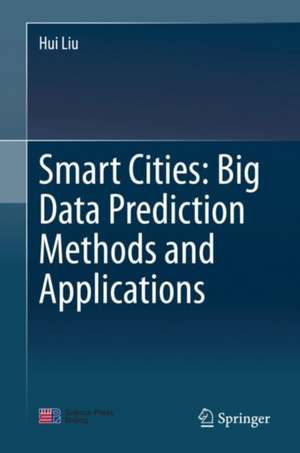
Smart Cities: Big Data Prediction Methods and Applications
Autor Hui Liuen Limba Engleză Hardback – 26 mar 2020
This timely book discusses big data forecasting for smart cities. It introduces big data forecasting techniques for the key aspects (e.g., traffic, environment, building energy, green grid, etc.) of smart cities, and explores three key areas that can be improved using big data prediction: grid energy, road traffic networks and environmental health in smart cities. The big data prediction methods proposed in this book are highly significant in terms of the planning, construction, management, control and development of green and smart cities.
Including numerous case studies to explain each method and model, this easy-to-understand book appeals to scientists, engineers, college students, postgraduates, teachers and managers from various fields of artificial intelligence, smart cities, smart grid, intelligent traffic systems, intelligent environments and big data computing.
Preț: 1146.72 lei
Preț vechi: 1433.40 lei
-20%
Puncte Express: 1720
Carte tipărită la comandă
Livrare economică 23-30 noiembrie
Livrare prin curier în România Termenul estimat este afișat lângă disponibilitate.
Transport gratuit pentru acest produs Plată online sau ramburs, în funcție de opțiunile comenzii.
Retur gratuit în 14 zile Comandă securizată și suport în română.
Specificații
ISBN-13: 9789811528361
ISBN-10: 9811528365
Pagini: 352
Ilustrații: XXXV, 314 p. 251 illus., 20 illus. in color.
Dimensiuni: 160 x 241 x 24 mm
Greutate: 0.71 kg
Ediția:1st edition 2020
Editura: Springer Nature Singapore
Locul publicării:Singapore, Singapore
ISBN-10: 9811528365
Pagini: 352
Ilustrații: XXXV, 314 p. 251 illus., 20 illus. in color.
Dimensiuni: 160 x 241 x 24 mm
Greutate: 0.71 kg
Ediția:1st edition 2020
Editura: Springer Nature Singapore
Locul publicării:Singapore, Singapore
V-ar putea interesa
-
 -31%Preț: 881.44 lei1270.05 lei
 -
 -40%Preț: 864.80 lei1434.39 lei
 -
 Computational Techniques for Structural Health MonitoringSrinivasan Gopalakrishnan-20%Preț: 1002.96 lei1253.70 lei
 -
 Artificial Intelligence in Power System OptimizationWeerakorn Ongsakul-20%Preț: 1557.89 lei1947.36 lei
 -
 Advances in Intelligent Systems and Computing IIINatalia Shakhovska-20%Preț: 1266.30 lei1582.87 lei
 -
 Simulation and Modeling Methodologies, Technologies and ApplicationsMohammad S. Obaidat-20%Preț: 995.93 lei1244.91 lei
 -
 -20%Preț: 666.73 lei833.42 lei
 -
 -20%Preț: 1236.52 lei1545.64 lei
 -
 Image Processing and Communications Challenges 10Micha¿ Chora¿-20%Preț: 633.39 lei791.74 lei
 -
 m¿Polar Fuzzy GraphsMuhammad Akram-20%Preț: 676.25 lei845.31 lei
 -
 Telematics and ComputingMiguel Felix Mata-Rivera-20%Preț: 335.02 lei418.78 lei
 -
 AI*IA 2018 - Advances in Artificial IntelligenceChiara Ghidini-20%Preț: 360.33 lei450.40 lei
 -
 Advances in Condensed Matter OpticsLiangyao Chen-23%Preț: 1480.74 lei1923.04 lei
 -
 AI*IA 2013: Advances in Artificial IntelligenceMatteo Baldoni-20%Preț: 335.48 lei419.35 lei
 -
 Metal-Based Composite NanomaterialsJun Yang-20%Preț: 610.73 lei763.41 lei
 -
 Learning Systems: Decision, Simulation, and ControlY. M. El-Fattah-20%Preț: 312.92 lei391.15 lei
 -
 -20%Preț: 313.74 lei392.17 lei
 -
 Pattern RecognitionJesús Ariel Carrasco-Ochoa-20%Preț: 327.27 lei409.09 lei
 -
 -20%Preț: 348.66 lei435.83 lei
 -
 Intelligent Decision Support in Process EnvironmentsE. Hollnagel-20%Preț: 326.87 lei408.59 lei
 -
 -20%Preț: 961.00 lei1201.25 lei
 -
 Neurocomputation in Remote Sensing Data AnalysisIoannis Kanellopoulos-20%Preț: 335.02 lei418.78 lei
 -
 Advanced Computing Concepts and Techniques in Control EngineeringMichael J. Denham-20%Preț: 334.67 lei418.33 lei
 -
 Künstliche Intelligenz im Handel 1 - ÜberblickRainer Gläß-20%Preț: 105.86 lei132.32 lei
 -
 Künstliche Intelligenz im Handel 2 - AnwendungenRainer Gläß-20%Preț: 102.16 lei127.71 lei
 -
 -20%Preț: 315.93 lei394.92 lei
 -
 Non-intrusive Load MonitoringHui Liu-15%Preț: 619.05 lei728.29 lei
 -
 Big Data in Energy EconomicsHui Liu-15%Preț: 403.10 lei474.24 lei
 -
 -15%Preț: 673.69 lei792.57 lei
Cuprins
Part 1 Exordium.- 1. Key Issues of Smart Cities.- Part 2 Smart Grid and Buildings.- 2. Electrical Characteristics and Correlation Analysis in Smart Grid.- 3. Prediction Model of City Electricity Consumption.- 4. Prediction Models of Energy Consumption in Smart Urban Buildings.- Part 3 Smart Traffic Systems.- 5. Characteristics and Analysis of Urban Traffic Flow in Smart Traffic Systems.- 6. Prediction Model of Traffic Flow Driven Based on Single Data in Smart Traffic Systems.- 7. Prediction Models of Traffic Flow Driven Based on Multi-dimensional Data in Smart Traffic Systems.- Part 4 Smart Environment 8 Prediction Models of Urban Air Quality in Smart Environment.- 9. Prediction Models of Urban Hydrological Status in Smart Environment.- 10. Prediction Model of Urban Environmental Noise in Smart Environment.
Notă biografică
Hui Liu is Professor of Artificial Intelligence and Smart Cities, Central South University, China; Vice Dean, Faculty of Traffic and Transportation Engineering, Central South University, China. He has double Ph.D. degrees from China and Germany (Ph.D. in Traffic & Transportation Engineering from Central South University of China in 2011/Ph.D. in Automation Engineering from Rostock University of Germany in 2013). He obtained his habilitation degree (professorship degree) on Automation Engineering from University of Rostock, Germany, in 2016. He had been employed as the BMBF Junior Group Leader of Ministry of Education & Research of Germany at CELISCA (Center for Life Science Automation), University of Rostock, Germany, since 01/2015 until 12/2016. He authorized 40 China invention patents in the field of data science, air quality monitoring and time series modeling, as the first inventor. He won many reputable research awards, including the second prize for Natural Science Research by Ministry of Education of China in 2017, the first prize for National Scientific and Technological Progress Award of China in 2018, the first prize for Scientific and Technology Award of China Railway Society in 2018, etc. He also received Elsevier Applied Energy Most Highly Cited Research Paper Award (20 papers globally selected in 2015), national outstanding doctoral thesis nomination awards of China, Hunan outstanding doctoral thesis of China, Baosteel Education Award, Mao Yisheng Railway Award and other personal honours. Ms. Fang Cheng is now pursuing Ph.D. at Central South University, Changsha, China. Her research interests include machine learning for predictive health management. Yanfei Li is Associate Professor, Shennong Chair Professor, College of Mechanical and Electrical Engineering, Hunan Agricultural University, Changsha, China. Prof. Li published 2 monographs, 45 SCI/EI papers, including 27 JCR Q1 journal papers, 2 ESI 1% highly-cited papers, and authorized 10 China national invention patents as the first inventor as well. She leaded several important research projects, including China National Key Research and Development Project, Human Natural Science Foundation Project. She won the second prize of the Natural Science Award of Ministry of Education in 2017, the first prize of the Hunan New Energy Science and Technology Progress Award in 2020, the Logistics Technology Innovation Award of China Federation of Logistics and Purchasing in 2021 and the Transportation and Logistics Innovation Award of China Highway and Transportation Society in 2020.
Textul de pe ultima copertă
Smart Cities: Big Data Prediction Methods and Applications is the first reference to provide a comprehensive overview of smart cities with the latest big data predicting techniques.
This timely book discusses big data forecasting for smart cities. It introduces big data forecasting techniques for the key aspects (e.g., traffic, environment, building energy, green grid, etc.) of smart cities, and explores three key areas that can be improved using big data prediction: grid energy, road traffic networks and environmental health in smart cities. The big data prediction methods proposed in this book are highly significant in terms of the planning, construction, management, control and development of green and smart cities.
Including numerous case studies to explain each method and model, this easy-to-understand book appeals to scientists, engineers, college students, postgraduates, teachers and managers from various fields of artificial intelligence,smart cities, smart grid, intelligent traffic systems, intelligent environments and big data computing.
This timely book discusses big data forecasting for smart cities. It introduces big data forecasting techniques for the key aspects (e.g., traffic, environment, building energy, green grid, etc.) of smart cities, and explores three key areas that can be improved using big data prediction: grid energy, road traffic networks and environmental health in smart cities. The big data prediction methods proposed in this book are highly significant in terms of the planning, construction, management, control and development of green and smart cities.
Including numerous case studies to explain each method and model, this easy-to-understand book appeals to scientists, engineers, college students, postgraduates, teachers and managers from various fields of artificial intelligence,smart cities, smart grid, intelligent traffic systems, intelligent environments and big data computing.
Caracteristici
Broadens readers' understanding of the smart cities Describes in detail the latest theories and specific applications of smart time series prediction methods in smart cities, as well as a big data framework for three key aspects of building smart cities: smart grid, smart traffic systems and smart environments Summarizes the most important big data forecasting theories and techniques for building smart cities and proposes embedded prediction algorithms and methods for the mainstream big data platforms