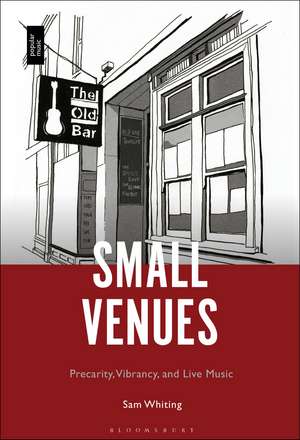
Small Venues: Precarity, Vibrancy and Live Music
Autor Dr. Sam Whitingen Limba Engleză Hardback – 7 sep 2023
This book focusses on the role of small live music venues as incubators for emerging talent and social hubs for music scene participants. Such venues are grassroots spaces of cultural labor and production that often struggle with issues of financial precarity yet are fundamental to the live music ecology of a city, acting both as platforms for emergent performers and spaces of sociality for local music scenes.
Preț: 512.14 lei
Preț vechi: 745.17 lei
-31%
Puncte Express: 768
Carte tipărită la comandă
Livrare economică 08-22 august
Livrare prin curier în România Termenul estimat este afișat lângă disponibilitate.
Transport gratuit pentru acest produs Plată online sau ramburs, în funcție de opțiunile comenzii.
Retur gratuit în 14 zile Comandă securizată și suport în română.
Specificații
ISBN-13: 9781501379888
ISBN-10: 1501379887
Pagini: 240
Dimensiuni: 160 x 232 x 20 mm
Greutate: 0.48 kg
Editura: Bloomsbury Publishing
Colecția Bloomsbury Academic
Locul publicării:New York, United States
ISBN-10: 1501379887
Pagini: 240
Dimensiuni: 160 x 232 x 20 mm
Greutate: 0.48 kg
Editura: Bloomsbury Publishing
Colecția Bloomsbury Academic
Locul publicării:New York, United States
Cuprins
Part 1: Live Music and Small Venues
Introduction
1. Theorizing Live Music 'Scenes', 'Subcultures' and the 'Live Music Ecology'
Part 2: Vibrancy
2. Live Music and the City
3. Place, Space and Small Venues
Part 3: Precarity
4. Capital, Value and Cultural Intermediaries
Conclusion
References
Index
Introduction
1. Theorizing Live Music 'Scenes', 'Subcultures' and the 'Live Music Ecology'
Part 2: Vibrancy
2. Live Music and the City
3. Place, Space and Small Venues
Part 3: Precarity
4. Capital, Value and Cultural Intermediaries
Conclusion
References
Index
Recenzii
Whiting's book is a long overdue and critical addition to research on the spaces and places of live music performance and consumption. Small venues are often referred to in passing but rarely a sustained focus in academic scholarship; and yet, as this book masterfully illustrates, they are the lifeblood of local and trans-local music scenes. Crucial reading for anyone who is interested in gaining a deeper knowledge of the social, economic and emotional value of small venues, the challenges they face and the unequivocal part they have played in keeping music "live" for successive generations of music fans around the world.
Small venues are the lifeblood of any music scene: a heady mix of sights, smells and sounds; spaces full of creativity and pleasure, ambition and rivalry; sites where the artistic expression, profit motives and government regulations come in to conflict. Without small venues there is no place for experimentation and failure. Without small venues nothing can develop to fill the larger venues. Sam Whiting's exploration of these key sites of cultural production and consumption is a must read for any scholars interested in the historic importance of these vital spaces, their relation to sense of place, taste, desires and belonging, and governmental aspects that frustrate artistic endeavours. But most importantly, Small Venues illuminates how precarity and vibrancy, that is, social aspects of the way these spaces feel, are central to the success or closure of venues and therefore whether a creative scene thrives or dies. Bringing together cultural sociology and cultural studies analysis with his own industry experiences and a sharp antenna for bullshit, Whiting's Small Venues is an important and evocative intervention into the scholarship of music ecosystems and scenes.
This is a welcome and timely study of live music ecologies, made more so by the impact of the pandemic on music-making around the world. Whiting has offered us a cogent study of small venues, for contributions to not only music scenes but also the larger creative cultures within which they exist.
Small venues are the lifeblood of any music scene: a heady mix of sights, smells and sounds; spaces full of creativity and pleasure, ambition and rivalry; sites where the artistic expression, profit motives and government regulations come in to conflict. Without small venues there is no place for experimentation and failure. Without small venues nothing can develop to fill the larger venues. Sam Whiting's exploration of these key sites of cultural production and consumption is a must read for any scholars interested in the historic importance of these vital spaces, their relation to sense of place, taste, desires and belonging, and governmental aspects that frustrate artistic endeavours. But most importantly, Small Venues illuminates how precarity and vibrancy, that is, social aspects of the way these spaces feel, are central to the success or closure of venues and therefore whether a creative scene thrives or dies. Bringing together cultural sociology and cultural studies analysis with his own industry experiences and a sharp antenna for bullshit, Whiting's Small Venues is an important and evocative intervention into the scholarship of music ecosystems and scenes.
This is a welcome and timely study of live music ecologies, made more so by the impact of the pandemic on music-making around the world. Whiting has offered us a cogent study of small venues, for contributions to not only music scenes but also the larger creative cultures within which they exist.