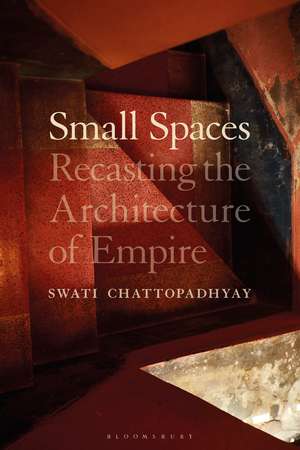
Small Spaces: Recasting the Architecture of Empire
Autor Professor Swati Chattopadhyayen Limba Engleză Paperback – 21 sep 2023
WINNER Historians of British Art Book Award 2025 for Exemplary Scholarship on the Period between 1800-1960
Small Spaces recasts the history of the British empire by focusing on the small spaces that made the empire possible. It takes as its subject a series of small architectural spaces, objects, and landscapes and uses them to narrate the untold stories of the marginalized people-the servants, women, children, subalterns, and racialized minorities-who held up the infrastructure of empire. In so doing it opens up an important new approach to architectural history: an invitation to shift our attention from the large to the small scale.
Taking the British empire in India as its primary focus, this book presents eighteen short, readable chapters to explore an array of overlooked places and spaces. From cook rooms and slave quarters to outhouses, go-downs, and medicine cupboards, each chapter reveals how and why these kinds of minor spaces are so important to understanding colonialism. With the focus of history so often on the large scale - global trade networks, vast regions, and architectures of power and domination - Small Spaces shows instead how we need to rethink this aura of magnitude so that our reading is not beholden such imperialist optics.
With chapters which can be read separately as individual accounts of objects, spaces, and buildings, and introductions showing how this critical methodology can challenge the methods and theories of urban and architectural history, Small Spaces is a must-read for anyone wishing to decolonize disciplinary practices in the field of architectural, urban, and colonial history. Altogether, it provides a paradigm-breaking account of how to 'unlearn empire', whether in British India or elsewhere.
Preț: 189.45 lei
Preț vechi: 246.42 lei
-23%
Puncte Express: 284
Carte disponibilă
Livrare economică 30 octombrie-04 noiembrie
Livrare express 14-20 octombrie pentru 107.50 lei
Livrare prin curier în România Termenul estimat este afișat lângă disponibilitate.
Transport gratuit de la 400.00 lei Plată online sau ramburs, în funcție de opțiunile comenzii.
Retur gratuit în 14 zile Comandă securizată și suport în română.
Specificații
ISBN-13: 9781350288201
ISBN-10: 1350288209
Pagini: 360
Ilustrații: 30 colour & 68 bw illus
Dimensiuni: 156 x 234 x 22 mm
Greutate: 0.82 kg
Editura: Bloomsbury Publishing
Colecția Bloomsbury Visual Arts
Locul publicării:London, United Kingdom
ISBN-10: 1350288209
Pagini: 360
Ilustrații: 30 colour & 68 bw illus
Dimensiuni: 156 x 234 x 22 mm
Greutate: 0.82 kg
Editura: Bloomsbury Publishing
Colecția Bloomsbury Visual Arts
Locul publicării:London, United Kingdom
V-ar putea interesa
-
 Non-Design: Architecture, Liberalism, and the MarketAnthony FontenotPreț: 407.39 lei
 -
 Preț: 416.37 lei
 -
 The Ruins of Palmyra and Baalbek: Volumes I-IIRobert Wood-38%Preț: 1968.68 lei3156.32 lei
 -
 Models and World MakingAnnabel Jane WhartonPreț: 292.04 lei
 -
 Environmental DesignAvigail SachsPreț: 255.82 lei
 -
 Preț: 261.62 lei
 -
 -26%Preț: 225.33 lei303.10 lei
 -
 Making the Arctic CityPeter Hemmersam-32%Preț: 627.90 lei927.19 lei
 -
 -23%Preț: 204.78 lei266.54 lei
 -
 Designing Pan-America: U.S. Architectural Visions for the Western HemisphereRobert Alexander GonzálezPreț: 346.26 lei
 -
 Preț: 189.57 lei
 -
 The Cannibal's CookbookBrandon CliffordPreț: 131.36 lei
 -
 Trans-Atlantic EngagementsSteffen LehmannPreț: 182.44 lei
 -
 Preț: 324.41 lei
 -
 G. E. Kidder Smith BuildsAngelo MaggiPreț: 376.20 lei
 -
 Preț: 141.65 lei
Cuprins
Preface and Acknowledgments
Part I. Small Spaces
1. Of Small Spaces
2. Empire of Small Spaces
Part II: Trade and Labor
3. Dependency
4. Locating the Bottlekhana
5. Potable Empire
6. Europe Goods
7. Strange Tongues
8. Making Invisible
Part III: Land Imagination
9. Vantage
10. Connective Spaces
11. Anomalous Spaces
12. An Aesthetic Episode
13. Roofscape
Part IV: A Geography of Small Spaces
14. Collections and Containment
15. Portable Geographies
16. A Good Shelf
17. A Box of Medicine
18. Epilogue
Appendix A
Index
Part I. Small Spaces
1. Of Small Spaces
2. Empire of Small Spaces
Part II: Trade and Labor
3. Dependency
4. Locating the Bottlekhana
5. Potable Empire
6. Europe Goods
7. Strange Tongues
8. Making Invisible
Part III: Land Imagination
9. Vantage
10. Connective Spaces
11. Anomalous Spaces
12. An Aesthetic Episode
13. Roofscape
Part IV: A Geography of Small Spaces
14. Collections and Containment
15. Portable Geographies
16. A Good Shelf
17. A Box of Medicine
18. Epilogue
Appendix A
Index
Recenzii
A new paradigm for methods in architectural history ... Truly a monumental achievement.
Fascinating, engaging, experimental . [A] genre-bending mode of narration.
Studies [of empire] typically focus on the nation state or on 'connected histories' which foreground international, elite networks at the expense of the local. This intriguing book offers us microhistories instead. An architectural history as much as social history.
This brilliantly provocative study provides an alternative, micro-scalar history of colonial and middle-class domiciles, along with an extraordinary archaeology of objects and bodies that mediated the intimacy of the rulers and the ruled-taking us on an exhilarating journey from the cellars, kitchens, dining rooms and verandahs of the imperial mansions of Calcutta to the streets, bazars and bungalows of the Bengal and north-Indian countryside.
In this erudite yet eminently accessible volume, Chattopadhyay imaginatively stitches together the overlooked worlds of fragmented and seemingly minor spaces underpinning the workings of everyday life and better regarded practices, inspiring readers, by example, to recognize their indispensability and resilience.
An original examination of empire from marginal spaces in the built environment. This book unites subalterns with the spatial medium of their agency during colonial rule. It brilliantly reveals the hidden infrastructure of empire through an architectural and social history of service, separation, and subordination.
Fascinating, engaging, experimental . [A] genre-bending mode of narration.
Studies [of empire] typically focus on the nation state or on 'connected histories' which foreground international, elite networks at the expense of the local. This intriguing book offers us microhistories instead. An architectural history as much as social history.
This brilliantly provocative study provides an alternative, micro-scalar history of colonial and middle-class domiciles, along with an extraordinary archaeology of objects and bodies that mediated the intimacy of the rulers and the ruled-taking us on an exhilarating journey from the cellars, kitchens, dining rooms and verandahs of the imperial mansions of Calcutta to the streets, bazars and bungalows of the Bengal and north-Indian countryside.
In this erudite yet eminently accessible volume, Chattopadhyay imaginatively stitches together the overlooked worlds of fragmented and seemingly minor spaces underpinning the workings of everyday life and better regarded practices, inspiring readers, by example, to recognize their indispensability and resilience.
An original examination of empire from marginal spaces in the built environment. This book unites subalterns with the spatial medium of their agency during colonial rule. It brilliantly reveals the hidden infrastructure of empire through an architectural and social history of service, separation, and subordination.