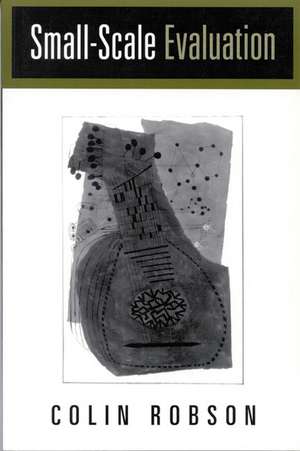
Small-Scale Evaluation: Principles and Practice
Autor Colin Robsonen Limba Engleză Paperback – 19 dec 1999
Preț: 209.57 lei
Preț vechi: 376.66 lei
-44%
Puncte Express: 314
Carte indisponibilă temporar
Livrare prin curier în România Termenul estimat este afișat lângă disponibilitate.
Transport gratuit de la 400.00 lei Plată online sau ramburs, în funcție de opțiunile comenzii.
Retur gratuit în 14 zile Comandă securizată și suport în română.
Specificații
ISBN-13: 9780761955108
ISBN-10: 0761955100
Pagini: 168
Dimensiuni: 156 x 234 x 11 mm
Ediția:1
Editura: SAGE Publications
Colecția Sage Publications Ltd
Locul publicării:London, United Kingdom
ISBN-10: 0761955100
Pagini: 168
Dimensiuni: 156 x 234 x 11 mm
Ediția:1
Editura: SAGE Publications
Colecția Sage Publications Ltd
Locul publicării:London, United Kingdom
V-ar putea interesa
-
 How to ResearchLoraine Blaxter-28%Preț: 173.08 lei241.68 lei
 -
 Quantitative Health Research: Issues and MethodsElizabeth Curtis-26%Preț: 238.76 lei322.99 lei
 -
 Research Methods for PostgraduatesTony GreenfieldPreț: 448.94 lei
 -
 -19%Preț: 446.28 lei550.96 lei
 -
 -8%Preț: 526.43 lei572.21 lei
 -
 ReproducibilityHarald Atmanspacher-9%Preț: 742.86 lei816.33 lei
 -
 Essential Guide to Reading Biomedical PapersPhilip D LangtonPreț: 349.16 lei
 -
 SAGE Handbook of Mixed Methods in Social & Behavioral ResearchAbbas Tashakkori-27%Preț: 1119.61 lei1533.71 lei
 -
 An Introduction to the Philosophy of MethodologyKerry E Howell-8%Preț: 482.14 lei524.06 lei
 -
 A Companion to Survey ResearchMichael Ornstein-8%Preț: 450.17 lei489.32 lei
 -
 Preț: 446.64 lei
 -
 Exploring Media ResearchAndy RuddockPreț: 426.84 lei
Cuprins
Introduction
Evaluation
The What and the Why
The Advantages of Collaboration
Ethical and Political Considerations
Designs for Different Purposes
Getting Answers to Evaluation Questions
Some Practicalities
Communicating the Findings
Evaluation
The What and the Why
The Advantages of Collaboration
Ethical and Political Considerations
Designs for Different Purposes
Getting Answers to Evaluation Questions
Some Practicalities
Communicating the Findings
Descriere
Colin Robson provides guidance on how evaluation be used most effectively in a clear and uncluttered way. The issue of collaboration is examined step-by-step; stakeholder models are compared with techniques such as participatory evaluation; ethical considerations are placed in context; and the best ways of communicating findings are discussed.
Recenzii
A masterfully written text making complex issues approachable and very workable! Robson’s personable style as if engaged in a conversation with the reader entices and enlightens. It is rare to find a text that to such an extent combines user-friendliness and an engaging style without compromising scientific stringency, ethics or practical usefulness and common sense. This is indeed a treasure trove for students and professionals of any kind and everywhere whose study or work involves people in groups and organisations in need of development, change or just a healthy reality check on how their organisation is doing.
This is a marvelous book. It communicates clearly and directly to the reader, making the subject accessible and usable rather than abstruse or forbidding. Robson excels in thinking with the reader and getting the reader to think along with him, so that reading his work seems like collaborating with a helpful mentor. Supported by many helpful diagrams and charts, he uses real-world situations, contexts, examples, and research literature to give the reader an understanding of how she might go about conducting actual research using this book as a guide. He discusses the challenges a researcher can face in conducting evaluations, such as getting those being studied to collaborate in the research project, and the strengths and weaknesses, benefits and pitfalls of so doing. And it is of great value that his focus is specifically on small-scale evaluation, because that is the type of evaluation in which a student or budding researcher is most likely to be involved. Robson is a great demystifier and guide--other research texts would benefit greatly from adopting Robson's style of thinking, writing, and guiding.
This is a marvelous book. It communicates clearly and directly to the reader, making the subject accessible and usable rather than abstruse or forbidding. Robson excels in thinking with the reader and getting the reader to think along with him, so that reading his work seems like collaborating with a helpful mentor. Supported by many helpful diagrams and charts, he uses real-world situations, contexts, examples, and research literature to give the reader an understanding of how she might go about conducting actual research using this book as a guide. He discusses the challenges a researcher can face in conducting evaluations, such as getting those being studied to collaborate in the research project, and the strengths and weaknesses, benefits and pitfalls of so doing. And it is of great value that his focus is specifically on small-scale evaluation, because that is the type of evaluation in which a student or budding researcher is most likely to be involved. Robson is a great demystifier and guide--other research texts would benefit greatly from adopting Robson's style of thinking, writing, and guiding.
Notă biografică
Colin Robson is an Emeritus Professor in the School of Human & Health Sciences at the University of Huddersfield. He directed a series of local, regional and national research and evaluation projects, mainly in aspects of special educational needs, at Huddersfield in association with the Hester Adrian Research Centre, University of Manchester. He subsequently was a supervisor for over twenty research students, mainly at Doctoral level, covering a wide range of disciplines - education, social work, management, music, and aspects of health, including nursing, midwifery and osteopathy, while developing and leading a postgraduate programe in Social Research and Evaluation. More recently he was, for over a decade, chief Consultant at the Centre for Educational Research and Innovation at OECD in Paris, for projects evaluating and comparing national systems for the education of students with disabilities, learning and behavioural difficulties and social disadvantages, and a follow-up project for Eurostat, the statistical arm of the European Union.