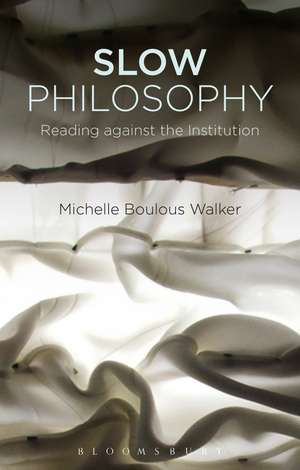
Slow Philosophy: Reading against the Institution
Autor Michelle Boulous Walkeren Limba Engleză Paperback – 15 dec 2016
Slow reading shares something in common with contemporary social movements, such as that devoted to slow food; it offers us ways to engage the complexity of the world. With the help of writers as diverse as Nietzsche, Wittgenstein, Woolf, Adorno, Levinas, Critchley, Beauvoir, Le Douff, Irigaray, Cixous, Weil, and others, Boulous Walker offers a foundational text in the emerging field of slow philosophy, one that explores the importance of unhurried time in establishing our institutional encounters with complex and demanding works.
Preț: 172.84 lei
Preț vechi: 193.93 lei
-11%
Puncte Express: 259
Carte tipărită la comandă
Livrare economică 27 noiembrie-11 decembrie
Livrare prin curier în România Termenul estimat este afișat lângă disponibilitate.
Transport gratuit de la 400.00 lei Plată online sau ramburs, în funcție de opțiunile comenzii.
Retur gratuit în 14 zile Comandă securizată și suport în română.
Specificații
ISBN-13: 9781474279925
ISBN-10: 1474279929
Pagini: 336
Dimensiuni: 138 x 214 x 20 mm
Greutate: 0.36 kg
Editura: Bloomsbury Publishing
Colecția Bloomsbury Academic
Locul publicării:London, United Kingdom
ISBN-10: 1474279929
Pagini: 336
Dimensiuni: 138 x 214 x 20 mm
Greutate: 0.36 kg
Editura: Bloomsbury Publishing
Colecția Bloomsbury Academic
Locul publicării:London, United Kingdom
V-ar putea interesa
-
 -18%Preț: 339.76 lei412.99 lei
 -
 Atlas – The Archaeology of an Imaginary CityKai–cheung DungPreț: 203.43 lei
 -
 RaptureIliazdPreț: 103.77 lei
 -
 The Nose and Other StoriesNikolai GogolPreț: 108.30 lei
 -
 The Limits of LoyaltySimon KellerPreț: 349.06 lei
 -
 The Clash of ImagesAbdelfattah KilitoPreț: 67.16 lei
 -
 The WalkRobert WalserPreț: 68.01 lei
 -
 The Family Coach MethodLynne KenneyPreț: 105.61 lei
 -
 Pacifism: A Philosophy of NonviolenceProfessor Robert L. Holmes-16%Preț: 196.36 lei233.09 lei
 -
 Many Many Many Gods of HinduismSwami AchuthanandaPreț: 98.88 lei
 -
 Sharing TimeElizabeth VerdickPreț: 57.49 lei
 -
 -25%Preț: 94.15 lei126.32 lei
 -
 My InventionsNikola TeslaPreț: 40.35 lei
 -
 Vasko PopaVasko PopaPreț: 126.36 lei
 -
 Preț: 139.07 lei
 -
 Cléo de 5 a 7Steven Ungar-32%Preț: 66.17 lei97.74 lei
 -
 L'AtalanteMarina Warner-18%Preț: 89.13 lei108.62 lei
 -
 ArdorRoberto Calasso-18%Preț: 77.31 lei94.27 lei
 -
 Language Behind BarsPaul CelanPreț: 96.61 lei
Cuprins
Acknowledgements
Preface: Why Slow Reading Today?
Posing the Question: what is it to read?
About the Chapters
Introduction: On Being Slow and Doing Philosophy
The Love of Wisdom and the Desire to Know
The Play Between the Instituting and the Instituted in Philosophy
Philosophy as a Way of Life: Slow Reading - Slow Philosophy
Resisting Institutional Reading
1 Habits of Reading: Le Douff's Future Philosophy
Philosophy as Discipline
Philosophy's Old Habits of Reading
How Men and Women Read
Teaching Reading: Sadism, Collaboration?
Le Douff's Habits of Reading
A Philosophy Still to Come: Open-ended Work
Habits of Slow Reading
2 Reading Essayistically: Levinas and Adorno
Emmanuel Levinas: An Ethics of Reading?
Institution and Instrumental Reason
Theodor W. Adorno: The Essay as Form
Luiz Costa Lima: Criticity and the Essay
Hans Ulrich Gumbrecht: Reading for "Stimmung"
Robert Musil: Essay, Ethics, Aesthetics
3 Re-reading: Irigaray on Love and Wonder
Psychoanalysis, Listening, Attention
Irigaray's Diotima: The Arts of Philosophy, Reading, and Love
Descartes's "Passions of the Soul": Irigaray's Wondrous Reading
Love and Wonder: Reading
4 The Present of Reading: Irigaray's Attentive Listening
The Nobility of Sight: Hans Jonas
Listening-to: Luce Irigaray's Way of Love
The Present of Reading: Friedrich Nietzsche and Others
5 Romance and Authenticity: Beauvoir's Lesson in Reading
Romantic and Authentic Love
Reading and Love
Authenticity as Ethics?
Returning to Beauvoir: How does she read?
Le Douff's Reading of Beauvoir's Reading of Sartre: "Operative Philosophy"
Rethinking "Operative Philosophy" with the help of Beauvoir's Own Categories of
Romance and Authenticity
Beauvoir Reading the Couple: "Sartre and Beauvoir"
6 Intimate Reading: Cixous's Approach
A Desire resonant with Love
Cixous Writing: "Entredeux"
Writing as Gift and Generosity
Generosity, Love, Abandon
Cixous Reading: Intimacy, Giving
The Approach: A slow passage between the self and the strangeness of the other
Cixous and Irigaray: extreme proximity?
The Gifts of Abandon and Grace: An ethics of reading
Conclusion: The Attentive Work of Grace
Simone Weil: attention to gravity and grace
Martin Heidegger: rapture (Rausch) and meditative thinking
Reading as an Aesthetic Experience
Hans Ulrich Gumbrecht: reading for intensity
Notes
Bibliography
Preface: Why Slow Reading Today?
Posing the Question: what is it to read?
About the Chapters
Introduction: On Being Slow and Doing Philosophy
The Love of Wisdom and the Desire to Know
The Play Between the Instituting and the Instituted in Philosophy
Philosophy as a Way of Life: Slow Reading - Slow Philosophy
Resisting Institutional Reading
1 Habits of Reading: Le Douff's Future Philosophy
Philosophy as Discipline
Philosophy's Old Habits of Reading
How Men and Women Read
Teaching Reading: Sadism, Collaboration?
Le Douff's Habits of Reading
A Philosophy Still to Come: Open-ended Work
Habits of Slow Reading
2 Reading Essayistically: Levinas and Adorno
Emmanuel Levinas: An Ethics of Reading?
Institution and Instrumental Reason
Theodor W. Adorno: The Essay as Form
Luiz Costa Lima: Criticity and the Essay
Hans Ulrich Gumbrecht: Reading for "Stimmung"
Robert Musil: Essay, Ethics, Aesthetics
3 Re-reading: Irigaray on Love and Wonder
Psychoanalysis, Listening, Attention
Irigaray's Diotima: The Arts of Philosophy, Reading, and Love
Descartes's "Passions of the Soul": Irigaray's Wondrous Reading
Love and Wonder: Reading
4 The Present of Reading: Irigaray's Attentive Listening
The Nobility of Sight: Hans Jonas
Listening-to: Luce Irigaray's Way of Love
The Present of Reading: Friedrich Nietzsche and Others
5 Romance and Authenticity: Beauvoir's Lesson in Reading
Romantic and Authentic Love
Reading and Love
Authenticity as Ethics?
Returning to Beauvoir: How does she read?
Le Douff's Reading of Beauvoir's Reading of Sartre: "Operative Philosophy"
Rethinking "Operative Philosophy" with the help of Beauvoir's Own Categories of
Romance and Authenticity
Beauvoir Reading the Couple: "Sartre and Beauvoir"
6 Intimate Reading: Cixous's Approach
A Desire resonant with Love
Cixous Writing: "Entredeux"
Writing as Gift and Generosity
Generosity, Love, Abandon
Cixous Reading: Intimacy, Giving
The Approach: A slow passage between the self and the strangeness of the other
Cixous and Irigaray: extreme proximity?
The Gifts of Abandon and Grace: An ethics of reading
Conclusion: The Attentive Work of Grace
Simone Weil: attention to gravity and grace
Martin Heidegger: rapture (Rausch) and meditative thinking
Reading as an Aesthetic Experience
Hans Ulrich Gumbrecht: reading for intensity
Notes
Bibliography
Recenzii
The real innovation of Boulous Walker's book is its understanding of philosophia - the love of wisdom - in terms of the love of reading. The point is not that philosophers do not read, or that they ought to read more, but that philosophy needs to rethink what it is to read, and to think carefully about what it is to read better. Hence the importance of slowness.
[T]his book represents a welcome refreshment for the academic; it allows one to remember why and how reading and thinking is central to engaging with the world--one's work is not always an attempt at grasping and defining the voice of the text, but it also includes letting the text express itself through attentive and respectful listening, involving a "sitting-with" that allows for silence, meditation, reflection, until the text becomes strangely at home enough to become a member of an emerging ethical community of readers, a vision to which we are summoned.
Systematic reading is characterised by a desire for knowledge. Whereas slow reading, according to Walker, is about nothing less than the love of wisdom.
This is a book that goes against the grain. In an age of generalized speeding up and institutional pressure to generate rapid outcomes, Michelle Boulous Walker teaches us how to appreciate and enjoy the intellectual splendors of slowness. The most important things in life have a tendency to "take their time," and philosophers should be the first to understand that. Indeed, they should make slowness a vital dimension of their work. Slow philosophy is enjoyable, imaginative, provocative, subversive - a gem of a book. Read it now. Slowly!
Philosophy professes to think about thinking in its many forms. Michelle Boulous Walker shows how hard it is to do it, and the many ways contemporary academic philosophy betrays the obligation to do it. In this beautifully written book she teaches us how to read thoughtfully by her attentive reading of philosophers and writers both ancient and contemporary, who taught her how to do it... slowly. Seldom does a work of philosophy practice what it preaches in such an exemplary manner.
[T]his book represents a welcome refreshment for the academic; it allows one to remember why and how reading and thinking is central to engaging with the world--one's work is not always an attempt at grasping and defining the voice of the text, but it also includes letting the text express itself through attentive and respectful listening, involving a "sitting-with" that allows for silence, meditation, reflection, until the text becomes strangely at home enough to become a member of an emerging ethical community of readers, a vision to which we are summoned.
Systematic reading is characterised by a desire for knowledge. Whereas slow reading, according to Walker, is about nothing less than the love of wisdom.
This is a book that goes against the grain. In an age of generalized speeding up and institutional pressure to generate rapid outcomes, Michelle Boulous Walker teaches us how to appreciate and enjoy the intellectual splendors of slowness. The most important things in life have a tendency to "take their time," and philosophers should be the first to understand that. Indeed, they should make slowness a vital dimension of their work. Slow philosophy is enjoyable, imaginative, provocative, subversive - a gem of a book. Read it now. Slowly!
Philosophy professes to think about thinking in its many forms. Michelle Boulous Walker shows how hard it is to do it, and the many ways contemporary academic philosophy betrays the obligation to do it. In this beautifully written book she teaches us how to read thoughtfully by her attentive reading of philosophers and writers both ancient and contemporary, who taught her how to do it... slowly. Seldom does a work of philosophy practice what it preaches in such an exemplary manner.