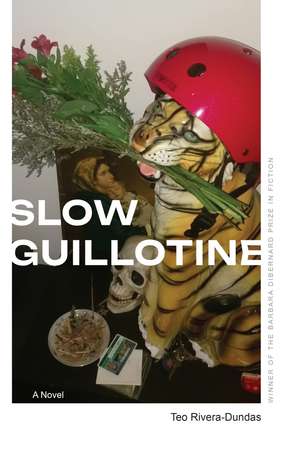
Slow Guillotine: A Novel: Zero Street Fiction
Autor Teo Rivera-Dundasen Limba Engleză Paperback – mar 2026
Slow Guillotine follows three broke weirdos whose collective desire to make and think about art is constantly interrupted by their art-industry-adjacent minimum-wage jobs. Throughout the novel, the three friends’ day jobs in a failing independent bookstore, a sterile gallery in downtown Manhattan, and miscellaneous living rooms across the Long Island birthday-party-clown circuit interweave with their attempts to come to terms with their precarity, gender-dysphoric embodiment, and the floating dream of collective liberation.
Spanning one year and told through an obsessive first-person present tense, Slow Guillotine brings the bildungsroman structure through the autofictional looking glass, questioning how “coming of age” could be feasible in a society of debtors, wage laborers, and renters.




Preț: 120.19 lei
Puncte Express: 180
Carte disponibilă
Livrare economică 09-23 noiembrie
Livrare express 24-30 octombrie pentru 41.73 lei
Livrare prin curier în România Termenul estimat este afișat lângă disponibilitate.
Transport gratuit de la 400.00 lei Plată online sau ramburs, în funcție de opțiunile comenzii.
Retur gratuit în 14 zile Comandă securizată și suport în română.
Specificații
ISBN-13: 9781496247315
ISBN-10: 1496247310
Pagini: 220
Dimensiuni: 140 x 216 mm
Greutate: 0.26 kg
Editura: Nebraska
Colecția University of Nebraska Press
Seria Zero Street Fiction
Locul publicării:United States
ISBN-10: 1496247310
Pagini: 220
Dimensiuni: 140 x 216 mm
Greutate: 0.26 kg
Editura: Nebraska
Colecția University of Nebraska Press
Seria Zero Street Fiction
Locul publicării:United States
Notă biografică
Teo Rivera-Dundas is a writer in western Massachusetts. His work has received support from the Wassaic Project, Anderson Center at Tower View, California Institute of the Arts, and the University of California, San Diego. His writing has appeared in Gulf Coast, Meridian, Tupelo Quarterly, and Desperate Literature’s annual Eleven Stories anthology, among other publications.
Extras
Ten Notes about Work
before We Can Get Started
1.
Here are the types of packing material: bubble wrap, butcher paper
scraps, wiggly cardboard scraps, packing peanuts (blue polystyrene),
packing peanuts (biodegradable thermoplastic starch, a corn derivative,
edible), and weird bone-or meat-cross-section-looking
cardboard chunks. Also there’s the filler Hachette Book Group sends
with their cookbooks, a solid foam in the perfect negative space
shape of whatever was—or wasn’t, I guess—in the box. These are
uncanny, art object-type pieces, basically useless unless you’re prepared
to pack an outgoing shipment the exact size and shape of the
negative space foam. We throw this (nonbiodegradable, immortal)
foam away, and try not to think about it.
Hachette happens to be the least evil of the five big publisher-distributors,
apart from their use of hyperobject packing filler. I
learn this from Dima. HarperCollins is owned by Rupert Murdoch,
Simon and Schuster is Viacom, Penguin Random House is an endlessly
consumptive monopoly blob, and Macmillan Publishing Services
is some inscrutable British company that Dima tells me has
ties to weapons manufacturing. Is this actually true? I don’t know.
2.
I really like books. Ford hired me for the receiving room after I
told him so. I wanted to work the sales floor, as a regular bookseller,
but the back room had an opening and I needed the job. Now
I internalize corporate gossip, shipping and receiving jargon—I
guess knowing all this can become a kind of skill, or hobby, eventually,
too.
3.
Within the packing material, the book. Beyond the receiving room,
the bookstore.
4.
Today, it’s me and Arthur. Arthur is singing.
I grip the tape roller with both hands. He sings, but his voice
has nowhere to land. It rummages through the receiving room and
crashes, flailing, onto the floor. I grip the blue plastic handle of the
tape roller, which is indented at the fingers, with both hands. {~?~:
Repetition of “with both hands” intentional? Or consider cutting
the first sentence and retaining this one.}{~?~: yes, intentional! }
The in-progress box I hold between my legs. My feet I plant on the
floor, knees buckling against the standing desk.
The sound made by the tape roller as it peels over a cardboard
box’s two central flaps. The long pull of plastic, then a rip. Arthur
shelves the returns. Music plays over his singing. The two songs—one
from the speakers above my computer and the other issuing out
of Arthur’s mouth—have, as far as I can tell, decoupled.
I finish the last box and heave it to the top of its pile. When the
next load comes in I’ll slice each box open one at a time, keeping it
down with my legs. And if Arthur is still singing then I will hold
the boxcutter with both hands.
5.
Maybe this is the wrong way to start. I am not actually going to
freak out and attack Arthur with a boxcutter or anything. All I
mean to say is that my attention looks for something to hold onto,
moments like these. Arthur and I share the room. We perform
the same two or three tasks for eight hours at a time, unmediated
by conversation or any mutual interest in one another. I lift fifty-pound
boxes with my back. I take a fifteen-minute break on the
curb and return inside. Such conditions produce either trance or
obsession. Small things expand. It’s a phenomenon I’m tracking,
starting now.
The punch clock, the two computers at their standing desks,
the point-of-sale and inventory software. Last year’s calendar open
to next month.
A system of ropes hugs the receiving room ceiling, keeping a mass
of trash bags loaded with packing material in declining blobs above
us. Every day either I or Arthur or Dima (who’s still out) will fill a
trash bag with packing material from incoming shipments, hoist
the bag into the rope netting zone, and then take it down again a
few hours later, using its packing material to stuff outgoing shipments.
But because we end up collecting more material than we
use, the ceiling is constantly, slowly, lowering.
6.
Ford calls. He needs Arthur downstairs for shelving. “Good,” I say,
and send him down.
Dima is still out. Yesterday he called from Moscow and told me
about a pro-government demonstration that ended in a big roundup
of imported cheese being run over by a tank or a bulldozer or something.
He said this happened right in the central revolutionary
square, people throwing their Western cheese products into a grow-
ing pile, and that it was staged as a spontaneous patriotic thing but
was in fact a minor government operation meant to foment anti-nato
sentiment. I asked him why cheese, but he just described the
way the pile looked after getting steamrolled: flat brie, listen, flat
thin dirty bleu, dirty cheese, but paper cheese . . .
Dima is the one who taught me about certain packing peanuts
being edible. You can also lick them at the ends and stick them
together, and because they’re weightless you can assemble surprisingly
large packing peanut sculptures this way. It’s all cornstarch.
7.
Someone has rolled in the day’s returns using one of the red handcarts
they have out on the sales floor.
Before he left, Dima trained me to file returns. Here’s how it
works: sort every book by distributor, stacking each title on the
shelves labeled prh or ss or whatever, respectively. Vintage is Penguin,
Tor is mps, New Directions is Norton, Coffee House is Perseus,
Anchor is Penguin, Norton is Norton, fsg is mps, Archipelago
is Penguin, Melville House is Penguin, tiny presses are usually spd,
Chicago is Chicago, Columbia is Wiley, Scholastic is Scholastic,
Vintage is Penguin again, Graywolf is mps, Scribner is Simon, Ecco
is Harper, Harper is Harper, Knopf is Penguin, Puffin is Penguin,
Random House is Penguin, Penguin is Penguin.
These, and a few dozen adult coloring books at the bottom of my
handcart. That has to be a mistake—Ford recently implemented a
“buy a coloring book get My Brilliant Friend half off” special that
became so popular he had to discontinue it. People started returning
My Brilliant Friend for full store credit just to turn around and
buy another coloring book, essentially for free.
I draw a question mark on a pink Post-it, slap this to the topmost
coloring book, and stack.
8.
Ford is about to walk into the room and say something. I can feel
it. He’s about to stride his seven-foot-tall leatherette mass in here
and say listen we need to think about how we proceed with X or Y
folks it’s important. He’ll say folks even though he’s talking just to
me. Ford’s green voice and boat shoes. In his office there are two
books about how to build a yacht, up on a shelf twelve feet off the
ground. Do you build them from scratch or what?
Here he comes. The year is 2014, or it’s 2015—it doesn’t matter,
either works. Ford crams his massive face into the room. “Milton is
on his way,” he says. Then he eyes the coloring books on the return
stack and stoops over, rapping them with his enormous knuckles.
“You are not just blithely returning adult coloring books right
now, folks,” he says. “We need to think about how we work. These
should’ve been at the registers yesterday.”
He looks at the return pile, looks at me looking at him, then
looks at the drooping penis statue Dima made out of licked-together
packing peanuts just before he left. “For God’s sake,” Ford says.
9.
An hour or so later the intrastore phone rings: Milton’s here. I tell
Ford to give me Arthur back, and then I pull the convertible hand
truck from under my standing desk and roll it to the elevator. At the
curb, there’s Milton, perched against his double-parked
minivan, smoking. He hands me a cigarette, and a minute later we’re hauling
boxes from his minivan onto the hand truck.
When I first started, Dima explained the Milton situation. Let’s
say you knew a guy, call him Philton, who works at one of the major
book distribution warehouses. Alright. Say every now and again,
maybe every three weeks, a pallet of boxes of books fell off this guy’s
truck. Well, the distributor who owns the warehouse—especially
a distributor major enough to have multiple warehouses, shipping,
say, global quantities of science fiction trade paperbacks—well,
they barely notice when stock goes missing, or so says Milton, or so says
Ford, according to Dima. And if a couple hundred sci-fi
paperbacks with titles like Perihelion Uprising and Ninth Fae: A Gereon Ëxter
Novel end up in our return pool, then, well, such an enormous distributor
would happily pay us to have these back, this kind of thing
happens all the time, and if we make a few thousand dollars on the
side returning inventory we never had to buy in the first place, great.
By we, of course, I mean the store. Milton gets his cut.
It’s the least he can do to share his shitty Camels with me as we
lift fifty-pound boxes, one after the other, onto a small mountain
on the hand truck.
When we finish, Milton asks if I’ve met any special ladies in the
Big Apple. I tell him I have, and that I am in love. Then Milton
does a thing where he looks at me, adjusts his crotch, says alright
then boss, and drives away.
10.
By the time I’ve wheeled the boxes past the front registers—past
New Releases and milling customers side-eyeing tote bags, into a
three-point reversal to fit diagonally in the elevator, up the elevator,
past the second floor information desk and buyback booth, past
Middle Readers and Young Adult, and into the receiving room—by
the time this is done, Arthur has cleared an area for me by the
standing desks and waits with his arms out for the boxes. I heave
them at him, lifting with my back. He catches and stacks.
I plant my feet on the floor and flick open a boxcutter, keeping
the first box in place with my legs as I slice it open. The bubble wrap
I tear from the box and stuff into an in-progress trash bag, which
quickly fills. I toss the bag to Arthur, who hoists it into the netting
zone above us. The ceiling lowers. Each book has to be individually
scanned into the point-of-sale and inventory software, which,
because these are Milton-ass sci-fi trade paperbacks, the majority
of them don’t show up in the store’s system and we have to do data
input manually. The process takes forever and is why, before he
left to visit his dad in Moscow, Dima changed the receiving room
computers’ passwords to fuckmilton. I boot mine up and put on
the song of the summer, which is twenty minutes long and will
forever represent my moving to the Big Apple and falling in love.
Arthur, who has never heard this song in his life, begins to sing.
Alright then boss. We scan. With everything scanned in, we start
the return, which is going to Macmillan Publishing Services. We
launder the stolen sci-fi with actual stock from the return shelves.
Minotaur is mps, Forge is mps, Picador is mps, Starscape is mps,
Graywolf is mps, Tor is mps. Arthur, neck jutting back and forth
with the music, pulls a trash bag down from the ceiling and tears
out a long bunch of butcher paper. I fill a box, holding it in place
with my legs, and Arthur stuffs its negative space with paper. A
good box you should be able to stand on no problem, no bowing
with your weight or anything like that. I tape the box shut using
the tape roller, which is blue plastic, indented at the fingers, a perfect
negative space shape for the thin layer of skin holding back my
blood, and which I hold with both hands.
before We Can Get Started
1.
Here are the types of packing material: bubble wrap, butcher paper
scraps, wiggly cardboard scraps, packing peanuts (blue polystyrene),
packing peanuts (biodegradable thermoplastic starch, a corn derivative,
edible), and weird bone-or meat-cross-section-looking
cardboard chunks. Also there’s the filler Hachette Book Group sends
with their cookbooks, a solid foam in the perfect negative space
shape of whatever was—or wasn’t, I guess—in the box. These are
uncanny, art object-type pieces, basically useless unless you’re prepared
to pack an outgoing shipment the exact size and shape of the
negative space foam. We throw this (nonbiodegradable, immortal)
foam away, and try not to think about it.
Hachette happens to be the least evil of the five big publisher-distributors,
apart from their use of hyperobject packing filler. I
learn this from Dima. HarperCollins is owned by Rupert Murdoch,
Simon and Schuster is Viacom, Penguin Random House is an endlessly
consumptive monopoly blob, and Macmillan Publishing Services
is some inscrutable British company that Dima tells me has
ties to weapons manufacturing. Is this actually true? I don’t know.
2.
I really like books. Ford hired me for the receiving room after I
told him so. I wanted to work the sales floor, as a regular bookseller,
but the back room had an opening and I needed the job. Now
I internalize corporate gossip, shipping and receiving jargon—I
guess knowing all this can become a kind of skill, or hobby, eventually,
too.
3.
Within the packing material, the book. Beyond the receiving room,
the bookstore.
4.
Today, it’s me and Arthur. Arthur is singing.
I grip the tape roller with both hands. He sings, but his voice
has nowhere to land. It rummages through the receiving room and
crashes, flailing, onto the floor. I grip the blue plastic handle of the
tape roller, which is indented at the fingers, with both hands. {~?~:
Repetition of “with both hands” intentional? Or consider cutting
the first sentence and retaining this one.}{~?~: yes, intentional! }
The in-progress box I hold between my legs. My feet I plant on the
floor, knees buckling against the standing desk.
The sound made by the tape roller as it peels over a cardboard
box’s two central flaps. The long pull of plastic, then a rip. Arthur
shelves the returns. Music plays over his singing. The two songs—one
from the speakers above my computer and the other issuing out
of Arthur’s mouth—have, as far as I can tell, decoupled.
I finish the last box and heave it to the top of its pile. When the
next load comes in I’ll slice each box open one at a time, keeping it
down with my legs. And if Arthur is still singing then I will hold
the boxcutter with both hands.
5.
Maybe this is the wrong way to start. I am not actually going to
freak out and attack Arthur with a boxcutter or anything. All I
mean to say is that my attention looks for something to hold onto,
moments like these. Arthur and I share the room. We perform
the same two or three tasks for eight hours at a time, unmediated
by conversation or any mutual interest in one another. I lift fifty-pound
boxes with my back. I take a fifteen-minute break on the
curb and return inside. Such conditions produce either trance or
obsession. Small things expand. It’s a phenomenon I’m tracking,
starting now.
The punch clock, the two computers at their standing desks,
the point-of-sale and inventory software. Last year’s calendar open
to next month.
A system of ropes hugs the receiving room ceiling, keeping a mass
of trash bags loaded with packing material in declining blobs above
us. Every day either I or Arthur or Dima (who’s still out) will fill a
trash bag with packing material from incoming shipments, hoist
the bag into the rope netting zone, and then take it down again a
few hours later, using its packing material to stuff outgoing shipments.
But because we end up collecting more material than we
use, the ceiling is constantly, slowly, lowering.
6.
Ford calls. He needs Arthur downstairs for shelving. “Good,” I say,
and send him down.
Dima is still out. Yesterday he called from Moscow and told me
about a pro-government demonstration that ended in a big roundup
of imported cheese being run over by a tank or a bulldozer or something.
He said this happened right in the central revolutionary
square, people throwing their Western cheese products into a grow-
ing pile, and that it was staged as a spontaneous patriotic thing but
was in fact a minor government operation meant to foment anti-nato
sentiment. I asked him why cheese, but he just described the
way the pile looked after getting steamrolled: flat brie, listen, flat
thin dirty bleu, dirty cheese, but paper cheese . . .
Dima is the one who taught me about certain packing peanuts
being edible. You can also lick them at the ends and stick them
together, and because they’re weightless you can assemble surprisingly
large packing peanut sculptures this way. It’s all cornstarch.
7.
Someone has rolled in the day’s returns using one of the red handcarts
they have out on the sales floor.
Before he left, Dima trained me to file returns. Here’s how it
works: sort every book by distributor, stacking each title on the
shelves labeled prh or ss or whatever, respectively. Vintage is Penguin,
Tor is mps, New Directions is Norton, Coffee House is Perseus,
Anchor is Penguin, Norton is Norton, fsg is mps, Archipelago
is Penguin, Melville House is Penguin, tiny presses are usually spd,
Chicago is Chicago, Columbia is Wiley, Scholastic is Scholastic,
Vintage is Penguin again, Graywolf is mps, Scribner is Simon, Ecco
is Harper, Harper is Harper, Knopf is Penguin, Puffin is Penguin,
Random House is Penguin, Penguin is Penguin.
These, and a few dozen adult coloring books at the bottom of my
handcart. That has to be a mistake—Ford recently implemented a
“buy a coloring book get My Brilliant Friend half off” special that
became so popular he had to discontinue it. People started returning
My Brilliant Friend for full store credit just to turn around and
buy another coloring book, essentially for free.
I draw a question mark on a pink Post-it, slap this to the topmost
coloring book, and stack.
8.
Ford is about to walk into the room and say something. I can feel
it. He’s about to stride his seven-foot-tall leatherette mass in here
and say listen we need to think about how we proceed with X or Y
folks it’s important. He’ll say folks even though he’s talking just to
me. Ford’s green voice and boat shoes. In his office there are two
books about how to build a yacht, up on a shelf twelve feet off the
ground. Do you build them from scratch or what?
Here he comes. The year is 2014, or it’s 2015—it doesn’t matter,
either works. Ford crams his massive face into the room. “Milton is
on his way,” he says. Then he eyes the coloring books on the return
stack and stoops over, rapping them with his enormous knuckles.
“You are not just blithely returning adult coloring books right
now, folks,” he says. “We need to think about how we work. These
should’ve been at the registers yesterday.”
He looks at the return pile, looks at me looking at him, then
looks at the drooping penis statue Dima made out of licked-together
packing peanuts just before he left. “For God’s sake,” Ford says.
9.
An hour or so later the intrastore phone rings: Milton’s here. I tell
Ford to give me Arthur back, and then I pull the convertible hand
truck from under my standing desk and roll it to the elevator. At the
curb, there’s Milton, perched against his double-parked
minivan, smoking. He hands me a cigarette, and a minute later we’re hauling
boxes from his minivan onto the hand truck.
When I first started, Dima explained the Milton situation. Let’s
say you knew a guy, call him Philton, who works at one of the major
book distribution warehouses. Alright. Say every now and again,
maybe every three weeks, a pallet of boxes of books fell off this guy’s
truck. Well, the distributor who owns the warehouse—especially
a distributor major enough to have multiple warehouses, shipping,
say, global quantities of science fiction trade paperbacks—well,
they barely notice when stock goes missing, or so says Milton, or so says
Ford, according to Dima. And if a couple hundred sci-fi
paperbacks with titles like Perihelion Uprising and Ninth Fae: A Gereon Ëxter
Novel end up in our return pool, then, well, such an enormous distributor
would happily pay us to have these back, this kind of thing
happens all the time, and if we make a few thousand dollars on the
side returning inventory we never had to buy in the first place, great.
By we, of course, I mean the store. Milton gets his cut.
It’s the least he can do to share his shitty Camels with me as we
lift fifty-pound boxes, one after the other, onto a small mountain
on the hand truck.
When we finish, Milton asks if I’ve met any special ladies in the
Big Apple. I tell him I have, and that I am in love. Then Milton
does a thing where he looks at me, adjusts his crotch, says alright
then boss, and drives away.
10.
By the time I’ve wheeled the boxes past the front registers—past
New Releases and milling customers side-eyeing tote bags, into a
three-point reversal to fit diagonally in the elevator, up the elevator,
past the second floor information desk and buyback booth, past
Middle Readers and Young Adult, and into the receiving room—by
the time this is done, Arthur has cleared an area for me by the
standing desks and waits with his arms out for the boxes. I heave
them at him, lifting with my back. He catches and stacks.
I plant my feet on the floor and flick open a boxcutter, keeping
the first box in place with my legs as I slice it open. The bubble wrap
I tear from the box and stuff into an in-progress trash bag, which
quickly fills. I toss the bag to Arthur, who hoists it into the netting
zone above us. The ceiling lowers. Each book has to be individually
scanned into the point-of-sale and inventory software, which,
because these are Milton-ass sci-fi trade paperbacks, the majority
of them don’t show up in the store’s system and we have to do data
input manually. The process takes forever and is why, before he
left to visit his dad in Moscow, Dima changed the receiving room
computers’ passwords to fuckmilton. I boot mine up and put on
the song of the summer, which is twenty minutes long and will
forever represent my moving to the Big Apple and falling in love.
Arthur, who has never heard this song in his life, begins to sing.
Alright then boss. We scan. With everything scanned in, we start
the return, which is going to Macmillan Publishing Services. We
launder the stolen sci-fi with actual stock from the return shelves.
Minotaur is mps, Forge is mps, Picador is mps, Starscape is mps,
Graywolf is mps, Tor is mps. Arthur, neck jutting back and forth
with the music, pulls a trash bag down from the ceiling and tears
out a long bunch of butcher paper. I fill a box, holding it in place
with my legs, and Arthur stuffs its negative space with paper. A
good box you should be able to stand on no problem, no bowing
with your weight or anything like that. I tape the box shut using
the tape roller, which is blue plastic, indented at the fingers, a perfect
negative space shape for the thin layer of skin holding back my
blood, and which I hold with both hands.
Cuprins
Ten Notes About Work Before We Can Get Started
Another Note (To the Reader)
In the Summer We Are Inside Preparing Food
A Snake Appearing in Dreams
I Have Yet to Develop a Skincare Routine
Ten More Notes About Work
Still Winter
Look How Badly It Wants to Live
Weeks Not Months
Final Ten Notes About Work
Acknowledgments
Another Note (To the Reader)
In the Summer We Are Inside Preparing Food
A Snake Appearing in Dreams
I Have Yet to Develop a Skincare Routine
Ten More Notes About Work
Still Winter
Look How Badly It Wants to Live
Weeks Not Months
Final Ten Notes About Work
Acknowledgments
Recenzii
"Throughout the book, we are reminded again and again that 'adjacent' doesn’t mean 'parallel.' Adjacence means intersection is possible, centering oneself is possible, movement is possible, if one decides to act. But the agency of Slow Guillotine isn’t commanding. It shows up quietly, almost practically. Our characters stop paying their rent, they celebrate birthdays, make art that won’t hang in galleries, cook for each other, take trips outside the city, these tiny rebellions that, even if just for a moment, trip the system and center themselves."—Chelsea C. Jackson, Maine Review
“Slow Guillotine’s subversive, heat-seeking pulse is defiantly pro-ennui, embracing projectile vomit and the thing we want most besides love, that is—language at the very edge, and the shedding of our perpetually too-snug skins.”—Jess Arndt, author of Large Animals: Stories
“An incisive, fluid, and absurdly funny portrait of both the bookselling industry and of what it’s like to try to piece a life together in Manhattan while young(ish) and poor. Whether talking about book-return scams, clowns, social media, cooking, the awfulness of searching for an apartment, tattooing, or pop-ups, Slow Guillotine is sharply observant as it eviscerates the movie myth of New York and replaces it with something less romantic but much more real, current, and painfully hilarious.”—Brian Evenson, author of Song for the Unraveling of the World
“Teo Rivera-Dundas makes the banal shine brilliantly—because when you’re young and in New York, geared with friendship, queerness, and art, even the most mundane trivialities can turn into bold misadventures. Slow Guillotine is a tender, slithering threat: hope hovering, ready to strike.”—Lily Hoang, author of A Bestiary
“Slow Guillotine’s subversive, heat-seeking pulse is defiantly pro-ennui, embracing projectile vomit and the thing we want most besides love, that is—language at the very edge, and the shedding of our perpetually too-snug skins.”—Jess Arndt, author of Large Animals: Stories
“An incisive, fluid, and absurdly funny portrait of both the bookselling industry and of what it’s like to try to piece a life together in Manhattan while young(ish) and poor. Whether talking about book-return scams, clowns, social media, cooking, the awfulness of searching for an apartment, tattooing, or pop-ups, Slow Guillotine is sharply observant as it eviscerates the movie myth of New York and replaces it with something less romantic but much more real, current, and painfully hilarious.”—Brian Evenson, author of Song for the Unraveling of the World
“Teo Rivera-Dundas makes the banal shine brilliantly—because when you’re young and in New York, geared with friendship, queerness, and art, even the most mundane trivialities can turn into bold misadventures. Slow Guillotine is a tender, slithering threat: hope hovering, ready to strike.”—Lily Hoang, author of A Bestiary
Descriere
Using humor and thoughtful poetics to examine the impact structural violence takes on the body, Slow Guillotine follows three broke weirdos whose collective desire to make and think about art is constantly interrupted by their art-industry-adjacent minimum-wage jobs.