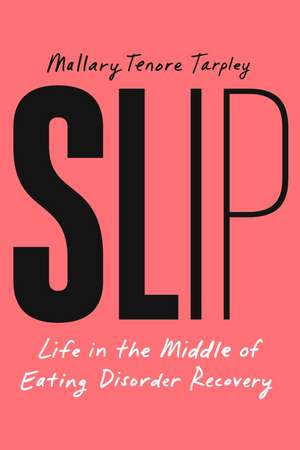
Slip
Autor Mallary Tenore Tarpleyen Limba Engleză Hardback – 5 aug 2025
Written by journalist and professor at the University of Texas-Austin Mallary Tenore Tarpley, Slip offers a groundbreaking framework for understanding eating disorder recovery and interweaves poignant personal stories, immersive reporting, and cutting-edge science.
When Mallary Tenore Tarpley lost her mother at eleven years old, she wanted to stop time. If growing up meant living without her mother, then she wanted to stay little forever. What started as small acts of food restriction soon turned into a full-blown eating disorder, and a year later, Tarpley was admitted to Boston’s Children’s Hospital. With honesty and grace, Slip chronicles Tarpley’s childhood struggles with anorexia to her present-day experiences grappling with recovery.
This book tells Tarpley’s story, but it also transcends her personal narrative. A journalist by trade, Tarpley interviewed and surveyed hundreds of patients, doctors, and researchers to provide a deeper understanding of eating disorder treatment. She draws on this original reporting, as well as cutting-edge science, to illuminate what has changed in the years since she was first diagnosed.
As Tarpley came to learn, “full recovery” from an eating disorder is complicated. And that idea provides the basis for the groundbreaking new framework explored in this book: that there is a “middle place” between sickness and full recovery, a place where slips are accepted as part of the process but progress is always possible.
With new insights and an uplifting message, Slip brings much-needed attention to an issue that affects many. It offers a beacon of hope with its revolutionary perspective on recovery. This inspiring and life-affirming book is a must-read for individuals with eating disorders, their loved ones, educators, medical professionals, and anyone seeking to understand eating disorders and the path to recovery.
| Toate formatele și edițiile | Preț | Express |
|---|---|---|
| Paperback (1) | 54.56 lei Precomandă | |
| S&S/Simon Element – 11 aug 2026 | 54.56 lei Precomandă | |
| Hardback (1) | 106.54 lei 24-36 zile | +55.19 lei 4-10 zile |
| S&S/Simon Element – 5 aug 2025 | 106.54 lei 24-36 zile | +55.19 lei 4-10 zile |
Preț: 106.54 lei
Preț vechi: 138.47 lei
-23% Recomandat
18.86€ • 21.91$ • 16.34£
Carte disponibilă
Livrare economică 13-25 februarie
Livrare express 24-30 ianuarie pentru 65.18 lei
Specificații
ISBN-10: 1668035014
Pagini: 368
Dimensiuni: 154 x 232 x 37 mm
Greutate: 0.52 kg
Editura: S&S/Simon Element
V-ar putea interesa
-
 Good GirlsHadley FreemanPreț: 95.97 lei
 -
 Life Without EdJenni Schaefer-13%Preț: 88.94 lei102.55 lei
 -
 -14%Preț: 88.05 lei102.01 lei
 -
 8 Keys to Recovery from an Eating DisorderCarolyn CostinPreț: 150.95 lei
 -
 8 Keys to Recovery from an Eating Disorder WorkbookCarolyn CostinPreț: 161.82 lei
 -
 -29%Preț: 53.39 lei74.75 lei
 -
 Inner HarvestElisabeth L.-21%Preț: 95.68 lei121.87 lei
 -
 Preț: 104.17 lei
 -
 I Haven't Been Entirely Honest with YouMiranda HartPreț: 76.46 lei
 -
 The Reading Cure: How Books Restored My AppetiteLaura Freeman-27%Preț: 50.16 lei68.92 lei
 -
 The Joy of SnackingHillary Fitzgerald Campbell-21%Preț: 112.88 lei142.29 leiRecomandat
 -
 My Perfectly Imperfect BodyDebbie Tung-23%Preț: 80.94 lei104.45 leiRecomandat
 -
 Identity Theft, Second Edition: Rediscovering Ourselves After StrokeDebra E. Meyerson-21%Preț: 89.10 lei113.10 leiRecomandat
 -
 -22%Preț: 88.76 lei113.54 lei
 -
 To Exist As I Am: A Doctor's Notes on Recovery and Radical AcceptanceGrace Spence Green-25%Preț: 87.86 lei116.38 lei
 -
 -22%Preț: 102.14 lei130.85 lei
 -
 -22%Preț: 115.75 lei148.32 lei
 -
 -25%Preț: 98.29 lei131.65 lei
 -
 -21%Preț: 118.46 lei149.95 lei
 -
 -21%Preț: 59.15 lei74.88 lei
Notă biografică
Mallary Tenore Tarpley is a journalism and writing professor at the University of Texas at Austin’s Moody College of Communication and McCombs School of Business. Her writing has appeared in The New York Times, The Washington Post, Los Angeles Times, and The Dallas Morning News, among other publications. She is the recipient of a prestigious Alfred P. Sloan Foundation grant, which helped support her research and writing. Mallary graduated from Providence College and has a master’s of fine arts in nonfiction writing from Goucher College. She lives outside of Austin, Texas, with her husband and two children. Slip is her first book.
Extras
I was twelve when I developed anorexia nervosa, less than one year after my mother died of metastatic breast cancer. After years of treatment I got better, but not all better. I spent my early adulthood hoping the day would arrive when I would feel as though I had achieved the fullest expression of recovery. The truth is, though, that day hasn’t arrived. I’m further along than I ever thought I would be, but my disorder isn’t gone.
My recovery has been messy and maddening, and it is not redemptive in the ways our society hopes illness narratives will be. On one end of the spectrum of how we talk about this disease, there is sickness. On the other, full recovery. I live my life in the in-between, in what I’ve come to call the middle place. It’s the liminal space that many of us inhabit as we work our way toward wellness. And it’s an alternative to black-and-white thinking that bifurcates the world into two halves without exploring the beauty in between. In the middle place, hope and hardship coexist, slips are expected, and progress is possible.
As I’ve moved through the middle place, people have asked: What helped you get better? It’s a difficult question to answer. It took me years to realize that I had to work toward recovery first and foremost for myself. Intrinsic motivation is an important part of the process, and studies show that it can yield more positive outcomes. But I couldn’t do it by myself. No one can. I needed a team of people helping me, step by step, to get to where I am today. I was lucky to have the support of family and medical providers who cared for me and treated me over the course of five hospitalizations and a year and a half of residential treatment. It was only after getting help that I was able to begin the recovery process.
Recovery, I learned, is not a return to who you once were so much as a retrieval of all you lost while you were sick: pleasure, possibility, some semblance of peace. It requires a ruthless commitment to hard work. It’s an accumulation of slow steps, with an acceptance that some steps will lead to slips. And it’s a promise that you’ll be honest about the slips, knowing they are an inevitable part of progress. You can’t slip, after all, if you’re standing still. As you move forward, you may or may not reach full recovery, but you emerge as someone who can lead a fuller life.
Slip isn’t a tidy narrative about defeating my disorder but, rather, an intimate look at what it means to live with its imprints. By framing this book around the middle place, I hope to show what it takes to engage with the world even as I traverse the space between sickness and full recovery. I don’t mean to suggest that full recovery is not possible; for many people, it is. Nor do I want to imply that people in the middle place aren’t trying hard enough or are somehow settling. Living in the middle place isn’t about giving up on full recovery; it’s about viewing recovery as an ongoing process rather than a final destination.
To better understand my own story as a woman in the middle place, I poured through old therapy workbooks and medical records. I read the hundreds of journal entries I wrote while in treatment, and I interviewed former staffers and patients to corroborate my memory. I traveled back to the places where I was treated, where I relapsed, and where I got better. While resurfacing painful memories, it sometimes felt like I was climbing an emotional Mount Everest. I ascended with caution as I taught myself how to revisit my past without getting lost in it. Along the way, I arrived at a telling truth: it’s hard to be sick, but it’s even harder to fully recover.
When it comes to eating disorders, “full recovery” is complicated. Clinicians have varying thoughts on what it means, and those with lived experience are often left to grapple with the elusiveness of a term that has not been adequately defined. The middle place provides a framework that is more inclusive of people who don’t see themselves as fully recovered. Some people in the middle place meet all the BMI and body-weight criteria associated with someone who’s fully recovered, but they may still have distorted thoughts that dictate their choices regarding food and exercise. Some of us struggle silently, fearful of sharing our stories and ashamed that we aren’t “all better.” It’s easier to keep our secrets hidden if we don’t fit the stereotypical mold of someone with an eating disorder.
I’ve written this book with an awareness that people of all different sizes, races, ethnicities, genders, ages, and socioeconomic statuses can struggle with eating disorders, and with a deep sensitivity to the fact that many people are overlooked or denied treatment because they don’t match the stereotype. I am also sensitive to the fact that some of the childhood thoughts and writings I share may come across as fatphobic. I have spent my adult years trying to unlearn diet culture’s harmful anti-fat messages. I recognize the damage that weight stigma and discrimination have caused, and I believe diet culture hurts everyone.
Slip follows my own story, but it is not my story alone. The book features diverse perspectives from others with lived experience and from clinicians and researchers who have helped broaden my scope of understanding about eating disorders, the treatment of them, and recovery from them. As part of my reporting, I spoke with dozens of experts who are quoted throughout the book. I also created a survey that I shared with communities of recovered individuals, eating disorder support and recovery groups on social media, clinicians, and treatment centers. Respondents were asked to consider a variety of topics, including the factors that contributed to their eating disorder; whether they ever received treatment (and if they considered it effective); and the biggest obstacles they faced while working toward recovery. I also introduced respondents to the concept of the middle place, knowing that I wanted to explore the recovery process through this frame. The survey ultimately reached 718 people from forty-four states and thirty-seven countries. About 71 percent of respondents indicated they were still struggling with an eating disorder, while the remaining 29 percent said they were fully recovered or in recovery. Of all respondents, 85 percent said they’ve been in the middle place.
To expand my understanding of this in-between space, I interviewed nearly 170 survey respondents, clinicians, and researchers. My interviews were conducted between 2021 and 2024, so some details from people’s personal stories may have naturally changed since then. In some cases, I have used first-name pseudonyms for sources who were willing to share their stories with me but did not want to do so publicly. In other cases, I left out details from people’s stories (and my own) when I thought they would be too triggering for readers. It is a tricky balancing act as a writer—to reveal the hard truths of one’s personal narrative and to determine which details are better left unsaid. It is an even trickier one when you’re telling another’s narrative. Whenever interviewing people with lived experience, I asked them each the same question: How would you like me to describe where you’re at in your recovery process? I want to honor the language we each use, however far along we may be. And I hope that by naming the middle place, I can help people put words to this prevalent but often overlooked part of recovery.
This book is for my fellow travelers in the middle place. It’s also for people on either end of the spectrum—those who are acutely sick and those who consider themselves to be fully recovered. I hope this book will arrive like a knowing friend to families dealing with the ravages of eating disorders and that it will be of service to medical providers, educators, legislators, and others who want to deepen their understanding of how and why eating disorders take shape and what it takes to recover.
The story that follows marries memoir and journalism. Each chapter starts with my own story, told from the perspective of my younger self. That opens to my writing from my present-day self as a daughter, mother, wife, professor, and journalist living in the middle place, with stories and insights from others woven in. This structure, with its mix of narrative, research, and reflection, has enabled me to write intimately about my past and then examine all that has changed in the eating-disorder field in the twenty-five years since I was in treatment—and all the work that remains to be done.
Recenzii
"Her uplifting story should raise awareness about eating disorders, reduce stigma, and help survivors and their families stay hopeful." –Booklist
"For readers who have struggled with disordered eating or for the friends and family who support them, this book will be a welcome balm, reminding them that recovery is not always linear, and that’s okay." –Library Journal
“In Slip, Mallary Tenore Tarpley carves out a "middle place" between acute sickness and full recovery for those of us with eating disorders. Tarpley is the perfect guide for this conversation, as she seamlessly blends memoir, reportage, and research. At all times, Slip remains accessible, realistic, and hopeful about the messy and maddening process of recovering from disordered eating. This tremendous book will comfort, inspire, and educate readers. We are lucky that it exists.” – Christie Tate, New York Times bestselling author of Group
“This is a must-read for anyone affected by the devastation of an eating disorder. Those who have suffered themselves will find a redemptive narrative to guide their recovery. Loved ones will understand more about how to support recovery without expecting perfection. And clinicians, educators, activists, and policy makers may decide their narrative should be less about eradicating eating disorders and more about elucidating them. We need to make space in the middle, in the shadows, where recovery becomes possible, just as Tarpley has shown us.” – Margo Maine, PhD, clinical psychologist and author
“There is no single image of eating disorders in the United States, but so often, we think about eating disorders as a linear journey with a neat and happy ending. Mallary Tenore Tarpley beautifully disrupts this narrative with Slip, an erudite memoir that moves us into a new generation in which we’re not defined by our disorders. It’s an essential addition to a canon of memoirs that shift paradigms and push us toward a new idea of what it means to recover and to fully, completely live.” – Evette Dionne, author of Weightless: Making Space for My Resilient Body and Soul
“Slip is a gorgeous, paradigm-smashing book that explores the liminal space between sickness and health where so many of us live. Blending memoir and reportage, Slip defies tidy narratives to show us we are not alone when we struggle, when we strive to get better, when we slip.” – Emi Nietfeld, author of Acceptance
Descriere
From journalist and professor at University of Texas-Austin, SLIP presents a revelatory new framework to understand the experience of eating disorder recovery by weaving together moving personal narrative, immersive reporting, and emerging science.