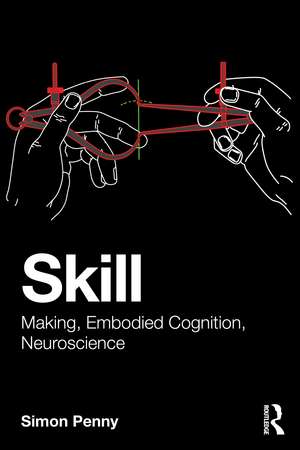
Skill: Making, Embodied Cognition, Neuroscience
Autor Simon Pennyen Limba Engleză Paperback – 28 dec 2026
The book begins with a philosophical historiography revealing the culturally contingent and historically constructed nature of conventional philosophical ideas of skill - Cartesian dualism, notions of mind, consciousness, cognition, and mental capacities. It then uses contemporary neuroscience and cognitive anthropology to develop an alternative: a holistic, non-dualist understanding of cognition that places skilled bodily practice at its center. Armed with this theorisation of skill, an exploration of artisanal and other skilled practice is pursued, drawing upon situated, distributed, embodied and enactive approaches to cognition which focus on the role of tools, structured spaces and cognitive ecologies. This leads into a discussion of pedagogies for skilled practices and the place of skilled practices in broader pedagogical contexts. Finally, it applies this framework to digital environments and artificial intelligence, questioning dominant narratives about cognition and technology.
Grounded in a lifetime of embodied practice and interdisciplinary inquiry, this work introduces the concept of neurophysiological holism and offers a new way of understanding skill. It is a must read for students and researchers from all backgrounds interested in expanding their knowledge of embodied approaches to cognition.
Preț: 357.92 lei
Preț vechi: 449.28 lei
-20% Precomandă
Puncte Express: 537
Carte nepublicată încă
Livrare prin curier în România Precomanda se expediază când titlul devine disponibil.
Transport gratuit de la 400.00 lei Plată online sau ramburs, în funcție de opțiunile comenzii.
Retur gratuit în 14 zile Comandă securizată și suport în română.
Doresc să fiu notificat când acest titlu va fi disponibil:
Se trimite...
Specificații
ISBN-13: 9781041283577
ISBN-10: 1041283571
Pagini: 404
Ilustrații: 42
Dimensiuni: 156 x 234 mm
Ediția:1
Editura: Taylor & Francis
Colecția Routledge
Locul publicării:Oxford, United Kingdom
ISBN-10: 1041283571
Pagini: 404
Ilustrații: 42
Dimensiuni: 156 x 234 mm
Ediția:1
Editura: Taylor & Francis
Colecția Routledge
Locul publicării:Oxford, United Kingdom
Public țintă
Postgraduate and Undergraduate AdvancedNotă biografică
Simon Penny trained as a sculptor in Australia. He was Professor of Robotic Art at Carnegie Mellon through the 1990s, where he worked in custom robotic art and interactive installation. He published Making Sense: Cognition, Computing, Art and Embodiment with MIT Press in 2017. He is professor of Art, Music and Informatics at University of California Irvine.
Cuprins
Introduction. Section 1. 1. The Enlightenment: Descartes and His Times. 2. Dualisms. 3. How to Lose Your Mind. 4. Consciousness, Awareness, and Lived Experience. 5. Mental Representation. 6. Cartesianism, Cognitivism, and (Digital) Computing. 7. Postcognitivism: Biological and Sociological Refutations of Mentalism. 8. Skill and the Academy. 9. Skill and Intelligence, Theoretical and Practical Knowledge. Section 2. 10. Brains and Bodies: Phylogenetic and Bioenergetic Perspectives. 11. Paleocognition. 12. Proprioception: The Sense That Makes the Other Senses Make Sense. 13. The Fascinations of Fascia. 14. Neural Prediction and Bioenergetics. 15. Neuroplasticity, Spinal Learning, and Embodied Simulation. 16. Aphantasia and Mental Rehearsal. 17. Learning and Teaching Skills. 18. Memory, Knowledge, Awareness. 19. Manifesto for a Holistic Neurophysiology. Section 3. 20. Putting Mind, Body, and World Back Together Again, Again. 21. The Incorporation of Tools: Proprioceptive Prosthetic Extension. 22. Cognitive Ecologies and Structured Spaces: Making in the Atelier, the Studio, the Workshop, the Lab. 23. Contingent Representations: Working Drawings and Witness Marks. 24. Creativity, Hylomorphism, and the Dance of Agency. 25. The Place of Artisanal Knowledge in Western History. 26. Traditional Indigenous Pacific Boatbuilding, Seafaring, and Navigation. 27. Skill and Machine Tools: The Sooty Stepchild Thesis. 28. Cognitive Ecologies on the Shop Floor. Section 4. 29. Skill and Digital Cultures. 30. Neurophysiological Holism and Digital Interaction. 31. Why Interfaces Make Sense. 32. In Screenspace: Interacting with Lively Models. 33. Learning on Screen and Knowing the World. 34. Computing, STEM, and Neoliberal Educational Policy: A Perfect Storm. 35. AI – a neurophysiologically holistic rejoinder. References.
Descriere
This book challenges the conventional binary skill vs intelligence and seeks to revalue skill as part of cognition. It seeks an explanation of skill that is experientially, philosophically, and scientifically satisfactory, arguing that skill is a form of intelligence rooted in embodied, sensorimotor experience rather than mental processes.