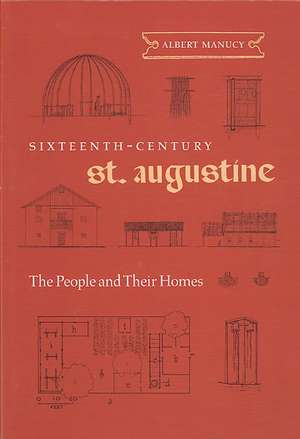
Sixteenth-Century St. Augustine
Autor Albert Manucyen Limba Engleză Paperback – 12 feb 1997
" The] first and only comprehensive historical and anthropological synthesis of America s first European colony . . . and a great story. There are very few scholars who can achieve this kind of precisely accurate, broadly synthetic, and wonderfully readable book."--Kathleen Deagan, curator of anthropology, Florida Museum of Natural History, Gainesville
In this companion volume to "TheHouses of St. Augustine, 1565 to 1821," Albert Manucy goes back in time to detail the first years of St. Augustine s settlement, from 1565 to 1700. Focusing on how the first Spanish colonists lived, Manucy describes the buildings and backyards of the early settlers and illustrates how the architecture of the Timucua Indians of Florida influenced Spanish colonial culture.
Though the description of early St. Augustine is necessarily hypothetical, since all of the early structures were burned by Sir Thomas Moore in 1702, Manucy incorporates a broad range of scholarship in architecture, art, history, and ethnohistory to establish a provocative, convincing, and fascinating model of early colonial life. For years the leading architectural interpreter of St. Augustine and formerly a historian of the Castillo de San Marcos, a Fulbright scholar in Spain, and a member of the St. Augustine 1580 research team, Albert Manucy combines his expertise with a true gift for story telling.
Richly illustrated and straightforwardly narrated, "Sixteenth-Century St. Augustine" will appeal to anyone interested in Florida history, particularly in the early Spanish settlers of St. Augustine and the Timucuan Indians. It will also prove an invaluable resource for archaeologists, architects, enthnohistorians, museum curators, and scholars of Spanish colonial history."
Preț: 177.56 lei
Puncte Express: 266
Carte tipărită la comandă
Livrare economică 17 noiembrie-01 decembrie
Livrare prin curier în România Termenul estimat este afișat lângă disponibilitate.
Transport gratuit de la 400.00 lei Plată online sau ramburs, în funcție de opțiunile comenzii.
Retur gratuit în 14 zile Comandă securizată și suport în română.
Specificații
ISBN-13: 9780813032764
ISBN-10: 0813032768
Pagini: 178
Dimensiuni: 152 x 229 x 10 mm
Greutate: 0.28 kg
Editura: University Press of Florida
ISBN-10: 0813032768
Pagini: 178
Dimensiuni: 152 x 229 x 10 mm
Greutate: 0.28 kg
Editura: University Press of Florida
V-ar putea interesa
-
 A World on FireAmanda ForemanPreț: 159.71 lei
 -
 Preț: 459.65 lei
 -
 RatificationPauline MaierPreț: 144.44 lei
 -
 Hellhound on his TrailHampton Sides-29%Preț: 76.30 lei106.74 lei
 -
 Slavery in FloridaLarry Eugene RiversPreț: 161.80 lei
 -
 Communists and Perverts Under the PalmsStacy BraukmanPreț: 164.80 lei
 -
 La FloridaViviana Díaz Balsera-15%Preț: 483.34 lei568.63 lei
 -
 Tropic of HopesHenry KnightPreț: 181.68 lei
 -
 Everything You Were Taught about the Civil War Is Wrong, Ask a Southerner!Lochlainn SeabrookPreț: 134.49 lei
 -
 Angel in the WhirlwindBenson BobrickPreț: 207.23 lei
 -
 Howard Zinn on HistoryHoward Zinn-6%Preț: 79.48 lei85.00 lei
 -
 9-11: 10th Anniversary EditionNoam Chomsky-20%Preț: 61.61 lei77.30 lei
 -
 Making Haste From BabylonNick BunkerPreț: 122.61 lei
Textul de pe ultima copertă
In this companion volume to The Houses of St. Augustine, 1565 to 1821, Albert Manucy goes back in time to detail the first years of St. Augustine's settlement, from 1565 to 1700. Focusing on how the first Spanish colonists lived, Manucy describes the buildings and backyards of the early settlers and illustrates how the architecture of the Timucua Indians of Florida influenced Spanish colonial culture. Though the description of early St. Augustine is necessarily hypothetical, since all of the early structures were burned by Sir Thomas Moore in 1702, Manucy incorporates a broad range of scholarship in architecture, art, history, and ethnohistory to establish a provocative and convincing model of early colonial life. For years the leading architectural interpreter of St. Augustine and formerly a historian of the Castillo de San Marcos, a Fulbright scholar in Spain, and a member of the St. Augustine 1580 research team, Albert Manucy combines his expertise with a true gift for story telling.