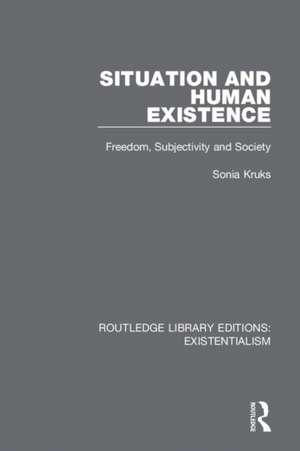
Situation and Human Existence: Freedom, Subjectivity and Society: Routledge Library Editions: Existentialism
Autor Sonia Kruksen Limba Engleză Hardback – 29 apr 2019
Preț: 894.05 lei
Preț vechi: 1090.30 lei
-18%
Puncte Express: 1341
Carte tipărită la comandă
Livrare economică 03-17 decembrie
Livrare prin curier în România Termenul estimat este afișat lângă disponibilitate.
Transport gratuit pentru acest produs Plată online sau ramburs, în funcție de opțiunile comenzii.
Retur gratuit în 14 zile Comandă securizată și suport în română.
Specificații
ISBN-13: 9780367110956
ISBN-10: 0367110954
Pagini: 236
Dimensiuni: 156 x 234 x 14 mm
Greutate: 0.45 kg
Ediția:1
Editura: Taylor & Francis
Colecția Routledge
Seria Routledge Library Editions: Existentialism
Locul publicării:Oxford, United Kingdom
ISBN-10: 0367110954
Pagini: 236
Dimensiuni: 156 x 234 x 14 mm
Greutate: 0.45 kg
Ediția:1
Editura: Taylor & Francis
Colecția Routledge
Seria Routledge Library Editions: Existentialism
Locul publicării:Oxford, United Kingdom
Cuprins
1. Marcel: Embodiment and Situation 2. Sartre: Individual Constitution of Situation 3. Beauvoir: the Weight of Situation 4. Merleau-Ponty: Situation and Social World 5. Sartre: Praxis in Situation
Descriere
This book, first published in 1990, traces the development of the concept of situation through the work of Marcel, Sartre, de Beauvoir and Merleau-Ponty. It shows how it illuminates questions of self or subjectivity, embodiment and gender, society and history, and argues that it goes far beyond notions of the ‘death of the subject’.