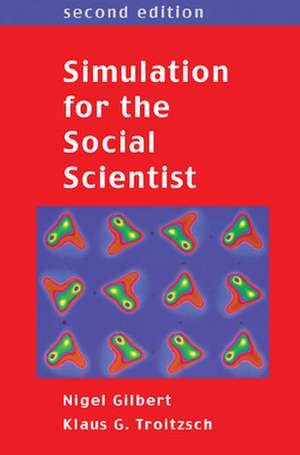
Simulation for the Social Scientist
Autor Nigel Gilbert, Klaus Troitzschen Limba Engleză Paperback – 16 feb 2005
- What can computer simulation contribute to the social sciences?
- Which of the many approaches to simulation would be best for my social science project?
- How do I design, carry out and analyse the results from a computer simulation?
New for this edition:
- A new chapter on designing multi-agent systems, to support the fact that multi-agent modelling has become the most common approach to simulation
- New examples and guides to current software
- Updated throughout to take new approaches into account
Preț: 215.63 lei
Preț vechi: 297.65 lei
-28%
Puncte Express: 323
Carte disponibilă
Livrare economică 30 octombrie-04 noiembrie
Livrare prin curier în România Termenul estimat este afișat lângă disponibilitate.
Transport gratuit de la 400.00 lei Plată online sau ramburs, în funcție de opțiunile comenzii.
Retur gratuit în 14 zile Comandă securizată și suport în română.
Specificații
ISBN-13: 9780335216000
ISBN-10: 0335216005
Pagini: 312
Dimensiuni: 153 x 231 x 16 mm
Greutate: 0.51 kg
Ediția:2nd edition
Editura: McGraw Hill Education
Colecția Open University Press
Locul publicării:United Kingdom
ISBN-10: 0335216005
Pagini: 312
Dimensiuni: 153 x 231 x 16 mm
Greutate: 0.51 kg
Ediția:2nd edition
Editura: McGraw Hill Education
Colecția Open University Press
Locul publicării:United Kingdom
V-ar putea interesa
-
 The Science of Web SurveysRoger Tourangeau-34%Preț: 667.30 lei1006.67 lei
 -
 Unequal Lives: Health and Socioeconomic InequalitiesHilary Graham-28%Preț: 188.61 lei262.98 lei
 -
 -27%Preț: 199.97 lei274.31 lei
 -
 -28%Preț: 191.95 lei264.80 lei
 -
 Ground Rules for Social ResearchMartyn Denscombe-29%Preț: 147.92 lei208.66 lei
 -
 The Myth of Research-Based Policy and PracticeMartyn Hammersley-18%Preț: 726.30 lei885.72 lei
 -
 Understanding Social StatisticsJane L. Fielding-8%Preț: 515.48 lei560.31 lei
 -
 Qualitative Research PracticeJane Ritchie-22%Preț: 404.40 lei518.46 lei
 -
 What is Qualitative Interviewing?Rosalind Edwards-17%Preț: 179.15 lei216.19 lei
 -
 Who Counts?Jeremy HollandPreț: 163.07 lei
 -
 -23%Preț: 257.36 lei336.19 lei
Cuprins
1: Simulation and social science
2: Simulation as a method
3: Systems dynamics and world models
4: Microanalytical simulation models
5: Queuing models
6: Multilevel simulation models
7: Cellular automata
8: Multi-agent models
9: Developing multi-agent systems
10: Learning and evolutionary models
Appendix A (websites)
Appendix B (Linear stability analysis of the hawk–dove–lawabider model)
Appendix C (Random number generators)
2: Simulation as a method
3: Systems dynamics and world models
4: Microanalytical simulation models
5: Queuing models
6: Multilevel simulation models
7: Cellular automata
8: Multi-agent models
9: Developing multi-agent systems
10: Learning and evolutionary models
Appendix A (websites)
Appendix B (Linear stability analysis of the hawk–dove–lawabider model)
Appendix C (Random number generators)