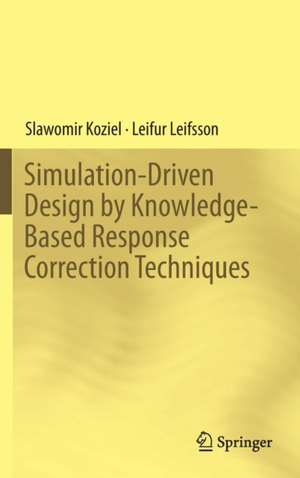
Simulation-Driven Design by Knowledge-Based Response Correction Techniques
Autor Slawomir Koziel, Leifur Leifssonen Limba Engleză Hardback – 24 mai 2016
The book presents a general formulation of response correction techniques as well as a number of specific methods, including those based on correcting the low-fidelity model response (output space mapping, manifold mapping, adaptive response correction and shape-preserving response prediction), as well as on suitable modification of design specifications. Detailed formulations, application examples and the discussion of advantages and disadvantages of these techniques are also included. The book demonstrates the use of the discussed techniques for solving real-world engineering design problems, including applications in microwave engineering, antenna design, and aero/hydrodynamics.
Preț: 407.65 lei
Puncte Express: 611
Carte tipărită la comandă
Livrare economică 08-22 decembrie
Livrare prin curier în România Termenul estimat este afișat lângă disponibilitate.
Transport gratuit pentru acest produs Plată online sau ramburs, în funcție de opțiunile comenzii.
Retur gratuit în 14 zile Comandă securizată și suport în română.
Specificații
ISBN-13: 9783319301136
ISBN-10: 3319301136
Pagini: 276
Ilustrații: XI, 262 p. 167 illus., 93 illus. in color.
Dimensiuni: 160 x 241 x 21 mm
Greutate: 0.53 kg
Ediția:1st edition 2016
Editura: Springer
Locul publicării:Cham, Switzerland
ISBN-10: 3319301136
Pagini: 276
Ilustrații: XI, 262 p. 167 illus., 93 illus. in color.
Dimensiuni: 160 x 241 x 21 mm
Greutate: 0.53 kg
Ediția:1st edition 2016
Editura: Springer
Locul publicării:Cham, Switzerland
V-ar putea interesa
-
 Cryptography: A Very Short IntroductionFred PiperPreț: 65.28 lei
 -
 -22%Preț: 519.99 lei670.41 lei
 -
 -21%Preț: 375.55 lei478.25 lei
 -
 Fundamentals of Weather and ClimateRobin McIlveen-20%Preț: 490.84 lei613.71 lei
 -
 Mathematical Models of Biological SystemsHugo van den Berg-22%Preț: 480.97 lei619.62 lei
 -
 Model Selection and Multimodel InferenceDavid R. Anderson-23%Preț: 1074.52 lei1395.49 lei
 -
 Empirical Model BuildingJames R Thompson-9%Preț: 947.09 lei1040.76 lei
 -
 Modeling and Simulation in Medicine and the Life SciencesFrank C. HoppensteadtPreț: 495.58 lei
 -
 Waves in Neural MediaPaul C. Bressloff-15%Preț: 732.88 lei862.21 lei
 -
 -18%Preț: 1136.11 lei1385.49 lei
 -
 Biological Implications of Human MobilitySlawomir Koziel-23%Preț: 1212.71 lei1583.26 lei
 -
 Reduced Order Methods for Modeling and Computational ReductionAlfio Quarteroni-15%Preț: 672.46 lei791.13 lei
 -
 Optimization with PDE ConstraintsRonald Hoppe-15%Preț: 676.61 lei796.01 lei
 -
 Topology OptimizationMartin Philip Bendsoe-18%Preț: 898.67 lei1095.94 lei
 -
 Dispersal, Individual Movement and Spatial EcologyMark A. LewisPreț: 397.70 lei
Cuprins
Introduction.- Simulation-Driven Design.- Fundamentals of Numerical Optimization.- Introduction to Surrogate-Based Modeling and Surrogate-Based Optimization.- Design Optimization Using Response Correction Techniques.- Surrogate-Based Optimization Using Parametric Response Correction.- Non-Parametric Response Correction Techniques.- Expedited Simulation-Driven Optimization Using Adaptively Adjusted Design Specification.- Surrogate-Assisted Design Optimization Using Response Features.- Enhancing Response Correction Techniques by Adjoint Sensitivity.- Multi-Objective Optimization Using Variable-Fidelity Models and Response Correction.- Physics-Base Surrogate Models Using Response Correction.- Summary and Discussion.- References.
Textul de pe ultima copertă
Focused on efficient simulation-driven multi-fidelity optimization techniques, this monograph on simulation-driven optimization covers simulations utilizing physics-based low-fidelity models, often based on coarse-discretization simulations or other types of simplified physics representations, such as analytical models. The methods presented in the book exploit as much as possible any knowledge about the system or device of interest embedded in the low-fidelity model with the purpose of reducing the computational overhead of the design process. Most of the techniques described in the book are of response correction type and can be split into parametric (usually based on analytical formulas) and non-parametric, i.e., not based on analytical formulas. The latter, while more complex in implementation, tend to be more efficient.
The book presents a general formulation of response correction techniques as well as a number of specific methods, including those based on correcting the low-fidelity model response (output space mapping, manifold mapping, adaptive response correction and shape-preserving response prediction), as well as on suitable modification of design specifications. Detailed formulations, application examples and the discussion of advantages and disadvantages of these techniques are also included. The book demonstrates the use of the discussed techniques for solving real-world engineering design problems, including applications in microwave engineering, antenna design, and aero/hydrodynamics.
The book presents a general formulation of response correction techniques as well as a number of specific methods, including those based on correcting the low-fidelity model response (output space mapping, manifold mapping, adaptive response correction and shape-preserving response prediction), as well as on suitable modification of design specifications. Detailed formulations, application examples and the discussion of advantages and disadvantages of these techniques are also included. The book demonstrates the use of the discussed techniques for solving real-world engineering design problems, including applications in microwave engineering, antenna design, and aero/hydrodynamics.
Notă biografică
Syed Imran Hussain Shah received the B.Sc. degree in Telecommunication Engineering from the University of Engineering and Technology, Peshawar, Pakistan, in 2011, and the M.S. degree in Electrical Engineering from the same university in 2014. He holds his Ph.D. degree from the School of Electrical and Electronics Engineering, Chung-Ang University, Seoul, Republic of Korea in 2020. Since Jan. 2023, he has been working as a Research Professor at Chung-Ang University, Seoul, Republic of Korea. His research interests include the design and analysis of frequency and pattern reconfigurable origami antennas, deployable origami antennas, 3-D printed antennas, and shape memory materials based smart antennas. He has authored more than 40 journal and conference papers focused on reconfigurable, deployable, smart materials-based antennas, and quasi-isotropic antennas. Shahid Bashir received the B.Sc. degree in Electrical Engineering from the University of Engineering and Technology, Peshawar, Pakistan, in 2001, and the Ph.D. Degree in Wireless Communications from the Department of Electronic and Electrical Engineering, Loughborough University, Leicestershire, UK, in 2009. He is an Assistant Professor in the Electrical Engineering Department, UET Peshawar, where he is also a member of National Center of Artificial Intelligence (NCAI) and Centre of Intelligent Systems and Networks Research (CISNR). He has published more than 50 research papers in various reputed journals and conferences. His main areas of research interest are wearable antennas, Origami antennas, Metamaterials, Electromagnetic band gap materials, Reconfigurable and miniaturized antennas for 5G, and THz antennas. Slawomir Koziel received the M.Sc. and Ph.D. degrees in electronic engineering from Gdansk University of Technology, Poland, in 1995 and 2000, respectively. He also received the M.Sc. degrees in theoretical physics and in mathematics, in 2000 and 2002, respectively, as well as the PhD in mathematics in 2003, from the University of Gdansk, Poland. He is currently a Professor with the Department of Engineering, Reykjavik University, Iceland. His research interests include CAD and modeling of antennas and microwave circuits, simulation-driven design, surrogate-based optimization, space mapping, circuit theory, evolutionary computation and numerical analysis. In recent years, he has been working extensively on surrogate-based modeling and optimization techniques as well as computationally efficient simulation-driven design methods for microwave engineering and aerospace engineering. He has published over 15 books, 30 book chapters and over 1,000 peer-reviewed research papers. He is a founder and director of Engineering Optimization & Modeling Center at Reykjavik University. Slawomir Koziel is a recipient of Fulbright Scholarship for the academic year 2003/2004. He has served on the Editorial Board of various international journals, program committee member as well as co-organizer of numerous special sessions and workshops at international conferences. He is a Chief Editor of Int. J. Antennas Propag., an Associate Editor of several journals (IET Microwaves Ant. Prop., El. Lett., Int. J. Math. Modeling Num. Opt., Int. J. Numerical Modeling). He has also been a guest co-editor of several special issues of international journals (including IEEE Trans. Microwave Theory Techn., Optimization and Engineering, Int. J. RF and Microwave CAE, Int. J. Math. Modelling and Num. Opt, Electronics, Applied Sciences).