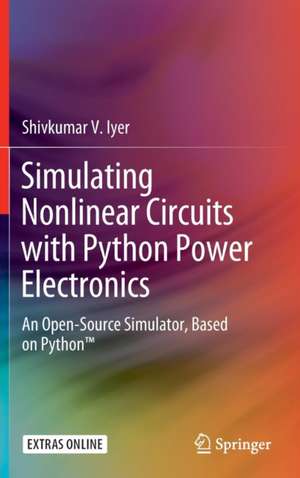
Simulating Nonlinear Circuits with Python Power Electronics
Autor Shivkumar V. Iyeren Limba Engleză Hardback – 6 feb 2018
Preț: 755.34 lei
Preț vechi: 921.16 lei
-18%
Puncte Express: 1133
Carte tipărită la comandă
Livrare economică 30 noiembrie-14 decembrie
Livrare prin curier în România Termenul estimat este afișat lângă disponibilitate.
Transport gratuit pentru acest produs Plată online sau ramburs, în funcție de opțiunile comenzii.
Retur gratuit în 14 zile Comandă securizată și suport în română.
Specificații
ISBN-13: 9783319739830
ISBN-10: 3319739832
Pagini: 228
Ilustrații: X, 215 p. 117 illus., 26 illus. in color.
Dimensiuni: 160 x 241 x 18 mm
Greutate: 0.46 kg
Ediția:1st edition 2018
Editura: Springer
Locul publicării:Cham, Switzerland
ISBN-10: 3319739832
Pagini: 228
Ilustrații: X, 215 p. 117 illus., 26 illus. in color.
Dimensiuni: 160 x 241 x 18 mm
Greutate: 0.46 kg
Ediția:1st edition 2018
Editura: Springer
Locul publicării:Cham, Switzerland
V-ar putea interesa
-
 Novel Silicon Based TechnologiesNATO Advanced Study Institute on Novel Silicon Based Technologies 1989-15%Preț: 605.06 lei711.83 lei
 -
 Architectures for RF Frequency SynthesizersCicero S. Vaucher-15%Preț: 668.72 lei786.73 lei
 -
 CMOS Circuit Design for RF SensorsGunnar Gudnason-15%Preț: 662.24 lei779.10 lei
 -
 PCB Design for Real-World EMI ControlBruce R. Archambeault-18%Preț: 1435.24 lei1750.29 lei
 -
 Power Aware Design MethodologiesJan M. Rabaey-18%Preț: 1273.95 lei1553.59 lei
 -
 Modern Placement TechniquesMajid Sarrafzadeh-15%Preț: 661.42 lei778.13 lei
 -
 RF/Microwave HybridsRichard Brown-18%Preț: 980.46 lei1195.68 lei
 -
 Low-Power CMOS Design for Wireless TransceiversAlireza Zolfaghari-15%Preț: 657.25 lei773.24 lei
 -
 System-On-Chip for Real-Time ApplicationsWael Badawy-18%Preț: 991.15 lei1208.72 lei
 -
 CTL for Test Information of Digital ICsRohit Kapur-15%Preț: 660.31 lei776.83 lei
 -
 -15%Preț: 664.95 lei782.28 lei
 -
 -18%Preț: 983.96 lei1199.95 lei
 -
 -18%Preț: 1147.77 lei1399.72 lei
 -
 CMOS Fractional-N SynthesizersBram De Muer-18%Preț: 1266.20 lei1544.14 lei
 -
 Parasitic-Aware Optimization of CMOS RF CircuitsDavid J Allstot-15%Preț: 643.56 lei757.12 lei
 -
 Circuit Design for Wireless CommunicationsKong-Pang Pun-18%Preț: 975.82 lei1190.03 lei
 -
 Low-Voltage CMOS Log Companding Analog DesignFrancisco Serra-Graells-15%Preț: 662.05 lei778.88 lei
 -
 Design of Low-Voltage CMOS Switched-Opamp Switched-Capacitor SystemsVincent S. L. Cheung-18%Preț: 975.42 lei1189.54 lei
 -
 Low-Voltage Low-Power CMOS Current ConveyorsGiuseppe Ferri-18%Preț: 981.70 lei1197.19 lei
 -
 -15%Preț: 658.85 lei775.11 lei
 -
 8051 MicrocontrollersSalvador Pinillos Gimenez-15%Preț: 558.75 lei657.35 lei
 -
 -15%Preț: 665.66 lei783.13 lei
 -
 -18%Preț: 924.79 lei1127.79 lei
 -
 -18%Preț: 1016.85 lei1240.06 lei
 -
 Advanced HDL Synthesis and SOC PrototypingVaibbhav Taraate-18%Preț: 1156.19 lei1409.99 lei
Cuprins
Introduction.- Introduction to Python.- User Interface.- Interface for User Control Functions.- Case Study - Shunt VAR Compensator.- Nodes, Branches and Loops.- Circuit analysis - Loop analysis.- Circuit analysis - Nodal analysis.- Conclusions.
Notă biografică
Shivkumar Venkatraman Iyer ist ein unabhängiger Forscher mit Sitz in Toronto, Kanada, und verfügt über Fachkenntnisse im Bereich Leistungselektronik.
Textul de pe ultima copertă
This book provides readers with an in-depth discussion of circuit simulation, combining basic electrical engineering circuit theory with Python programming. It fills an information gap by describing the development of Python Power Electronics, an open-source software for simulating circuits, and demonstrating its use in a sample circuit. Unlike typical books on circuit theory that describe how circuits can be solved mathematically, followed by examples of simulating circuits using specific, commercial software, this book has a different approach and focus. The author begins by describing every aspect of the open-source software, in the context of non-linear power electronic circuits, as a foundation for aspiring or practicing engineers to embark on further development of open source software for different purposes. By demonstrating explicitly the operation of the software through algorithms, this book brings together the fields of electrical engineering and software technology.
- Written by a practicing engineer, with expertise in both power electronic circuits and Python programming, who developed an open-source circuit simulator from scratch;
- Based on a free and open source circuit simulator, which makes it accessible to everyone in the world to run the tests when reading the book;
- Supplemented by online tutorials on the simulator website, making the material vast compared to other books that are limited to selective cases.