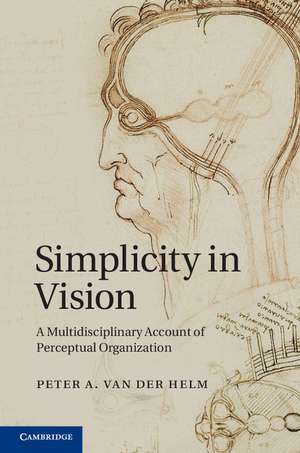
Simplicity in Vision
Autor Peter A. Van Der Helmen Limba Engleză Hardback – 6 feb 2014
Preț: 526.91 lei
Preț vechi: 592.03 lei
-11%
Puncte Express: 790
Carte tipărită la comandă
Livrare economică 28 noiembrie-12 decembrie
Livrare prin curier în România Termenul estimat este afișat lângă disponibilitate.
Transport gratuit pentru acest produs Plată online sau ramburs, în funcție de opțiunile comenzii.
Retur gratuit în 14 zile Comandă securizată și suport în română.
Specificații
ISBN-13: 9781107034341
ISBN-10: 1107034345
Pagini: 430
Ilustrații: 115 b/w illus. 12 tables
Dimensiuni: 157 x 235 x 28 mm
Greutate: 0.77 kg
Ediția:New.
Editura: Cambridge University Press
Locul publicării:New York, United States
ISBN-10: 1107034345
Pagini: 430
Ilustrații: 115 b/w illus. 12 tables
Dimensiuni: 157 x 235 x 28 mm
Greutate: 0.77 kg
Ediția:New.
Editura: Cambridge University Press
Locul publicării:New York, United States
V-ar putea interesa
-
 -31%Preț: 1125.62 lei1622.04 lei
 -
 Understanding Vision: Theory, Models, and DataLi Zhaoping-32%Preț: 686.24 lei1004.81 lei
 -
 -31%Preț: 797.12 lei1151.25 lei
 -
 The Mind's EyeOliver Sacks-43%Preț: 51.76 lei90.69 lei
 -
 Foucault & the Politics of HearingLauri Siisiäinen-18%Preț: 1249.58 lei1523.89 lei
 -
 The Psychology of Visual ArtGeorge MatherPreț: 432.22 lei
 -
 Attention, Perception and Memory: An Integrated IntroductionElizabeth StylesPreț: 422.78 lei
 -
 Face PerceptionAndy Young-9%Preț: 1018.44 lei1119.16 lei
 -
 Living Sensationally: Understanding Your SensesWinnie DunnPreț: 146.46 lei
 -
 DistractionDamon YoungPreț: 378.65 lei
 -
 Time WarpedClaudia HammondPreț: 79.39 lei
Cuprins
Prologue: levels of vision, description, and evaluation; Part I. The Theoretical Cycle: 1. Visual information processing; 2. Veridicality by simplicity; Part II. The Empirical Cycle: 3. Transparent holographic regularity; 4. Symmetry perception; Part III. The Tractability Cycle: 5. Transparallel processing; 6. Cognition by synchronization; Epilogue: towards a Gestalt of perceptual organization.
Recenzii
'Van der Helm's book takes us on from the highly influential work of David Marr and his colleagues. Simplicity in Vision is deep but lucid: an important book.' Dr Ian Gordon, Honorary Research Fellow, University of Exeter
'… the three parts of the book provide a coherent and deep underpinning of the role of simplicity in vision.' Johan Wagemans, Perception
'… the three parts of the book provide a coherent and deep underpinning of the role of simplicity in vision.' Johan Wagemans, Perception
Descriere
A multidisciplinary account of human perceptual organization, with rigorous theoretical foundations, quantitative and qualitative models, and extensive empirical evidence.