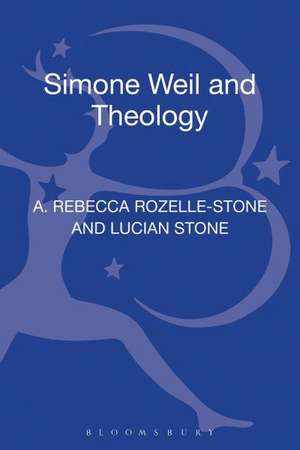
Simone Weil and Theology: Philosophy and Theology
Autor Professor A. Rebecca Rozelle-Stone, Professor Lucian Stoneen Limba Engleză Hardback – 28 mar 2013
Din seria Philosophy and Theology
- 17%
 Preț: 177.30 lei
 - 14%
 Preț: 233.01 lei
 - 15%
 Preț: 231.73 lei
 - 20%
 Preț: 192.72 lei
 - 17%
 Preț: 207.80 lei
 - 26%
 Preț: 179.15 lei
 - 25%
 Preț: 193.20 lei
 - 17%
 Preț: 180.62 lei
 - 25%
 Preț: 192.03 lei
 - 17%
 Preț: 178.35 lei
 - 24%
 Preț: 238.94 lei
 - 26%
 Preț: 176.16 lei
 - 25%
 Preț: 652.78 lei
 - 22%
 Preț: 535.67 lei
 - 17%
 Preț: 190.60 lei
 - 17%
 Preț: 190.12 lei
 - 20%
 Preț: 165.47 lei
 - 36%
 Preț: 654.12 lei
 - 25%
 Preț: 186.11 lei
 - 13%
 Preț: 193.00 lei
 - 17%
 Preț: 193.56 lei
Preț: 613.93 lei
Preț vechi: 810.88 lei
-24%
Puncte Express: 921
Carte tipărită la comandă
Livrare economică 23 noiembrie-07 decembrie
Livrare prin curier în România Termenul estimat este afișat lângă disponibilitate.
Transport gratuit pentru acest produs Plată online sau ramburs, în funcție de opțiunile comenzii.
Retur gratuit în 14 zile Comandă securizată și suport în română.
Specificații
ISBN-13: 9780567537249
ISBN-10: 0567537242
Pagini: 192
Dimensiuni: 138 x 218 x 20 mm
Greutate: 0.48 kg
Ediția:New.
Editura: Bloomsbury Publishing
Colecția T&T Clark
Seria Philosophy and Theology
Locul publicării:London, United Kingdom
ISBN-10: 0567537242
Pagini: 192
Dimensiuni: 138 x 218 x 20 mm
Greutate: 0.48 kg
Ediția:New.
Editura: Bloomsbury Publishing
Colecția T&T Clark
Seria Philosophy and Theology
Locul publicării:London, United Kingdom
V-ar putea interesa
-
 Tears and SaintsE. M. CioranPreț: 204.74 lei
 -
 Preț: 199.11 lei
 -
 A Genealogy of Marion`s Philosophy of Religion – Apparent DarknessTamsin Jones FarmerPreț: 158.50 lei
 -
 Cloud-Hidden, Whereabouts UnknownAlan WattsPreț: 77.60 lei
 -
 Islamic Thought: An IntroductionAbdullah SaeedPreț: 392.61 lei
 -
 The Cambridge Companion to Arabic PhilosophyPeter AdamsonPreț: 284.20 lei
 -
 Habermas and TheologyProfessor Maureen Junker-Kenny-17%Preț: 180.62 lei217.48 lei
 -
 The Relevance of the Radical: Simone Weil 100 Years LaterProfessor A. Rebecca Rozelle-Stone-15%Preț: 280.66 lei331.78 lei
 -
 A Secular AgeCharles TaylorPreț: 394.65 lei
 -
 Preț: 184.10 lei
 -
 The Paradox of God and the Science of OmniscienceClifford A. PickoverPreț: 122.42 lei
 -
 -24%Preț: 849.05 lei1123.71 lei
 -
 Iranian Identity and Cosmopolitanism: Spheres of BelongingProfessor Lucian Stone-24%Preț: 849.42 lei1123.93 lei
 -
 The Twelve Conditions of a MiracleTodd MichaelPreț: 145.07 lei
Cuprins
Introduction: On Being a Paradox/1. Atheism and Mysticism/ 2. Christology and Religious Pluralism/ 3. Human Nature and Decreation/ 4. Love and Detachment/ 5. Beauty and Anonymity/ 6. Possibility and Impossibility/ Conclusion: Educating Paradox
Recenzii
Rebecca Rozelle-Stone and Lucian Stone critically apply Simone Weil's "negative-reflective" theology to attitudes of modernity by grappling with the obscurities in her text. They explore her theories of attention as negative effort, creative action in "decreation", positive elements in affliction, essential ties between love and justice, plus her ambivalence toward Judaism. This presentation of her thought opens the reader to Simone Weil's conception of human life, as she believed it to be revealed in the Gospels. Extensive references to other major thinkers and personal insights into this French philosopher's thought make this work a provocative and valuable contribution to Weil studies.
This is an extended set of reflections that begin in Weil's claim that "the gospel contains a conception of human life and not a theology." In seriously engaging the post-modern, the authors draw out Weil's deep and subtle meditations on the human temptation to self-deception and on the possibilities of transformation in today's world. There are wonderful insights here on attention, beauty, grace and education that go to the real depth of Weil's thinking. These are things to be thought about carefully and for a long time.
Rebecca Rozelle-Stone and Lucian Stone have deftly bypassed the current sterile debates between militant atheists and simplistic Christian fundamentalists by engaging critically with the deep, paradoxical and sometimes disturbing writings of Simone Weil. Many postmodern themes such as the body, the erotic, and the gift are examined through the lens of Weil's understanding of the Gospels which do not contain a theology but manifest a "conception of human life." God or the good is like the sun, only to be understood by an examination of what is illuminated not by a direct gaze. Human goodness is not to be achieved by acts of the will but by attention and decreation. The authors set out to explain Weil's reasons for asserting this. Along the way, they develop an insightful critique of today's liberal, capitalist, therapeutic culture with its tendency to medicalize and psychologize every aspect of humanity.
Two things need to be said in praise of this book and its ability to uncover Weil's depth, leaving a good
deal of her cutting edge insights about human selves intact, and not muted ... This book fortunately keeps a strong sense of Weil's edge. But this is because, second, in talking about Weil's issues, it does so by itself engaging those issues in some wonderfully concrete, contemporary ways. The use of studies, contemporary philosophical literature, including feminist philosophy, and the illustrations used to support those points are all exceptionally to the point ... Not only a very good, and insightful book on Simone Weil's thinking, but a very good and wise book overall, that will bear close attention itself.
This is an extended set of reflections that begin in Weil's claim that "the gospel contains a conception of human life and not a theology." In seriously engaging the post-modern, the authors draw out Weil's deep and subtle meditations on the human temptation to self-deception and on the possibilities of transformation in today's world. There are wonderful insights here on attention, beauty, grace and education that go to the real depth of Weil's thinking. These are things to be thought about carefully and for a long time.
Rebecca Rozelle-Stone and Lucian Stone have deftly bypassed the current sterile debates between militant atheists and simplistic Christian fundamentalists by engaging critically with the deep, paradoxical and sometimes disturbing writings of Simone Weil. Many postmodern themes such as the body, the erotic, and the gift are examined through the lens of Weil's understanding of the Gospels which do not contain a theology but manifest a "conception of human life." God or the good is like the sun, only to be understood by an examination of what is illuminated not by a direct gaze. Human goodness is not to be achieved by acts of the will but by attention and decreation. The authors set out to explain Weil's reasons for asserting this. Along the way, they develop an insightful critique of today's liberal, capitalist, therapeutic culture with its tendency to medicalize and psychologize every aspect of humanity.
Two things need to be said in praise of this book and its ability to uncover Weil's depth, leaving a good
deal of her cutting edge insights about human selves intact, and not muted ... This book fortunately keeps a strong sense of Weil's edge. But this is because, second, in talking about Weil's issues, it does so by itself engaging those issues in some wonderfully concrete, contemporary ways. The use of studies, contemporary philosophical literature, including feminist philosophy, and the illustrations used to support those points are all exceptionally to the point ... Not only a very good, and insightful book on Simone Weil's thinking, but a very good and wise book overall, that will bear close attention itself.