
Signs, Intentionality, and Imaginability: Selected Papers: Semiotics, Signs of the Times, cartea 3
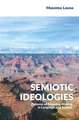
Autor Horst Ruthrofen Limba Engleză Hardback – 23 oct 2025
With tools from Locke, Kant, Peirce, and especially Husserl, the author redefines natural language as “a set of social instructions for schematically imagining, and acting in, a world” and gradually identifies what grants natural language its power: imaginability.

Preț: 746.65 lei
Preț vechi: 910.56 lei
-18%
Puncte Express: 1120
Carte disponibilă
Livrare economică 06-17 noiembrie
Livrare prin curier în România Termenul estimat este afișat lângă disponibilitate.
Transport gratuit pentru acest produs Plată online sau ramburs, în funcție de opțiunile comenzii.
Retur gratuit în 14 zile Comandă securizată și suport în română.
Specificații
ISBN-13: 9789004741256
ISBN-10: 9004741259
Pagini: 466
Dimensiuni: 155 x 235 x 30 mm
Greutate: 0.9 kg
Editura: Brill
Colecția Brill
Seria Semiotics, Signs of the Times
ISBN-10: 9004741259
Pagini: 466
Dimensiuni: 155 x 235 x 30 mm
Greutate: 0.9 kg
Editura: Brill
Colecția Brill
Seria Semiotics, Signs of the Times
V-ar putea interesa
-
 Kant And The PlatypusUmberto Eco-18%Preț: 77.37 lei94.29 lei
 -
 Meaning: A Very Short IntroductionEmma Borg-20%Preț: 56.92 lei71.00 lei
 -
 Reference and Beyond: Essays in Philosophy of LanguageMichael Devitt-32%Preț: 925.22 lei1370.30 lei
 -
 Philosophy of LanguageA. P. Martinich-27%Preț: 867.52 lei1188.39 lei
 -
 Wittgenstein: The Senses of UseSandra LaugierPreț: 336.45 lei
 -
 When Everyone Knows That Everyone Knows...Steven PinkerPreț: 136.05 lei
 -
 Schott's SignificaBen SchottPreț: 165.42 lei
 -
 Decolonizing Language and Other Revolutionary IdeasNgugi Wa Thiong'OPreț: 164.89 lei
 -
 The Hidden Language of SymbolsMatthew Wilson-16%Preț: 201.64 lei238.83 lei
 -
 IntentionGertrude E. M. AnscombePreț: 227.66 lei
 -
 -27%Preț: 1662.80 lei2277.81 leiNou
 -
 Preț: 351.43 lei
 -
 The Human AnimalMarkus GabrielPreț: 236.82 lei
 -
 Religion for ThoughtPaul RicoeurPreț: 166.47 lei
 -
 Rosen's AlmanacMichael RosenPreț: 121.22 lei
 -
 AlgospeakAdam AleksicPreț: 122.02 leiRecomandat
 -
 Philosophical Perspectives on LanguageRobert J. Stainton-25%Preț: 330.50 lei440.17 lei
 -
 Perspectives in the Philosophy of Language: A Concise AnthologyRobert J. Stainton-25%Preț: 376.45 lei501.69 lei
 -
 Hiding in Plain SightSerghei SadohinPreț: 83.44 lei
 -
 The Place of the Symbolic: Essays on Art and PoliticsReiner SchürmannPreț: 206.30 lei
Notă biografică
Horst Ruthrof FAHA, Ph.D. (1969) Rhodes University, is Emeritus Professor of Philosophy and English at Murdoch University, Perth, Western Australia. He has published over a hundred articles and seven books in literary theory, semiotics, and the philosophy of language.
Cuprins
Acknowledgments
Abbreviations
Original Publications
Introduction: from Literary Theory to the Critique of Language Philosophy
Part 1
Signs in Literary Theory
Introduction to Part 1
1 Reading the Signs of Literary Works
2 Signs in Translation
3 Motivated Signifieds: the Fourth Critique
4 The Role of Imaginability in Literary Semantics
Part 2
Intentionality in Peircean Semiotics
Introduction to Part 2
5 How to Get the Body Back into the Linguistic Sign
6 Intentionality as Sufficient Semiosis
7 Signs of Resemblance: Hypoiconicity as Intentionality
Part 3
Locke, Kant, Heidegger, Einstein and Freud
Introduction to Part 3
8 The Logos of Modernity: Vernunftspaltung
9 From Kant’s Monogram to Conceptual Blending
10 Locke: Linguistic Meaning as Indirectly Public
11 Missing Signs: Heidegger’s Forgetting of Perception
12 Signs of Irrationality: Einstein and Freud on Why War?
Part 4
Imaginable Signs in the Phenomenology of Language
Introduction to Part 4
13 Speculations on the Origins of Linguistic Signification
14 Knowing a Language: What Sort of Knowing Is It?
15 Perception or Imaginability: Which Has Primacy in Language?
16 On Sign Compulsion in Natural Language
Conclusion
Bibliography
Index
Abbreviations
Original Publications
Introduction: from Literary Theory to the Critique of Language Philosophy
Part 1
Signs in Literary Theory
Introduction to Part 1
1 Reading the Signs of Literary Works
2 Signs in Translation
3 Motivated Signifieds: the Fourth Critique
4 The Role of Imaginability in Literary Semantics
Part 2
Intentionality in Peircean Semiotics
Introduction to Part 2
5 How to Get the Body Back into the Linguistic Sign
6 Intentionality as Sufficient Semiosis
7 Signs of Resemblance: Hypoiconicity as Intentionality
Part 3
Locke, Kant, Heidegger, Einstein and Freud
Introduction to Part 3
8 The Logos of Modernity: Vernunftspaltung
9 From Kant’s Monogram to Conceptual Blending
10 Locke: Linguistic Meaning as Indirectly Public
11 Missing Signs: Heidegger’s Forgetting of Perception
12 Signs of Irrationality: Einstein and Freud on Why War?
Part 4
Imaginable Signs in the Phenomenology of Language
Introduction to Part 4
13 Speculations on the Origins of Linguistic Signification
14 Knowing a Language: What Sort of Knowing Is It?
15 Perception or Imaginability: Which Has Primacy in Language?
16 On Sign Compulsion in Natural Language
Conclusion
Bibliography
Index