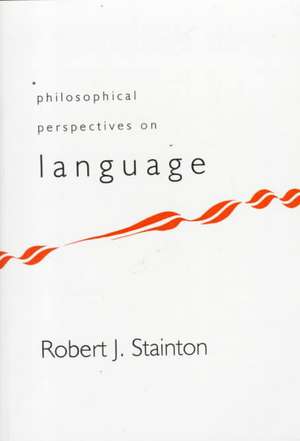
Philosophical Perspectives on Language
Autor Robert J. Staintonen Limba Engleză Paperback – 18 mar 1996
Philosophical Perspectives on Language is distinguished in several important respects from other introductions to the topic. Rather than looking at philosophy of language as a collection of (at best) loosely related topics—speech acts, demonstratives, sense and reference, truth and meaning, etc.—this book is organized around a unifying theme: language as a system of symbols that is known and used.
Preț: 330.50 lei
Preț vechi: 440.17 lei
-25%
Puncte Express: 496
Carte disponibilă
Livrare economică 02-16 noiembrie
Livrare express 17-23 octombrie pentru 146.40 lei
Livrare prin curier în România Termenul estimat este afișat lângă disponibilitate.
Transport gratuit de la 400.00 lei Plată online sau ramburs, în funcție de opțiunile comenzii.
Retur gratuit în 14 zile Comandă securizată și suport în română.
Specificații
ISBN-13: 9781551110868
ISBN-10: 1551110865
Pagini: 254
Dimensiuni: 165 x 229 x 11 mm
Greutate: 0.43 kg
Ediția:New.
Editura: BROADVIEW PR
Colecția Broadview Press
Locul publicării:Peterborough, Canada
ISBN-10: 1551110865
Pagini: 254
Dimensiuni: 165 x 229 x 11 mm
Greutate: 0.43 kg
Ediția:New.
Editura: BROADVIEW PR
Colecția Broadview Press
Locul publicării:Peterborough, Canada
V-ar putea interesa
-
 -20%Preț: 148.75 lei185.69 lei
 -
 -32%Preț: 900.82 lei1324.52 lei
 -
 Meaning: A Very Short IntroductionEmma Borg-20%Preț: 56.92 lei71.00 lei
 -
 Reference and Beyond: Essays in Philosophy of LanguageMichael Devitt-32%Preț: 925.22 lei1370.30 lei
 -
 Philosophy of LanguageA. P. Martinich-27%Preț: 867.52 lei1188.39 lei
 -
 Metaphors We Live ByProfessor George LakoffPreț: 142.06 lei
 -
 Women, Fire, and Dangerous Things: What Categories Reveal about the MindProfessor George LakoffPreț: 193.86 lei
 -
 Wittgenstein: The Senses of UseSandra LaugierPreț: 325.46 lei
 -
 When Everyone Knows That Everyone Knows...Steven PinkerPreț: 136.05 lei
 -
 Schott's SignificaBen SchottPreț: 165.42 lei
 -
 Mathematical Structure of Syntactic MergeMatilde Marcolli-14%Preț: 411.52 lei478.51 lei
 -
 -27%Preț: 1662.80 lei2277.81 leiNou
 -
 Preț: 351.43 lei
 -
 Language and Symbolic PowerPierre BourdieuPreț: 160.63 lei
 -
 The Epistemology of Language Use: Wittgenstein and a Philosophical PragmaticsProfessor Arley Ramos Moreno-26%Preț: 205.67 lei278.89 leiNou
 -
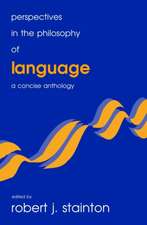 Perspectives in the Philosophy of Language: A Concise AnthologyRobert J. Stainton-25%Preț: 376.45 lei501.69 lei
 -
 Logic, Language and PhilosophyFenrong LiuPreț: 314.93 lei
 -
 Prose & ConsGyles BrandrethPreț: 106.99 lei
 -
 Preț: 242.54 lei
 -
 Language and Reality from a Naturalistic PerspectiveAndrea Bianchi-18%Preț: 1161.85 lei1416.88 lei
Recenzii
Philosophical theorizing about language now involves an increasing emphasis on empirical work and a renewed convergence with philosophy of mind, formal semantics and logic. This new text reflects this evolution.
Philosophical Perspectives on Language is distinguished in several important respects from other introductions to the topic. Rather than looking at philosophy of language as a collection of (at best) loosely related topics—speech acts, demonstratives, sense and reference, truth and meaning, etc.—this book is organized around a unifying theme: language as a system of symbols that is known and used.
“Stainton has written an excellent textbook on the philosophy of language. It provides a clear and careful introduction to all the main issues in the area. It can be easily [used in conjunction with] some very good anthologies on the topic. … It’s extremely well-written and very polished; Stainton’s prose just flows smoothly from beginning to end. … It’s a joy to read a textbook that walks the reader through some rather tough terrain, never faltering along the way.” — Reinaldo Elugardo, University of Oklahoma
“This is a very good text indeed. It covers the important issues in contemporary philosophy of language, and is extremely clear. It is written in a chatty, lively style … an excellent resource for those new to the philosophy of language.” — Patricia Blanchette, Notre Dame University
Philosophical Perspectives on Language is distinguished in several important respects from other introductions to the topic. Rather than looking at philosophy of language as a collection of (at best) loosely related topics—speech acts, demonstratives, sense and reference, truth and meaning, etc.—this book is organized around a unifying theme: language as a system of symbols that is known and used.
“Stainton has written an excellent textbook on the philosophy of language. It provides a clear and careful introduction to all the main issues in the area. It can be easily [used in conjunction with] some very good anthologies on the topic. … It’s extremely well-written and very polished; Stainton’s prose just flows smoothly from beginning to end. … It’s a joy to read a textbook that walks the reader through some rather tough terrain, never faltering along the way.” — Reinaldo Elugardo, University of Oklahoma
“This is a very good text indeed. It covers the important issues in contemporary philosophy of language, and is extremely clear. It is written in a chatty, lively style … an excellent resource for those new to the philosophy of language.” — Patricia Blanchette, Notre Dame University
Cuprins
Acknowledgements
Preface
Chapter One: Introduction
Chapter Two: Syntax
Chapter Six: The Idea Theory of Meaning
Chapter Nine: The Use Theory of Meaning
Notes
References
Index
Preface
Chapter One: Introduction
- Three Perspectives on Language
- Who Cares?
- Some Terminology
Chapter Two: Syntax
- Introduction
- Option One — Rule Systems
- Option Two — Principles and Parameters
- Epilogue: Prescriptive and Descriptive Syntax
- Three Approaches to Meaning
- Direct Reference Theories
- Bertrand Russell on Descriptions
- Introduction
- Frege
- Possible Worlds
- Truth and Meaning
- Non-Declaratives and Truth
Chapter Six: The Idea Theory of Meaning
- Introduction
- Mental Images
- H. Paul Grice
- Mentalese and the Idea Theory of Meaning
- An Alternative to LOT: Connectionism
- Another Alternative to LOT: Dennett’s International Stance
- Innateness
- Rules and Regularities
- Radical Translation
Chapter Nine: The Use Theory of Meaning
- Meaning and Use
- Indexicals
- Strawson on Referring
- Speech Act Theory
- Quine and Meaning Nihilism
- Conversational Implication
- Metaphor
- Referential-Attributive
- Non-Literal Use and the Need for Conventions
- The Private Language Argument
- Davidson on the Limits of Convention
Notes
References
Index