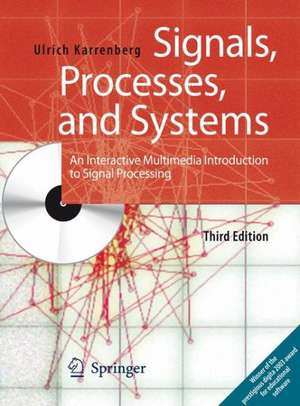
Signals, Processes, and Systems: An Interactive Multimedia Introduction to Signal Processing
Autor Ulrich Karrenbergen Limba Engleză Mixed media product – 28 iun 2013
Subliniem experiența vastă a autorului Ulrich Karrenberg, care îmbină șapte ani de inginerie practică în telecomunicații cu o carieră didactică solidă la Heinrich-Hertz-Berufskolleg. Această dualitate se reflectă direct în structura lucrării Signals, Processes, and Systems, unde conceptele teoretice sunt imediat ancorate în aplicații industriale. Ca și Tomasz P. Zieliński în Starting Digital Signal Processing in Telecommunication Engineering, autorul distilează experiența reală în principii acționabile, însă Karrenberg optează pentru un sistem multimedia bazat pe DasyLab în loc de mediul tradițional MATLAB.
Reținem că această a treia ediție transformă studiul prelucrării semnalelor dintr-un exercițiu matematic abstract într-o investigație interactivă. Ne-a atras atenția utilizarea programării grafice, care permite utilizatorului să modifice și să optimizeze aplicații de metrologie și control fără a se pierde în sintaxă de cod complexă. Cartea este organizată riguros, pornind de la analiza semnalelor în domeniile timp și frecvență, trecând prin principiul incertitudinii și simetriei, până la tehnologii avansate de codare de canal și rețele neuronale. Un element distinctiv este noul capitol dedicat modelării matematice, care oferă rigoarea necesară pentru a susține experimentele „vii” de pe DVD-ul inclus.
Spre deosebire de lucrarea sa anterioară în limba germană, Signale - Prozesse - Systeme, această ediție extinde suportul tehnic pentru sistemele moderne pe 64 de biți și rafinează materialele vizuale. Volumul nu se limitează la teorie; cele peste 200 de sisteme pre-programate permit achiziția și procesarea semnalelor reale folosind placa de sunet a calculatorului, oferind o experiență de laborator completă în format de studiu individual.
Preț: 580.60 lei
Preț vechi: 683.06 lei
-15%
Carte disponibilă
Livrare economică 07-21 noiembrie
Specificații
ISBN-10: 3642380522
Pagini: 450
Ilustrații: XI, 527 p. 200 illus. With DVD.
Dimensiuni: 193 x 260 x 33 mm
Greutate: 1.13 kg
Ediția:3rd ed. 2013
Editura: Springer Berlin, Heidelberg
Colecția Springer
Locul publicării:Berlin, Heidelberg, Germany
V-ar putea interesa
-
 DSP FirstJames H. McClellan-23%Preț: 1526.36 lei1982.28 lei
 -
 Principles of Computer HardwareAlan Clements-29%Preț: 602.71 lei846.14 lei
 -
 Digital Signal ProcessingEmmanuel Ifeachor-20%Preț: 572.74 lei715.93 lei
 -
 -31%Preț: 622.38 lei907.21 lei
 -
 Signals and Systems Using MATLAB®Aydin Akan-32%Preț: 669.76 lei981.55 lei
 -
 -41%Preț: 601.71 lei1017.61 lei
 -
 Introduction to Digital CommunicationsAli Grami-32%Preț: 700.54 lei1034.41 lei
 -
 -40%Preț: 622.22 lei1028.93 lei
 -
 -19%Preț: 430.60 lei531.60 lei
 -
 -24%Preț: 143.13 lei189.40 lei
 -
 Preț: 383.51 lei
 -
 -9%Preț: 125.42 lei138.36 lei
 -
 -9%Preț: 563.36 lei619.07 lei
 -
 MechatronicsW. Bolton-11%Preț: 666.56 lei748.94 lei
 -
 Signals and SystemsChi-Tsong ChenPreț: 156.42 lei
 -
 Foundations of Analog and Digital Electronic CircuitsAnant Agarwal-28%Preț: 546.19 lei754.30 lei
 -
 Fundamentals of Music ProcessingMeinard Müller-20%Preț: 379.20 lei474.00 lei
 -
 Signals and Systems with MATLAB® and Simulink®Farzin AsadiPreț: 431.01 lei
 -
 New Approaches for Multidimensional Signal ProcessingLakhmi C. Jain-18%Preț: 1335.59 lei1628.76 lei
 -
 -24%Preț: 2041.25 lei2685.84 lei
Public țintă
ResearchDe ce să citești această carte
Această resursă este esențială pentru cercetători și studenți la inginerie electronică sau tehnologia informației care preferă învățarea prin vizualizare și experiment. Cititorul câștigă acces la un laborator virtual complet, utilizând software-ul DasyLab pentru a simula și procesa semnale reale. Este o alternativă practică la manualele teoretice, oferind instrumente gata de utilizat pentru optimizarea sistemelor de comunicații.
Despre autor
Ulrich Karrenberg este un expert recunoscut în telecomunicații, cu o carieră începută în Berlinul anului 1960. După șapte ani de practică în inginerie, și-a completat studiile în fizică și matematică la Universitatea din Köln, dedicându-se ulterior pedagogiei tehnice. Timp de peste un deceniu, a coordonat formarea profesională în inginerie electrică la Heinrich-Hertz-Berufskolleg din Düsseldorf. Experiența sa în consiliile de curriculum și pasiunea pentru cercetarea creierului aplicată în didactică au condus la crearea acestui sistem interactiv de învățare, premiat anterior pentru inovație în software educațional.