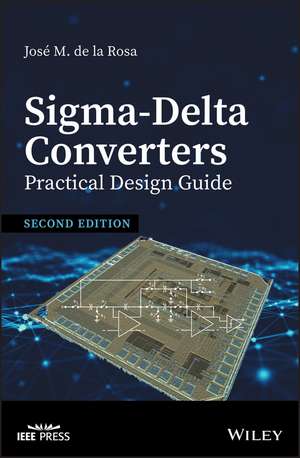
Sigma-Delta Converters: Practical Design Guide
Autor Jose M de la Rosaen Limba Engleză Hardback – 13 noi 2018
Sigma-Delta Modulators (Ms) have become one of the best choices for the implementation of analog/digital interfaces of electronic systems integrated in CMOS technologies. Compared to other kinds of Analog-to-Digital Converters (ADCs), Ms cover one of the widest conversion regions of the resolution-versus-bandwidth plane, being the most efficient solution to digitize signals in an increasing number of applications, which span from high-resolution low-bandwidth digital audio, sensor interfaces, and instrumentation, to ultra-low power biomedical systems and medium-resolution broadband wireless communications.
Following the spirit of its first edition, Sigma-Delta Converters: Practical Design Guide, 2nd Edition takes a comprehensive look at Ms, their diverse types of architectures, circuit techniques, analysis synthesis methods, and CAD tools, as well as their practical design considerations. It compiles and updates the current research reported on the topic, and explains the multiple trade-offs involved in the whole design flow of Ms--from specifications to chip implementation and characterization. The book follows atop-downapproach in order to provide readers with the necessary understanding about recent advances, trends, and challenges in state-of-the-art Ms. It places more emphasis on two key points, which were not treated so deeply in the first edition:
- It includes a more detailed explanation of Ms implemented using Continuous-Time (CT) circuits, going from system-level synthesis to practical circuit limitations.
- It provides more practical case studies and applications, as well as a deeper description of the synthesis methodologies and CAD tools employed in the design of converters.
Preț: 906.68 lei
Preț vechi: 996.36 lei
-9%
Puncte Express: 1360
Carte tipărită la comandă
Livrare economică 02-16 decembrie
Livrare prin curier în România Termenul estimat este afișat lângă disponibilitate.
Transport gratuit pentru acest produs Plată online sau ramburs, în funcție de opțiunile comenzii.
Retur gratuit în 14 zile Comandă securizată și suport în română.
Specificații
ISBN-13: 9781119275787
ISBN-10: 1119275784
Pagini: 576
Dimensiuni: 175 x 250 x 35 mm
Greutate: 1.14 kg
Ediția:2nd edition
Editura: Wiley
Locul publicării:Chichester, United Kingdom
ISBN-10: 1119275784
Pagini: 576
Dimensiuni: 175 x 250 x 35 mm
Greutate: 1.14 kg
Ediția:2nd edition
Editura: Wiley
Locul publicării:Chichester, United Kingdom
V-ar putea interesa
-
 Charge Pump IC DesignFeng Pan-41%Preț: 826.03 lei1394.90 lei
 -
 The Homeowner's DIY Guide to Electrical WiringDavid Herres-37%Preț: 162.34 lei259.42 lei
 -
 GNSS Systems and EngineeringShusen Tan-23%Preț: 838.85 lei1089.41 lei
 -
 Sibernetik Hobi - AileTurkay YildizPreț: 272.27 lei
 -
 Sibernetik Hobi - GencTurkay YildizPreț: 272.27 lei
 -
 Arduino Led ProjectsRobert J. Davis IIPreț: 76.48 lei
 -
 The Guitar Amplifier Preventive Maintenence and Repair GuideMR James B. BinghamPreț: 33.01 lei
 -
 Nvivo in 7 StepsDr Troy L. LooneyPreț: 226.93 lei
 -
 -18%Preț: 654.51 lei798.19 lei
 -
 Massive MIMO NetworksEmil Bjornson-8%Preț: 548.70 lei596.40 lei
 -
 High Power Microwave TubesVishal KesariPreț: 341.56 lei
 -
 Nach Hause telefonieren (Tischkalender 2016 DIN A5 quer)K. A. CalvendoPreț: 108.08 lei
 -
 Spectral Enhancement of Organic PhotodetectorsTobias RauchPreț: 379.86 lei
 -
 Preț: 409.89 lei
 -
 Détection des Défauts MécaniquesMohammad Javad Rastegar Fatemi-19%Preț: 527.61 lei651.37 lei
 -
 Les onduleurs multi-niveauxMounia Samira KelaiaiaPreț: 386.08 lei
 -
 Étude de la commande des mouvements dynamiques d¿un robot humanoideJosé Victor Nunez Nalda-15%Preț: 440.25 lei517.94 lei
 -
 Annulation d'intérferences et filtre sur répliqueRabah Maoudj-15%Preț: 522.30 lei614.47 lei
 -
 Continuité de service d'un système éolien à base de MADASondes Sk. Mustapha-19%Preț: 533.31 lei658.41 lei
 -
 -19%Preț: 505.09 lei623.58 lei
 -
 Preț: 247.82 lei
 -
 Preț: 243.93 lei
 -
 Preț: 232.38 lei
Public țintă
Primary: Researchers and electronics engineering practitioners interested in the design of high–performance data converters integrated in nanometer CMOS technologies; mixed–signal designers.Secondary: Undergraduate and graduate (master and PhD) students in electrical engineering or working on Delta–Sigma ADC design/data–converter design.
Cuprins
Preface xix
Acknowledgements xxv
List of Abbreviations xxvii
1 Introduction to ;;;; Modulators: Fundamentals, Basic Architecture and Performance Metrics 1
1.1 Basics of Analog-to-Digital Conversion 2
1.2 Sigma-Delta Modulation 9
1.3 The First-order ¿¿ Modulator 13
1.4 Performance Enhancement and Taxonomy of ¿¿Ms 16
1.5 Putting All The Pieces Together: From ¿¿Ms to ¿¿ ADCs 19
1.6 ¿¿ DACs 22
1.7 Summary 25
References 26
2 Taxonomy of ;;;; Architectures 29
2.1 Second-order ¿¿ Modulators 30
2.2 High-order Single-loop ¿¿Ms 35
2.3 Cascade ¿¿ Modulators 39
2.4 Multi-bit ¿¿ Modulators 49
2.5 Band-pass ¿¿ Modulators 55
2.6 Continuous-time ¿¿ Modulators: Architecture and Basic Concepts 64
2.7 DT-CT Transformation of ¿¿Ms 70
2.8 Direct Synthesis of CT-¿¿Ms 74
2.9 Summary 76
References 76
3 Circuit Errors in Switched-capacitor ;;;; Modulators 83
3.1 Overview of Nonidealities in Switched-capacitor ¿¿ Modulators 84
3.2 Finite Amplifier Gain in SC-¿¿Ms 86
3.3 Capacitor Mismatch in SC-¿¿Ms 90
3.4 Integrator Settling Error in SC-¿¿Ms 91
3.5 Circuit Noise in SC-¿¿Ms 101
3.6 Clock Jitter in SC-¿¿Ms 105
3.7 Sources of Distortion in SC-¿¿Ms 107
3.8 Case Study: High-level Sizing of a ¿¿M 111
3.9 Summary 119
References 119
4 Circuit Errors and Compensation Techniques in Continuous-time ;;;; Modulators 123
4.1 Overview of Nonidealities in Continuous-time ¿¿ Modulators 123
4.2 CT Integrators and Resonators 124
4.3 Finite Amplifier Gain in CT-¿¿Ms 126
4.4 Time-constant Error in CT-¿¿Ms 128
4.5 Finite Integrator Dynamics in CT-¿¿Ms 130
4.6 Sources of Distortion in CT-¿¿Ms 134
4.7 Circuit Noise in CT-¿¿Ms 137
4.8 Clock Jitter in CT-¿¿Ms 140
4.9 Excess Loop Delay in CT-¿¿Ms 149
4.10 Quantizer Metastability in CT-¿¿Ms 155
4.11 Summary 159
References 160
5 Behavioral Modeling and High-level Simulation 165
5.1 Systematic Design Methodology of ¿¿ Modulators 165
5.2 Simulation Approaches for the High-level Evaluation of ¿¿Ms 169
5.3 Implementing ¿¿M Behavioral Models 173
5.4 Efficient Behavioral Modeling of ¿¿M Building Blocks using C-MEX S-functions 188
5.5 SIMSIDES: A SIMULINK-based Behavioral Simulator for ¿¿Ms 209
5.6 Using SIMSIDES for High-level Sizing and Verification of ¿¿Ms 216
5.7 Summary 231
References 231
6 Automated Design and Optimization of ;;;;Ms 235
6.1 Architecture Exploration and Selection: Schreier's Toolbox 236
6.2 Optimization-based High-level Synthesis of ¿¿ Modulators 245
6.3 Lifting Method and Hardware Acceleration to Optimize CT-¿¿Ms 255
6.4 Using Multi-objective Evolutionary Algorithms to Optimize ¿¿Ms 259
6.5 Summary 269
References 269
7 Electrical Design of ;;;;Ms: From Systems to Circuits 271
7.1 Macromodeling ¿¿Ms 272
7.2 Examples of ¿¿M Macromodels 279
7.3 Including Noise in Transient Electrical Simulations of ¿¿Ms 286
7.4 Processing ¿¿M Output Results of Electrical Simulations 294
7.5 Summary 298
References 298
8 Design Considerations of ;;;;M Subcircuits 301
8.1 Design Considerations of CMOS Switches 302
8.2 Design Considerations of Operational Amplifiers 308
8.3 Design Considerations of Transconductors 317
8.4 Design Considerations of Comparators 324
8.5 Design Considerations of Current-Steering DACs 332
8.6 Summary 338
References 338
9 Practical Realization of ;;;;Ms: From Circuits to Chips 341
9.1 Auxiliary ¿¿M Building Blocks 341
9.2 Layout Design, Floorplanning, and Practical Issues 348
9.3 Chip Package, Test PCB, and Experimental Setup 354
9.4 Experimental Test Set-Up 355
9.5 ¿¿M Design Examples and Case Studies 359
9.6 Summary 385
References 386
10 Frontiers, Trends and Challenges: Towards Next-generation ;;;; Modulators 389
10.1 State-of-the-Art ADCs: Nyquist-rate versus ¿¿ Converters 390
10.2 Comparison of Different Categories of ¿¿ ADCs 393
10.3 Empirical and Statistical Analysis of State-of-the-Art ¿¿Ms 408
10.4 Gigahertz-range ¿¿Ms for RF-to-digital Conversion 415
10.5 Enhanced Cascade ¿¿Ms 418
10.6 Power-efficient ¿¿M Loop-filter Techniques 423
10.7 Hybrid ¿¿M/Nyquist-rate ADCs 428
10.8 Time-based ¿¿ ADCs 431
10.9 DAC Techniques for High-performance CT-¿¿Ms 436
10.10 Classification of State-of-the-Art References 437
10.11 Summary and Conclusions 437
References 438
A State-space Analysis of Clock Jitter in CT-;;;;Ms 463
A.1 State-space Representation of NTF (z) 463
A.2 Expectation Value of (¿qn)2 465
A.3 In-band Noise Power due to Clock Jitter 466
References 467
B SIMSIDES User Guide 469
B.1 Getting Started: Installing and Running SIMSIDES 470
B.2 Building and Editing ¿¿M Architectures in SIMSIDES 470
B.3 Analyzing ¿¿Ms in SIMSIDES 473
B.3.1 Node Spectrum Analysis 474
B.3.2 Integrated Power Noise 474
B.3.3 SNR/SNDR 475
B.3.4 Harmonic Distortion 475
B.3.5 Integral and Differential Non-Linearity 477
B.3.6 Multi-tone Power Ratio 477
B.3.7 Histogram 478
B.3.8 Parametric Analysis 478
B.3.9 Monte Carlo Analysis 479
B.4 Optimization Interface 480
B.5 Tutorial Example: Using SIMSIDES to Model and Analyze ¿¿Ms 482
B.5.1 Creating the Cascade 2-1 ¿¿M Block Diagram in SIMSIDES 482
B.5.2 Setting Model Parameters 482
B.5.3 Computing the Output Spectrum 484
B.5.4 SNR versus Input Amplitude Level 486
B.5.5 Parametric Analysis Considering Only One Parameter 487
B.5.6 Parametric Analysis Considering Two Parameters 488
B.5.7 Computing Histograms 489
B.6 Getting Help 489
C SIMSIDES Block Libraries and Models 491
C.1 Overview of SIMSIDES Libraries 491
C.2 Ideal Libraries 492
C.2.1 Ideal Integrators 492
C.2.1.1 Building-block Model Purpose and Description 492
C.2.1.2 Model Parameters 493
C.2.2 Ideal Resonators 493
C.2.2.1 Ideal_LD_Resonator 493
C.2.2.2 Ideal_FE_Resonator 493
C.2.2.3 Ideal_CT_Resonator 493
C.2.3 Ideal Quantizers 494
C.2.3.1 Ideal_Comparator 494
C.2.3.2 Ideal_Comparator_for_SI 495
C.2.3.3 Ideal_Multibit_Quantizer 495
C.2.3.4 Ideal_Multibit_Quantizer_for_SI 496
C.2.3.5 Ideal_Multibit_Quantizer_levels 496
C.2.3.6 Ideal_Multibit_Quantizer_levels_SD2 496
C.2.3.7 Ideal_Sampler 496
C.2.4 Ideal D/A Converters 496
C.2.4.1 Ideal_DAC_for_SI 496
C.2.4.2 Ideal_DAC_dig_level_SD2 497
C.3 Real SC Building-Block Libraries 497
C.3.1 Real SC Integrators 497
C.3.2 Real SC Resonators 501
C.4 Real SI Building-Block Libraries 503
C.4.1 Real SI Integrators 503
C.4.2 Real SI Resonators 505
C.4.3 SI Errors and Model Parameters 506
C.4.3.1 Basic_SI_FE(LD)_Integrator and Basic_SI_FE(LD)_Resonator 506
C.4.3.2 SI_FE(LD)_Int_Finite_Conductance 507
C.4.3.3 SI_FE(LD)_Int_Finite_Conductance & Settling & ChargeInjection 508
C.5 Real CT Building-Block Libraries 508
C.5.1 Real CT Integrators 508
C.5.1.1 Model Parameters used in Transconductors and Gm-C Integrator Building Blocks 511
C.5.1.2 Gm-MC Integrators 511
C.5.1.3 Active-RC Integrators 512
C.5.1.4 MOSFET-C Integrators 513
C.5.2 Real CT Resonators 513
C.5.2.1 Gm-C Resonators 514
C.5.2.2 Gm-LC Resonators 517
C.6 Real Quantizers & Comparators 517
C.7 Real D/A Converters 518
C.8 Auxiliary Blocks 519
Index 523
Acknowledgements xxv
List of Abbreviations xxvii
1 Introduction to ;;;; Modulators: Fundamentals, Basic Architecture and Performance Metrics 1
1.1 Basics of Analog-to-Digital Conversion 2
1.2 Sigma-Delta Modulation 9
1.3 The First-order ¿¿ Modulator 13
1.4 Performance Enhancement and Taxonomy of ¿¿Ms 16
1.5 Putting All The Pieces Together: From ¿¿Ms to ¿¿ ADCs 19
1.6 ¿¿ DACs 22
1.7 Summary 25
References 26
2 Taxonomy of ;;;; Architectures 29
2.1 Second-order ¿¿ Modulators 30
2.2 High-order Single-loop ¿¿Ms 35
2.3 Cascade ¿¿ Modulators 39
2.4 Multi-bit ¿¿ Modulators 49
2.5 Band-pass ¿¿ Modulators 55
2.6 Continuous-time ¿¿ Modulators: Architecture and Basic Concepts 64
2.7 DT-CT Transformation of ¿¿Ms 70
2.8 Direct Synthesis of CT-¿¿Ms 74
2.9 Summary 76
References 76
3 Circuit Errors in Switched-capacitor ;;;; Modulators 83
3.1 Overview of Nonidealities in Switched-capacitor ¿¿ Modulators 84
3.2 Finite Amplifier Gain in SC-¿¿Ms 86
3.3 Capacitor Mismatch in SC-¿¿Ms 90
3.4 Integrator Settling Error in SC-¿¿Ms 91
3.5 Circuit Noise in SC-¿¿Ms 101
3.6 Clock Jitter in SC-¿¿Ms 105
3.7 Sources of Distortion in SC-¿¿Ms 107
3.8 Case Study: High-level Sizing of a ¿¿M 111
3.9 Summary 119
References 119
4 Circuit Errors and Compensation Techniques in Continuous-time ;;;; Modulators 123
4.1 Overview of Nonidealities in Continuous-time ¿¿ Modulators 123
4.2 CT Integrators and Resonators 124
4.3 Finite Amplifier Gain in CT-¿¿Ms 126
4.4 Time-constant Error in CT-¿¿Ms 128
4.5 Finite Integrator Dynamics in CT-¿¿Ms 130
4.6 Sources of Distortion in CT-¿¿Ms 134
4.7 Circuit Noise in CT-¿¿Ms 137
4.8 Clock Jitter in CT-¿¿Ms 140
4.9 Excess Loop Delay in CT-¿¿Ms 149
4.10 Quantizer Metastability in CT-¿¿Ms 155
4.11 Summary 159
References 160
5 Behavioral Modeling and High-level Simulation 165
5.1 Systematic Design Methodology of ¿¿ Modulators 165
5.2 Simulation Approaches for the High-level Evaluation of ¿¿Ms 169
5.3 Implementing ¿¿M Behavioral Models 173
5.4 Efficient Behavioral Modeling of ¿¿M Building Blocks using C-MEX S-functions 188
5.5 SIMSIDES: A SIMULINK-based Behavioral Simulator for ¿¿Ms 209
5.6 Using SIMSIDES for High-level Sizing and Verification of ¿¿Ms 216
5.7 Summary 231
References 231
6 Automated Design and Optimization of ;;;;Ms 235
6.1 Architecture Exploration and Selection: Schreier's Toolbox 236
6.2 Optimization-based High-level Synthesis of ¿¿ Modulators 245
6.3 Lifting Method and Hardware Acceleration to Optimize CT-¿¿Ms 255
6.4 Using Multi-objective Evolutionary Algorithms to Optimize ¿¿Ms 259
6.5 Summary 269
References 269
7 Electrical Design of ;;;;Ms: From Systems to Circuits 271
7.1 Macromodeling ¿¿Ms 272
7.2 Examples of ¿¿M Macromodels 279
7.3 Including Noise in Transient Electrical Simulations of ¿¿Ms 286
7.4 Processing ¿¿M Output Results of Electrical Simulations 294
7.5 Summary 298
References 298
8 Design Considerations of ;;;;M Subcircuits 301
8.1 Design Considerations of CMOS Switches 302
8.2 Design Considerations of Operational Amplifiers 308
8.3 Design Considerations of Transconductors 317
8.4 Design Considerations of Comparators 324
8.5 Design Considerations of Current-Steering DACs 332
8.6 Summary 338
References 338
9 Practical Realization of ;;;;Ms: From Circuits to Chips 341
9.1 Auxiliary ¿¿M Building Blocks 341
9.2 Layout Design, Floorplanning, and Practical Issues 348
9.3 Chip Package, Test PCB, and Experimental Setup 354
9.4 Experimental Test Set-Up 355
9.5 ¿¿M Design Examples and Case Studies 359
9.6 Summary 385
References 386
10 Frontiers, Trends and Challenges: Towards Next-generation ;;;; Modulators 389
10.1 State-of-the-Art ADCs: Nyquist-rate versus ¿¿ Converters 390
10.2 Comparison of Different Categories of ¿¿ ADCs 393
10.3 Empirical and Statistical Analysis of State-of-the-Art ¿¿Ms 408
10.4 Gigahertz-range ¿¿Ms for RF-to-digital Conversion 415
10.5 Enhanced Cascade ¿¿Ms 418
10.6 Power-efficient ¿¿M Loop-filter Techniques 423
10.7 Hybrid ¿¿M/Nyquist-rate ADCs 428
10.8 Time-based ¿¿ ADCs 431
10.9 DAC Techniques for High-performance CT-¿¿Ms 436
10.10 Classification of State-of-the-Art References 437
10.11 Summary and Conclusions 437
References 438
A State-space Analysis of Clock Jitter in CT-;;;;Ms 463
A.1 State-space Representation of NTF (z) 463
A.2 Expectation Value of (¿qn)2 465
A.3 In-band Noise Power due to Clock Jitter 466
References 467
B SIMSIDES User Guide 469
B.1 Getting Started: Installing and Running SIMSIDES 470
B.2 Building and Editing ¿¿M Architectures in SIMSIDES 470
B.3 Analyzing ¿¿Ms in SIMSIDES 473
B.3.1 Node Spectrum Analysis 474
B.3.2 Integrated Power Noise 474
B.3.3 SNR/SNDR 475
B.3.4 Harmonic Distortion 475
B.3.5 Integral and Differential Non-Linearity 477
B.3.6 Multi-tone Power Ratio 477
B.3.7 Histogram 478
B.3.8 Parametric Analysis 478
B.3.9 Monte Carlo Analysis 479
B.4 Optimization Interface 480
B.5 Tutorial Example: Using SIMSIDES to Model and Analyze ¿¿Ms 482
B.5.1 Creating the Cascade 2-1 ¿¿M Block Diagram in SIMSIDES 482
B.5.2 Setting Model Parameters 482
B.5.3 Computing the Output Spectrum 484
B.5.4 SNR versus Input Amplitude Level 486
B.5.5 Parametric Analysis Considering Only One Parameter 487
B.5.6 Parametric Analysis Considering Two Parameters 488
B.5.7 Computing Histograms 489
B.6 Getting Help 489
C SIMSIDES Block Libraries and Models 491
C.1 Overview of SIMSIDES Libraries 491
C.2 Ideal Libraries 492
C.2.1 Ideal Integrators 492
C.2.1.1 Building-block Model Purpose and Description 492
C.2.1.2 Model Parameters 493
C.2.2 Ideal Resonators 493
C.2.2.1 Ideal_LD_Resonator 493
C.2.2.2 Ideal_FE_Resonator 493
C.2.2.3 Ideal_CT_Resonator 493
C.2.3 Ideal Quantizers 494
C.2.3.1 Ideal_Comparator 494
C.2.3.2 Ideal_Comparator_for_SI 495
C.2.3.3 Ideal_Multibit_Quantizer 495
C.2.3.4 Ideal_Multibit_Quantizer_for_SI 496
C.2.3.5 Ideal_Multibit_Quantizer_levels 496
C.2.3.6 Ideal_Multibit_Quantizer_levels_SD2 496
C.2.3.7 Ideal_Sampler 496
C.2.4 Ideal D/A Converters 496
C.2.4.1 Ideal_DAC_for_SI 496
C.2.4.2 Ideal_DAC_dig_level_SD2 497
C.3 Real SC Building-Block Libraries 497
C.3.1 Real SC Integrators 497
C.3.2 Real SC Resonators 501
C.4 Real SI Building-Block Libraries 503
C.4.1 Real SI Integrators 503
C.4.2 Real SI Resonators 505
C.4.3 SI Errors and Model Parameters 506
C.4.3.1 Basic_SI_FE(LD)_Integrator and Basic_SI_FE(LD)_Resonator 506
C.4.3.2 SI_FE(LD)_Int_Finite_Conductance 507
C.4.3.3 SI_FE(LD)_Int_Finite_Conductance & Settling & ChargeInjection 508
C.5 Real CT Building-Block Libraries 508
C.5.1 Real CT Integrators 508
C.5.1.1 Model Parameters used in Transconductors and Gm-C Integrator Building Blocks 511
C.5.1.2 Gm-MC Integrators 511
C.5.1.3 Active-RC Integrators 512
C.5.1.4 MOSFET-C Integrators 513
C.5.2 Real CT Resonators 513
C.5.2.1 Gm-C Resonators 514
C.5.2.2 Gm-LC Resonators 517
C.6 Real Quantizers & Comparators 517
C.7 Real D/A Converters 518
C.8 Auxiliary Blocks 519
Index 523