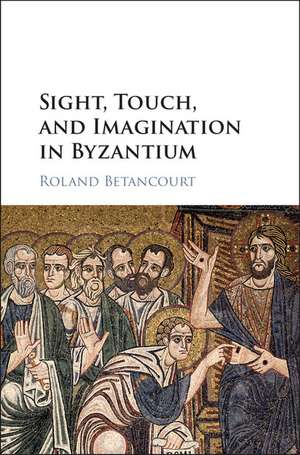
Sight, Touch, and Imagination in Byzantium
Autor Roland Betancourten Limba Engleză Hardback – 11 apr 2018
Reținem, în cele peste 400 de pagini ale acestui studiu dens publicat de Cambridge University Press, o investigație fascinantă asupra modului în care omul medieval „apuca” realitatea prin privire. Volumul propune un raport echilibrat între analiza riguroasă a textelor teoretice și interpretarea artefactelor, oferind o perspectivă rară asupra mecanismelor cognitive din spatele artei bizantine. Roland Betancourt ne invită să explorăm nu doar obiectele de cult, ci însăși experiența subiectivă a celui care le privea, transformând actul vederii într-o formă de atingere intelectuală.
Notăm cu interes modul în care autorul deconstruiește presupunerile despre tactilitatea vederii, demonstrând că în Bizanț, ochiul nu era doar un receptor pasiv, ci un instrument activ de modelare a imaginației și memoriei. Această abordare senzorială continuă preocupările autorului din Performing the Gospels in Byzantium, unde analiza manuscrisele iluminate prin prisma ritualului și a arhitecturii, dar se distanțează de latura politică explorată în The Secrets We Keep pentru a se concentra pe fenomenologia percepției.
Ca și Perceptions of the Body and Sacred Space in Late Antiquity and Byzantium, lucrarea pune în valoare dimensiunea corporală a sacrului, dar cu un accent pe procesele mentale prin care datele senzoriale sunt convertite în imagini de gândire. De asemenea, dacă Interruptions and Transitions: Essays on the Senses in Medieval and Early Modern Visual Culture explorează limitele hermeneuticii imaginii, Betancourt merge mai departe, ancorând experiența vizuală în retorică și dorința de a accesa divinitatea prin mediere materială. Este o lectură care schimbă fundamental înțelegerea modului în care arta bizantină funcționa ca interfață între uman și divin.
Preț: 781.64 lei
Preț vechi: 908.88 lei
-14%
Carte tipărită la comandă
Livrare economică 05-19 iunie
Specificații
ISBN-10: 1108424740
Pagini: 416
Ilustrații: 3 tables
Dimensiuni: 160 x 235 x 26 mm
Greutate: 0.73 kg
Editura: Cambridge University Press
Colecția Cambridge University Press
Locul publicării:Cambridge, United Kingdom
V-ar putea interesa
-
 -33%Preț: 743.12 lei1109.79 lei
 -
 Preț: 378.08 lei
 -
 Experiencing the Last JudgementNiamh BhallaPreț: 356.73 lei
 -
 The Thinking HandJuhani PallasmaaPreț: 308.07 lei
 -
 MeditationsMarcus AureliusPreț: 31.49 lei
 -
 Visual ThinkingRudolf ArnheimPreț: 193.82 lei
 -
 Imagining the DivineJas ElsnerPreț: 356.61 lei
 -
 Between the Pagan Past and Christian Present in Byzantine Visual CultureParoma Chatterjee-11%Preț: 607.99 lei683.14 lei
 -
 Images at the CrossroadsJudith M Barringer-10%Preț: 212.98 lei237.67 lei
 -
 Forms of the VisiblePhilippe DescolaPreț: 276.72 lei
 -
 -21%Preț: 118.97 lei150.01 lei
 -
 The Sensus Communis, Synesthesia, and the SoulEric McLuhanPreț: 118.78 lei
 -
 The Saturated Sensorium: Principles of Perception and Mediation in the Middle AgesHans Henrik Lohfert JorgensenPreț: 355.30 lei
 -
 Crafting Presence: Material Evocations, 300–1300Britta Dümpelmann-18%Preț: 713.45 lei870.06 lei
 -
 -18%Preț: 657.65 lei802.02 lei
 -
 -26%Preț: 109.10 lei146.74 leiRecomandat
De ce să citești această carte
Această lucrare este esențială pentru istoricii de artă și cercetătorii care doresc să înțeleagă cultura bizantină dincolo de estetică. Cititorul câștigă o perspectivă profundă asupra modului în care simțurile modelau credința și cunoașterea în Evul Mediu. Este o recomandare solidă pentru cei pasionați de filosofie, religie și istoria percepției umane, oferind instrumente teoretice noi pentru analiza reprezentărilor sacre.