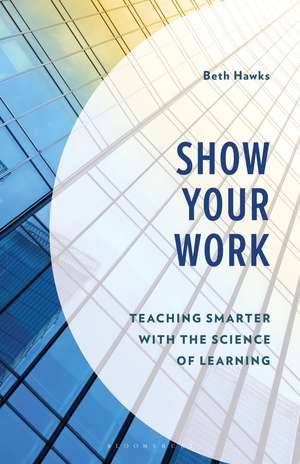
Show Your Work: Teaching Smarter with the Science of Learning
Autor Beth Hawks ConsultantLimba Hardback – 6 aug 2026
Preț: 790.22 lei
Preț vechi: 1113.32 lei
-29% Nou
Puncte Express: 1185
Carte disponibilă
Livrare economică 09-23 noiembrie
Livrare prin curier în România Termenul estimat este afișat lângă disponibilitate.
Transport gratuit pentru acest produs Plată online sau ramburs, în funcție de opțiunile comenzii.
Retur gratuit în 14 zile Comandă securizată și suport în română.
Specificații
ISBN-13: 9798216378518
Pagini: 176
Ilustrații: 4 b/w figures
Dimensiuni: 152 x 229 x 25 mm
Greutate: 0.45 kg
Editura: Bloomsbury Publishing
Colecția Bloomsbury Academic
Locul publicării:New York, United States
Pagini: 176
Ilustrații: 4 b/w figures
Dimensiuni: 152 x 229 x 25 mm
Greutate: 0.45 kg
Editura: Bloomsbury Publishing
Colecția Bloomsbury Academic
Locul publicării:New York, United States
Cuprins
Acknowledgements
Introduction
Chapter 1 - Working Memory
Chapter 2 - Clarity for Learning
Chapter 3 - Prior Knowledge and Schema
Chapter 4 - Focus and Diffuse Modes
Chapter 5 - Rich Encoding
Chapter 6 - The Dangers of Discovery Learning - Engagement is a Means, not an End
Chapter 7 - Modeling and Scaffolding
Chapter 8 - When to Memorize
Chapter 9 - Retrieval Practice
Chapter 10 - Formative Assessment
Conclusion
Citations
Index
Introduction
Chapter 1 - Working Memory
Chapter 2 - Clarity for Learning
Chapter 3 - Prior Knowledge and Schema
Chapter 4 - Focus and Diffuse Modes
Chapter 5 - Rich Encoding
Chapter 6 - The Dangers of Discovery Learning - Engagement is a Means, not an End
Chapter 7 - Modeling and Scaffolding
Chapter 8 - When to Memorize
Chapter 9 - Retrieval Practice
Chapter 10 - Formative Assessment
Conclusion
Citations
Index
Recenzii
Show Your Work: Teaching Smarter with the Science of Learning is a rare gem in the world of education books. Beth Hawks brings the credibility of a seasoned classroom teacher and the curiosity of a lifelong learner to every page. What makes this book stand out is its translation of research into potential strategies that teachers can tryout tomorrow. Beth doesn't just summarize cognitive science-she translates it into actionable steps, all while acknowledging the messy realities of real classrooms. Her candid stories, from both successes and failures, make the advice relatable and authentic. This is not theory in isolation; its research woven into lived experience, presented with clarity and humor. If you want a book that empowers teachers to make evidence-informed decisions without losing the human side of teaching, this is it.
Although research can offer teachers essential classroom guidance, we need a translator to sort out the terminology, the numbers, and all the conflicting suggestions. Enter Beth Hawks, a savvy classroom teacher who clarifies everything from working memory to effect sizes, from schema theory to retrieval practice. With Hawks as your guide, you'll finally know which strategies deserve space in your classroom-and why.
As a high school math teacher, I'm always searching for resources that bridge theory and practice. Show Your Work: Teaching Smarter With the Science of Learning does exactly that. Reading it feels like sitting with Beth Hawks in the teacher's lounge, brainstorming ideas for your own class. Her voice is warm, practical, and grounded in real classroom experience. I walked away with strategies I could implement immediately, while also deepening my understanding of current research in the science of teaching and learning. Teaching is difficult work, best done in community, and through her book, Beth provides the kind of collegial support that lightens the load.
As a school librarian, I teach lessons to many different classes of middle and high school students. Since I'm not with the same students all the time, I have found the practical strategies recommended in the "Retrieval Practice" and "Formative Assessment" chapters to be especially helpful. I had the privilege of learning many of these strategies from Beth firsthand, and I'm confident that Show Your Work will help teachers translate relevant research into effective practice.
Although research can offer teachers essential classroom guidance, we need a translator to sort out the terminology, the numbers, and all the conflicting suggestions. Enter Beth Hawks, a savvy classroom teacher who clarifies everything from working memory to effect sizes, from schema theory to retrieval practice. With Hawks as your guide, you'll finally know which strategies deserve space in your classroom-and why.
As a high school math teacher, I'm always searching for resources that bridge theory and practice. Show Your Work: Teaching Smarter With the Science of Learning does exactly that. Reading it feels like sitting with Beth Hawks in the teacher's lounge, brainstorming ideas for your own class. Her voice is warm, practical, and grounded in real classroom experience. I walked away with strategies I could implement immediately, while also deepening my understanding of current research in the science of teaching and learning. Teaching is difficult work, best done in community, and through her book, Beth provides the kind of collegial support that lightens the load.
As a school librarian, I teach lessons to many different classes of middle and high school students. Since I'm not with the same students all the time, I have found the practical strategies recommended in the "Retrieval Practice" and "Formative Assessment" chapters to be especially helpful. I had the privilege of learning many of these strategies from Beth firsthand, and I'm confident that Show Your Work will help teachers translate relevant research into effective practice.
Notă biografică
Beth Hawks taught middle and high school science for 25 years, stepping out in 2024 after becoming enamored with the science of learning and finding that she loved to talk to teachers about teaching. She is now doing business as The Learning Hawk in order to spread her passion for learning how we learn beyond her own school.