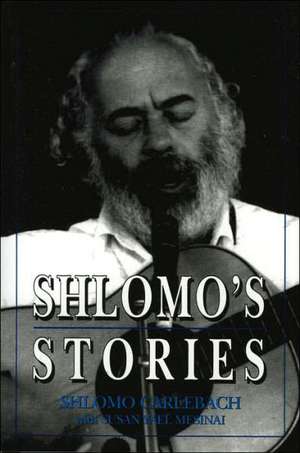
Shlomo's Stories: Selected Tales
Autor Shlomo Carlebach, Susan Yael Mesinaien Limba Engleză Paperback – iun 1996
Preț: 250.12 lei
Preț vechi: 318.94 lei
-22%
Puncte Express: 375
Carte tipărită la comandă
Livrare economică 08-22 iunie
Specificații
ISBN-13: 9781568219608
ISBN-10: 1568219601
Pagini: 290
Dimensiuni: 150 x 228 x 20 mm
Greutate: 0.56 kg
Editura: Bloomsbury Publishing
Colecția Jason Aronson Inc
Locul publicării:New York, United States
ISBN-10: 1568219601
Pagini: 290
Dimensiuni: 150 x 228 x 20 mm
Greutate: 0.56 kg
Editura: Bloomsbury Publishing
Colecția Jason Aronson Inc
Locul publicării:New York, United States
V-ar putea interesa
-
 Origins of the KabbalahGershom ScholemPreț: 466.27 lei
 -
 The Encyclopedia of Jewish Myth, Magic & MysticismGeoffrey W. Dennis-20%Preț: 209.47 lei260.84 lei
 -
 What Are the Dead Sea Scrolls and Why Do They Matter?Pam Fox KuhlkenPreț: 164.31 lei
 -
 Menstrual Purity: Rabbinic and Christian Reconstructions of Biblical GenderCharlotte FonrobertPreț: 204.54 lei
 -
 I Asked for WonderAbraham Joshua HeschelPreț: 116.04 lei
 -
 The Chicken Qabalah of Rabbi Lamed Ben CliffordLon Milo Duquette-15%Preț: 98.79 lei116.65 lei
 -
 Inspired Jewish LeadershipErica BrownPreț: 86.82 lei
 -
 Preț: 73.87 lei
 -
 Relational JudaismRon WolfsonPreț: 108.88 lei
 -
 Cain & AbelSandy Eisenberg SassoPreț: 74.67 lei
 -
 Writings of the Last Generation & the NationRav Yehuda Ashlag-12%Preț: 96.11 lei109.51 lei
 -
 What Do Jews Believe?Edward KesslerPreț: 47.32 lei
 -
 Judaism Alive: Using the Torah to Unlock Your Life's PotentialRabbi Shlomo EinhornPreț: 95.13 lei
 -
 -13%Preț: 213.85 lei246.69 lei
 -
 Preț: 214.26 lei
 -
 Lion Cub of Prague: 3-Volume SetDr Moshe David Kuhr-18%Preț: 373.86 lei457.01 lei
Recenzii
The stories assembled in this anthology are among the favorite hasidic tales told by Rabbi Shlomo Carlebach since his career as a teacher, musician, composer, and storyteller began in the mid-1950s. Internationally famed as a performer and the father of modern hasidic music, Rabbi Carlebach first emerged as a master in his own right when he established the House of Love and Prayer in San Francisco in 1967. Among the first to draw thousands of young people back to Judaism, he initiated a movement that now extends worldwide. While Rabbi Carlebach is best known for his teachings and his creative talents as a musician/composer, his gift as a storyteller has received acclaim in New Age retreats, storytelling seminars, and concerts throughout the world where Jew and non-Jew alike have been drawn to these stories and to their wisdom.
Storytelling is a time-honored means of teaching religion. Susan Yael Mesinai, translator and editor of famous American rabbi/folksinger Shlomo Carlebach's tales, has performed a service in presenting them to a much wider audience here. These stories reveal the mundane and spiritual lives of human beings struggling to make sense of their chaotic experiences. A common thread links them: the idea that faith gives meaning and purpose to ordinary existence. Shlomo's stories-each a sermon in itself-can evoke a responsive chord in anyone. While the themes are primarily Jewish, the stories impart universal religious truths. They suggest that life lived according to basic religious tenets results in good fortune now and joy in the hereafter. They are also literature, employing direct language to convey their message. A glossary of Yiddish terms (Carlebach uses many in his storytelling) removes any possible barriers and provides Mesinai a perfect vehicle for retaining the flavor as well as the linguistic richness of the stories. This book should delight people of all ages and beliefs.
Storytelling is a time-honored means of teaching religion. Susan Yael Mesinai, translator and editor of famous American rabbi/folksinger Shlomo Carlebach's tales, has performed a service in presenting them to a much wider audience here. These stories reveal the mundane and spiritual lives of human beings struggling to make sense of their chaotic experiences. A common thread links them: the idea that faith gives meaning and purpose to ordinary existence. Shlomo's stories-each a sermon in itself-can evoke a responsive chord in anyone. While the themes are primarily Jewish, the stories impart universal religious truths. They suggest that life lived according to basic religious tenets results in good fortune now and joy in the hereafter. They are also literature, employing direct language to convey their message. A glossary of Yiddish terms (Carlebach uses many in his storytelling) removes any possible barriers and provides Mesinai a perfect vehicle for retaining the flavor as well as the linguistic richness of the stories. This book should delight people of all ages and beliefs.