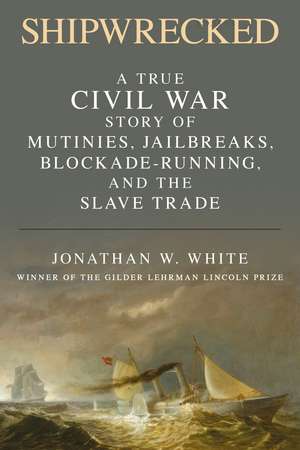
Shipwrecked: A True Civil War Story of Mutinies, Jailbreaks, Blockade-Running, and the Slave Trade
Autor Jonathan W. Whiteen Limba Engleză Paperback – 21 ian 2027
Historian Jonathan W. White tells the riveting story of Appleton Oaksmith, a swashbuckling sea captain whose life intersected with some of the most important moments, movements, and individuals of the mid-19th century, from the California Gold Rush, filibustering schemes in Nicaragua, Cuban liberation, and the Civil War and Reconstruction. Most importantly, the book depicts the extraordinary lengths the Lincoln Administration went to destroy the illegal trans-Atlantic slave trade. Using Oaksmith's case as a lens, White takes readers into the murky underworld of New York City, where federal marshals plied the docks in lower Manhattan in search of evidence of slave trading. Once they suspected Oaksmith, federal authorities had him arrested and convicted, but in 1862 he escaped from jail and became a Confederate blockade-runner in Havana. The Lincoln Administration tried to have him kidnapped in violation of international law, but the attempt was foiled. Always claiming innocence, Oaksmith spent the next decade in exile until he received a presidential pardon from U.S. Grant, at which point he moved to North Carolina and became an anti-Klan politician. Through a remarkable, fast-paced story, this book gives readers a new perspective on slavery and shifting political alliances during the turbulent Civil War Era.
Preț: 84.48 lei
Preț vechi: 118.49 lei
-29% Precomandă
Puncte Express: 127
Carte nepublicată încă
Livrare prin curier în România Precomanda se expediază când titlul devine disponibil.
Transport gratuit de la 400.00 lei Plată online sau ramburs, în funcție de opțiunile comenzii.
Retur gratuit în 14 zile Comandă securizată și suport în română.
Doresc să fiu notificat când acest titlu va fi disponibil:
Se trimite...
Specificații
ISBN-13: 9798216472247
Pagini: 336
Ilustrații: 28 b/w illustration
Dimensiuni: 152 x 226 x 22 mm
Greutate: 0.52 kg
Editura: Bloomsbury Publishing
Colecția Rowman & Littlefield
Locul publicării:New York, United States
Pagini: 336
Ilustrații: 28 b/w illustration
Dimensiuni: 152 x 226 x 22 mm
Greutate: 0.52 kg
Editura: Bloomsbury Publishing
Colecția Rowman & Littlefield
Locul publicării:New York, United States
Cuprins
Illustrations
Acknowledgments
Prologue
Part 1. Youth
Chapter 1: Family
Chapter 2: California
Chapter 3: Africa
Chapter 4: Diplomacy
Chapter 5: Secession
Part 2. War
Chapter 6: The Augusta
Chapter 7: Fort Lafayette
Chapter 8: Fort Warren
Chapter 9: Charles Street Prison
Chapter 10: Execution
Chapter 11: Trial
Part 3. Isolation
Chapter 12: Escape
Chapter 13: Exile
Chapter 14: Lincoln
Chapter 15: Kidnapping
Chapter 16: Divorce
Chapter 17: Storms
Chapter 18: Death
Appendix 1: Oaksmith Family Tree
Appendix 2: The Wells and Manuel Ortiz
Selected Bibliography
Abbreviations in Notes
Notes
Acknowledgments
Prologue
Part 1. Youth
Chapter 1: Family
Chapter 2: California
Chapter 3: Africa
Chapter 4: Diplomacy
Chapter 5: Secession
Part 2. War
Chapter 6: The Augusta
Chapter 7: Fort Lafayette
Chapter 8: Fort Warren
Chapter 9: Charles Street Prison
Chapter 10: Execution
Chapter 11: Trial
Part 3. Isolation
Chapter 12: Escape
Chapter 13: Exile
Chapter 14: Lincoln
Chapter 15: Kidnapping
Chapter 16: Divorce
Chapter 17: Storms
Chapter 18: Death
Appendix 1: Oaksmith Family Tree
Appendix 2: The Wells and Manuel Ortiz
Selected Bibliography
Abbreviations in Notes
Notes
Recenzii
Jonathan W. White, a prizewinning Civil War historian, finds in Oaksmith's spectacularly misguided life both a gripping yarn set far from the battlefields and a way to dramatize Lincoln's determination to eliminate the African slave trade.... The astonishing stories in Shipwrecked ... [offer] a fresh perspective on the mess of pitched emotions and politics in a nation at war over slavery.
Historian White's biography of nineteenth-century mariner Appleton Oaksmith vividly chronicles a life of adventure. Oaksmith sailed to China at 16, witnessed the California Gold Rush, foiled a mutiny on his ship, escaped attack "by three thousand African warriors," and was active in uprisings in Nicaragua and Cuba. During the Civil War, Oaksmith was convicted and imprisoned for modifying a whaling vessel for the transatlantic slave trade. He escaped and captained a Confederate blockade runner and fled to Cuba and then England. Returning to the U.S., he was pardoned by President Grant. As context for Oaksmith's life, White immerses readers in his world, elucidating how New York and New England were "hubs for slave trading"; efforts to end the slave trade by Lincoln, Secretary of State Seward, and other officials; and post-Civil War politics and society. Oaksmith's parents, Seba and Elizabeth, were abolitionists and progressives, with Elizabeth energetically advocating for women's rights. Despite extensive research, White could not determine why Oaksmith rejected his family's values to participate in the slave trade. A distinctive, exciting, and provocative perspective on the Civil War era.
White (A House Built by Slaves), a professor of American Studies at Christopher Newport University, provides a finely grained biography of sea captain Appleton Oaksmith (1828-1887). A "seafarer, poet, jailbird, convict, escapee, exile, and expat," Oaksmith's life "touched some of the most important moments in nineteenth-century American history," writes White, such as first-wave feminism, the Atlantic slave trade, and Southern schemes to seize Cuba and Nicaragua. His parents, Seba Smith and Elizabeth Oakes Smith, were notable literary figures in New York City, and Elizabeth, who is as much the subject of the book as her son, was "a leader in the women's rights movement." A life at sea brought Oaksmith little financial success; accused of fitting out his ship as a slaver, in 1861 he was imprisoned in Fort Lafayette in New York Harbor. Oaksmith-who maintained his innocence-escaped and sailed to Cuba. He eventually returned to the U.S. and was elected to the North Carolina general assembly. Evocative and well researched, White's narrative draws ample evidence from archival sources, including the journals Oaksmith kept at sea. It's an immersive account of a man who was not always likable but whose turbulent life sheds light on the nooks and crannies of the Civil War era.
White here profiles a virtually unknown, 19th-century adventurer seaman named Appleton Oaksmith (1828-1887). During the Antebellum years, that Southerner witnessed or participated in the China trade, the California Gold Rush, Latin American filibustering expeditions, and the African slave trade, including vessel provision. Following Lincoln's 1861 inauguration and the subsequent US crackdown on Northern involvement in such economic aspects of the trade's previously unenforced prohibition, Oaksmith was jailed as a participant, escaped, became a Confederate blockade-runner, and lived in exile until pardoned by President Grant. Returning home to North Carolina, he become a legislator and anti-KKK advocate prior to his death at age 59. Recommended. General readers through faculty.
Appleton Oaksmith had a colorful life, which is amply told in these pages.. The author tells his story artfully and in a manner that-no doubt-undergraduate and graduate students alike will find intriguing.
A gifted storyteller and careful scholar, White uses Oaksmith's action-packed life as a lens to explore some of the major events of the period, including the California gold rush, filibustering in Latin America, southern secession, Confederate blockade-running, Reconstruction, and Abraham Lincoln's concerted (and sometimes extralegal) efforts to destroy the transatlantic slave trade. Indeed, Oaksmith was like a Civil War-era Forrest Gump in the way his life intersected with so many of the period's key themes and episodes... Oaksmith's remarkable story, which White narrates with a dramatist's flair, is yet more evidence that the past is typically more complicated than it seems. Like the best biographers, White effectively situates that story in its larger setting, making Shipwrecked an ideal tool for teaching students (and the public) about key aspects of the Civil War era.
Historian White's biography of nineteenth-century mariner Appleton Oaksmith vividly chronicles a life of adventure. Oaksmith sailed to China at 16, witnessed the California Gold Rush, foiled a mutiny on his ship, escaped attack "by three thousand African warriors," and was active in uprisings in Nicaragua and Cuba. During the Civil War, Oaksmith was convicted and imprisoned for modifying a whaling vessel for the transatlantic slave trade. He escaped and captained a Confederate blockade runner and fled to Cuba and then England. Returning to the U.S., he was pardoned by President Grant. As context for Oaksmith's life, White immerses readers in his world, elucidating how New York and New England were "hubs for slave trading"; efforts to end the slave trade by Lincoln, Secretary of State Seward, and other officials; and post-Civil War politics and society. Oaksmith's parents, Seba and Elizabeth, were abolitionists and progressives, with Elizabeth energetically advocating for women's rights. Despite extensive research, White could not determine why Oaksmith rejected his family's values to participate in the slave trade. A distinctive, exciting, and provocative perspective on the Civil War era.
White (A House Built by Slaves), a professor of American Studies at Christopher Newport University, provides a finely grained biography of sea captain Appleton Oaksmith (1828-1887). A "seafarer, poet, jailbird, convict, escapee, exile, and expat," Oaksmith's life "touched some of the most important moments in nineteenth-century American history," writes White, such as first-wave feminism, the Atlantic slave trade, and Southern schemes to seize Cuba and Nicaragua. His parents, Seba Smith and Elizabeth Oakes Smith, were notable literary figures in New York City, and Elizabeth, who is as much the subject of the book as her son, was "a leader in the women's rights movement." A life at sea brought Oaksmith little financial success; accused of fitting out his ship as a slaver, in 1861 he was imprisoned in Fort Lafayette in New York Harbor. Oaksmith-who maintained his innocence-escaped and sailed to Cuba. He eventually returned to the U.S. and was elected to the North Carolina general assembly. Evocative and well researched, White's narrative draws ample evidence from archival sources, including the journals Oaksmith kept at sea. It's an immersive account of a man who was not always likable but whose turbulent life sheds light on the nooks and crannies of the Civil War era.
White here profiles a virtually unknown, 19th-century adventurer seaman named Appleton Oaksmith (1828-1887). During the Antebellum years, that Southerner witnessed or participated in the China trade, the California Gold Rush, Latin American filibustering expeditions, and the African slave trade, including vessel provision. Following Lincoln's 1861 inauguration and the subsequent US crackdown on Northern involvement in such economic aspects of the trade's previously unenforced prohibition, Oaksmith was jailed as a participant, escaped, became a Confederate blockade-runner, and lived in exile until pardoned by President Grant. Returning home to North Carolina, he become a legislator and anti-KKK advocate prior to his death at age 59. Recommended. General readers through faculty.
Appleton Oaksmith had a colorful life, which is amply told in these pages.. The author tells his story artfully and in a manner that-no doubt-undergraduate and graduate students alike will find intriguing.
A gifted storyteller and careful scholar, White uses Oaksmith's action-packed life as a lens to explore some of the major events of the period, including the California gold rush, filibustering in Latin America, southern secession, Confederate blockade-running, Reconstruction, and Abraham Lincoln's concerted (and sometimes extralegal) efforts to destroy the transatlantic slave trade. Indeed, Oaksmith was like a Civil War-era Forrest Gump in the way his life intersected with so many of the period's key themes and episodes... Oaksmith's remarkable story, which White narrates with a dramatist's flair, is yet more evidence that the past is typically more complicated than it seems. Like the best biographers, White effectively situates that story in its larger setting, making Shipwrecked an ideal tool for teaching students (and the public) about key aspects of the Civil War era.