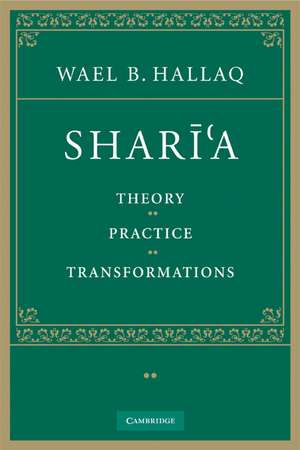
Sharī'a: Theory, Practice, Transformations
Autor Wael B. Hallaqen Limba Engleză Paperback – 15 apr 2009
Adresat studenților în istoria Orientului Mijlociu, cercetătorilor în drept comparat și practicienilor interesați de nuanțele juridice ale lumii islamice, acest volum oferă o claritate conceptuală rară într-un domeniu marcat de interpretări politizate. În Sharī'a, Wael B. Hallaq propune o analiză monumentală a legii islamice, examinând modul în care aceasta a funcționat ca o busolă morală esențială înainte de transformările radicale impuse de epoca modernă. Remarcăm capacitatea autorului de a trasa o hartă vastă, din Arabia secolului al VII-lea până în diversele spații culturale din India sau Asia de Sud-Est, explicând cum structurile juridice s-au adaptat și au fost ulterior reconfigurate sub presiunea colonialismului și a statului-națiune.
Subliniem faptul că Wael B. Hallaq nu este la prima incursiune în acest subiect, lucrarea de față reprezentând o maturizare a ideilor prezentate în A History of Islamic Legal Theories. Dacă în acea lucrare accentul cădea pe fundamentele metodologice, Sharī'a extinde perspectiva către practica socială și transformările politice. Comparabil cu An Introduction to Islamic Law în rigurozitate, volumul de față este însă actualizat pentru a răspunde provocărilor contemporane, oferind o viziune mult mai amplă asupra modului în care legea a fost „demontată” și reasamblată în modernitate. Apreciem în mod deosebit rigoarea cu care sunt tratate perioadele de tranziție de sub Imperiul Otoman, oferind cititorului un instrument de lucru indispensabil pentru a înțelege tensiunile dintre tradiție și codificările de tip occidental abordate de autor și în Islamic Law and the Challenges of Modernity.
Preț: 398.67 lei
Carte tipărită la comandă
Livrare economică 02-16 iulie
Specificații
ISBN-10: 0521678749
Pagini: 626
Dimensiuni: 152 x 228 x 29 mm
Greutate: 0.89 kg
Editura: Cambridge University Press
Colecția Cambridge University Press
Locul publicării:Cambridge, United Kingdom
V-ar putea interesa
-
 Fire Strike 7/9Damien LewisPreț: 115.42 lei
 -
 The Constitutional System of TurkeyE. ÖzbudunPreț: 375.28 lei
 -
 Democracy, Islam and Secularism in TurkeyAhmet Kuru-27%Preț: 689.64 lei944.71 lei
 -
 Essays in Ottoman and Turkish History, 1774-1923: The Impact of the WestRoderic H. DavisonPreț: 230.84 lei
 -
 -8%Preț: 424.03 lei460.91 lei
 -
 The 1967 Arab-Israeli War: Origins and ConsequencesWm Roger LouisPreț: 201.81 lei
 -
 Saladin: The Politics of the Holy WarMalcolm Cameron LyonsPreț: 427.81 lei
 -
 The Arab-Israeli ConflictTony McAleavyPreț: 259.19 lei
 -
 Levant: Splendour and Catastrophe on the MediterraneanPhilip Mansel-27%Preț: 76.70 lei105.41 lei
 -
 Preț: 281.00 lei
 -
 A History of Modern IsraelColin ShindlerPreț: 211.34 lei
 -
 -34%Preț: 801.35 lei1205.68 lei
 -
 The Palestine PapersClayton E. SwisherPreț: 101.18 lei
 -
 The Great Caliphs: The Golden Age of the 'Abbasid EmpireAmira K. Bennison-20%Preț: 179.42 lei224.86 lei
De ce să citești această carte
Această lucrare este esențială pentru oricine dorește să depășească simplificările mediatice despre legea islamică. Cititorul câștigă o înțelegere profundă a Sharī'a ca sistem etic și juridic viu, nu doar ca set de reguli statice. Este recomandată specialiștilor care caută un cadru teoretic solid și o perspectivă istorică documentată asupra modului în care tradiția juridică islamică a navigat prin provocările colonialismului și ale statului modern.
Descriere scurtă
Cuprins
Recenzii
'A work of deep learning and great theoretical sophistication, yet highly accessible, this book offers an unrivaled introduction to the Islamic legal tradition. The moral underpinnings of the law have never before been highlighted more clearly or in such varied social and political contexts. Hallaq's portrayal of how the Shari`a has come to be imagined in the modern world and the transformative impact of the nation-state on all facets of Islamic law brings new perspectives to the study of colonial and post-colonial societies, Muslim politics, and modern Islamic thought.' Muhammad Qasim Zaman, author of The Ulama in Contemporary Islam