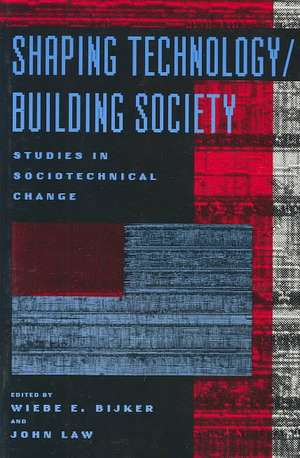
Shaping Technology / Building Society
Editat de Wiebe E. Bijker, John Lawen Limba Engleză Paperback – 29 sep 1994
Preț: 468.72 lei
Puncte Express: 703
Carte tipărită la comandă
Livrare economică 23 noiembrie-07 decembrie
Livrare prin curier în România Termenul estimat este afișat lângă disponibilitate.
Transport gratuit pentru acest produs Plată online sau ramburs, în funcție de opțiunile comenzii.
Retur gratuit în 14 zile Comandă securizată și suport în română.
Specificații
ISBN-13: 9780262521949
ISBN-10: 0262521946
Pagini: 352
Ilustrații: 21
Dimensiuni: 152 x 229 x 20 mm
Greutate: 0.51 kg
Ediția:Revised
Editura: Mit Press
ISBN-10: 0262521946
Pagini: 352
Ilustrații: 21
Dimensiuni: 152 x 229 x 20 mm
Greutate: 0.51 kg
Ediția:Revised
Editura: Mit Press
V-ar putea interesa
-
 Demanding the ImpossiblePeter MarshallPreț: 143.63 lei
 -
 -28%Preț: 408.70 lei567.96 lei
 -
 Tall Tales about the Mind and Brain: Separating fact from fictionSergio Della Sala-28%Preț: 501.43 lei692.91 lei
 -
 Cosmos and PsycheRichard TarnasPreț: 138.18 lei
 -
 The Foundations of Modern Political ThoughtQuentin SkinnerPreț: 206.54 lei
 -
 BodinJean BodinPreț: 272.15 lei
 -
 MarxKarl MarxPreț: 136.34 lei
 -
 LockeJohn LockePreț: 169.13 lei
 -
 MorrisWilliam MorrisPreț: 317.34 lei
 -
 -19%Preț: 511.38 lei631.33 lei
 -
 StirnerMax StirnerPreț: 444.78 lei
 -
 Preț: 306.52 lei
 -
 -19%Preț: 467.69 lei577.39 lei
 -
 A History of Western Educational IdeasProfessor Peter Gordon-8%Preț: 436.52 lei474.48 lei
 -
 -15%Preț: 453.11 lei533.08 lei
 -
 Possible WorldsJ.B.S. HaldanePreț: 440.94 lei
 -
 The Normal and the PathologicalGeorges CanguilhemPreț: 215.63 lei
Notă biografică
Wiebe E. Bijker is Professor at Maastricht University and the author of Of Bicycles, Bakelites, and Bulbs: Toward a Theory of Sociotechnical Change (MIT Press) and other books.
John Law is Professor in Sociology at the University of Keele, Staffordshire, England.
Wiebe E. Bijker is Professor at Maastricht University and the author of Of Bicycles, Bakelites, and Bulbs: Toward a Theory of Sociotechnical Change (MIT Press) and other books.
John Law is Professor in Sociology at the University of Keele, Staffordshire, England.
John Law is Professor in Sociology at the University of Keele, Staffordshire, England.
Michel Callon, developer (with Bruno Latour and others) of Actor Network Theory, is Professor at the École des mines de Paris and a Researcher at the Centre de Sociologie de l'innovation there.
Geoffrey C. Bowker is Professor and Director of the Evoke Lab at the University of California, Irvine. He is the coauthor (with Susan Leigh Star) of Sorting Things Out: Classification and Its Consequences and the author of Memory Practices in the Sciences, both published by the MIT Press.
Wiebe E. Bijker is Professor at Maastricht University and the author of Of Bicycles, Bakelites, and Bulbs: Toward a Theory of Sociotechnical Change (MIT Press) and other books.
Thomas J. Misa is ERA-Land Grant Professor of the History of Technology at the University of Minnesota, where he directs the Charles Babbage Institute. His books include Modernity and Technology (coedited with Philip Brey and Andrew Feenberg; MIT Press, 2003).
Bruno Latour, a philosopher and anthropologist, is the author of We Have Never Been Modern, An Inquiry into Modes of Existence, Facing Gaia, Down to Earth, and many other books. He coedited (with Peter Weibel) the previous ZKM volumes Making Things Public, ICONOCLASH, and Reset Modernity! (all published by the MIT Press).
Bruno Latour, a philosopher and anthropologist, is the author of We Have Never Been Modern, An Inquiry into Modes of Existence, Facing Gaia, Down to Earth, and many other books. He coedited (with Peter Weibel) the previous ZKM volumes Making Things Public, ICONOCLASH, and Reset Modernity! (all published by the MIT Press).
Trevor Pinch is Goldwin Smith Professor of Science and Technology Studies at Cornell University and coeditor of The Social Construction of Technological Systems: New Directions in the Sociology and History of Technology (anniversary edition, MIT Press).
John Law is Professor in Sociology at the University of Keele, Staffordshire, England.
Wiebe E. Bijker is Professor at Maastricht University and the author of Of Bicycles, Bakelites, and Bulbs: Toward a Theory of Sociotechnical Change (MIT Press) and other books.
John Law is Professor in Sociology at the University of Keele, Staffordshire, England.
Wiebe E. Bijker is Professor at Maastricht University and the author of Of Bicycles, Bakelites, and Bulbs: Toward a Theory of Sociotechnical Change (MIT Press) and other books.
John Law is Professor in Sociology at the University of Keele, Staffordshire, England.
John Law is Professor in Sociology at the University of Keele, Staffordshire, England.
Michel Callon, developer (with Bruno Latour and others) of Actor Network Theory, is Professor at the École des mines de Paris and a Researcher at the Centre de Sociologie de l'innovation there.
Geoffrey C. Bowker is Professor and Director of the Evoke Lab at the University of California, Irvine. He is the coauthor (with Susan Leigh Star) of Sorting Things Out: Classification and Its Consequences and the author of Memory Practices in the Sciences, both published by the MIT Press.
Wiebe E. Bijker is Professor at Maastricht University and the author of Of Bicycles, Bakelites, and Bulbs: Toward a Theory of Sociotechnical Change (MIT Press) and other books.
Thomas J. Misa is ERA-Land Grant Professor of the History of Technology at the University of Minnesota, where he directs the Charles Babbage Institute. His books include Modernity and Technology (coedited with Philip Brey and Andrew Feenberg; MIT Press, 2003).
Bruno Latour, a philosopher and anthropologist, is the author of We Have Never Been Modern, An Inquiry into Modes of Existence, Facing Gaia, Down to Earth, and many other books. He coedited (with Peter Weibel) the previous ZKM volumes Making Things Public, ICONOCLASH, and Reset Modernity! (all published by the MIT Press).
Bruno Latour, a philosopher and anthropologist, is the author of We Have Never Been Modern, An Inquiry into Modes of Existence, Facing Gaia, Down to Earth, and many other books. He coedited (with Peter Weibel) the previous ZKM volumes Making Things Public, ICONOCLASH, and Reset Modernity! (all published by the MIT Press).
Trevor Pinch is Goldwin Smith Professor of Science and Technology Studies at Cornell University and coeditor of The Social Construction of Technological Systems: New Directions in the Sociology and History of Technology (anniversary edition, MIT Press).
John Law is Professor in Sociology at the University of Keele, Staffordshire, England.
Wiebe E. Bijker is Professor at Maastricht University and the author of Of Bicycles, Bakelites, and Bulbs: Toward a Theory of Sociotechnical Change (MIT Press) and other books.
Descriere
Building on the influential book The Social Construction of Technological Systems, this volume carries forward the project of creating a theory of technological development and implementation that is strongly grounded in both sociology and history.