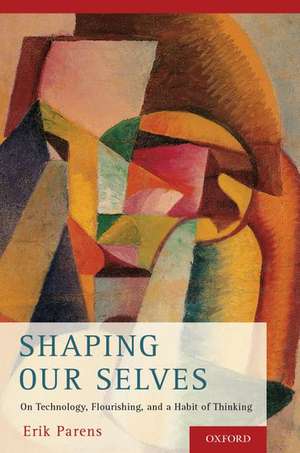
Shaping Our Selves: On Technology, Flourishing, and a Habit of Thinking
Autor Erik Parensen Limba Engleză Hardback – 13 noi 2014
Preț: 398.95 lei
Preț vechi: 537.75 lei
-26%
Puncte Express: 598
Carte tipărită la comandă
Livrare economică 26 noiembrie-02 decembrie
Livrare prin curier în România Termenul estimat este afișat lângă disponibilitate.
Transport gratuit de la 400.00 lei Plată online sau ramburs, în funcție de opțiunile comenzii.
Retur gratuit în 14 zile Comandă securizată și suport în română.
Specificații
ISBN-13: 9780190211745
ISBN-10: 0190211741
Pagini: 216
Dimensiuni: 211 x 145 x 23 mm
Greutate: 0.36 kg
Editura: Oxford University Press
Colecția OUP USA
Locul publicării:New York, United States
ISBN-10: 0190211741
Pagini: 216
Dimensiuni: 211 x 145 x 23 mm
Greutate: 0.36 kg
Editura: Oxford University Press
Colecția OUP USA
Locul publicării:New York, United States
V-ar putea interesa
-
 -31%Preț: 554.67 lei806.02 lei
 -
 When Everyone Knows That Everyone Knows...Steven PinkerPreț: 136.05 lei
 -
 Don't Burn Anyone at the Stake TodayNaomi AldermanPreț: 121.01 lei
 -
 Shared WisdomAlex PentlandPreț: 157.02 lei
 -
 If Anyone Builds It, Everyone DiesEliezer Yudkowsky-20%Preț: 130.65 lei163.30 lei
 -
 MeditationsMarcus AureliusPreț: 34.00 lei
 -
 Against the MachinePaul KingsnorthPreț: 193.57 lei
 -
 Always RememberCharlie MackesyPreț: 157.44 lei
 -
 Hacking HumanityLara LewingtonPreț: 123.80 lei
 -
 Smartphone NationKaitlyn RegehrPreț: 122.17 lei
 -
 The View from NinetyCharles B. HandyPreț: 106.76 lei
 -
 Imperfect OracleCass R. SunsteinPreț: 147.45 lei
 -
 The Future Loves YouAriel Zeleznikow-JohnstonPreț: 93.58 lei
 -
 Rethinking OurselvesAnwar IbrahimPreț: 164.85 lei
 -
 Could Should Might Don'tNick FosterPreț: 123.47 lei
 -
 The ImmortalistsAleks KrotoskiPreț: 123.00 lei
 -
 The AI ConEmily M. BenderPreț: 151.96 lei
Recenzii
One will read this book and be persuaded by the approachâThis volume will prove useful for those approaching this subject for the first time and Parens provides brief but useful discussions of various arguments in the enhancement controversies related to antidepressants and disabilities to illustrate both monocular and binocular approaches.
This is a wise and beautifully written book, which heralds the next wave in the bioethical analysis of the 'enhancement' uses of biomedical technologies and body-shaping surgeries. Parens' 'binocular' habit of thinking is just what the field needs now, and applies well beyond the specific issues addressed in this volume.
In this cogent and lucidly written work, Parens provides a clear-headed and open-hearted approach to dealing with the vexing questions raised by enhancement technologies. The use of technologies by which humans try to shape their bodies and their destinies must be viewed, he persuades us, by using two lenses at once-an approach that achieves depth of intellectual vision by benefitting from the insights of critics and enthusiasts alike. In the end, we have to take a stance, but we come to it not through an agonistic 'win the argument' approach, but through a careful, empathetic understanding of both positions. This judicious approach is so desperately needed in a combative discipline like philosophy and its offspring bioethics and still more a world filled with conflict and strife where too many think only through one self-righteous and dogmatic lens.
Chapter 6 alone is worth the price of the book. To look at enhancement technologies through Parens's binoculars is to bring them into lucid ethical focus. At the same time one sees a charming, gentle, and deeply knowledgeable man reaching out reconciling hands to fit together the insights from both critics and enthusiasts.
This is a book of remarkable clarity and balance; it illuminates important issues in bioethics with a substantial degree of care and respect for opposing perspectives in difficult, ongoing debates about the body, identity, disability and technology. Erik Parens' determined vision of a middle-ground in these debates challenges the 'knockers' and the 'boosters' to abandon their respective megaphones and discover more of what they might have in common. This is an essential book especially for those starting out in bioethics; would that there were more books that gave students a balanced perspective on 'hot' issues from the start.
This is a wise and beautifully written book, which heralds the next wave in the bioethical analysis of the 'enhancement' uses of biomedical technologies and body-shaping surgeries. Parens' 'binocular' habit of thinking is just what the field needs now, and applies well beyond the specific issues addressed in this volume.
In this cogent and lucidly written work, Parens provides a clear-headed and open-hearted approach to dealing with the vexing questions raised by enhancement technologies. The use of technologies by which humans try to shape their bodies and their destinies must be viewed, he persuades us, by using two lenses at once-an approach that achieves depth of intellectual vision by benefitting from the insights of critics and enthusiasts alike. In the end, we have to take a stance, but we come to it not through an agonistic 'win the argument' approach, but through a careful, empathetic understanding of both positions. This judicious approach is so desperately needed in a combative discipline like philosophy and its offspring bioethics and still more a world filled with conflict and strife where too many think only through one self-righteous and dogmatic lens.
Chapter 6 alone is worth the price of the book. To look at enhancement technologies through Parens's binoculars is to bring them into lucid ethical focus. At the same time one sees a charming, gentle, and deeply knowledgeable man reaching out reconciling hands to fit together the insights from both critics and enthusiasts.
This is a book of remarkable clarity and balance; it illuminates important issues in bioethics with a substantial degree of care and respect for opposing perspectives in difficult, ongoing debates about the body, identity, disability and technology. Erik Parens' determined vision of a middle-ground in these debates challenges the 'knockers' and the 'boosters' to abandon their respective megaphones and discover more of what they might have in common. This is an essential book especially for those starting out in bioethics; would that there were more books that gave students a balanced perspective on 'hot' issues from the start.
Notă biografică
Erik Parens is a senior research scholar at The Hastings Center, a bioethics research institute in Garrison, NY. He is also an adjunct professor in the program in Science, Technology, and Society at Vassar College, and a Fellow of the Center for Neuroscience and Society at the University of Pennsylvania.
Cuprins
- Introduction
- Chapter 1: Seeing from Somewhere in Particular
- Chapter 2: Embracing Binocularity
- Chapter 3: Creativity and Gratitude
- Chapter 4: Technology as Value-Free and as Value-Laden
- Chapter 5: Nobody's against True Enhancement
- Chapter 6: Comprehending Persons as Subjects and as Objects
- Chapter 7: Respecting Persons as Subjects and as Objects
- Closing Thoughts