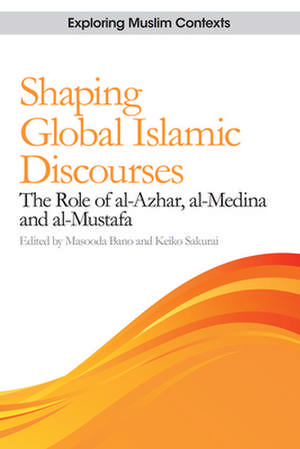
Shaping Global Islamic Discourses
Editat de Masooda Bano, Keiko Sakuraien Limba Engleză Paperback – 24 mar 2017
| Toate formatele și edițiile | Preț | Express |
|---|---|---|
| Paperback (1) | 197.27 lei 3-5 săpt. | |
| EDINBURGH UNIVERSITY PRESS – 24 mar 2017 | 197.27 lei 3-5 săpt. | |
| Hardback (1) | 570.02 lei 6-8 săpt. | |
| EDINBURGH UNIVERSITY PRESS – 20 mar 2015 | 570.02 lei 6-8 săpt. |
Preț: 197.27 lei
Preț vechi: 239.37 lei
-18%
Puncte Express: 296
Preț estimativ în valută:
34.87€ • 40.83$ • 30.45£
34.87€ • 40.83$ • 30.45£
Carte disponibilă
Livrare economică 13-27 februarie
Preluare comenzi: 021 569.72.76
Specificații
ISBN-13: 9781474424165
ISBN-10: 1474424163
Pagini: 240
Dimensiuni: 155 x 231 x 15 mm
Greutate: 0.36 kg
Editura: EDINBURGH UNIVERSITY PRESS
ISBN-10: 1474424163
Pagini: 240
Dimensiuni: 155 x 231 x 15 mm
Greutate: 0.36 kg
Editura: EDINBURGH UNIVERSITY PRESS
V-ar putea interesa
-
 The Qur'anTarif Khalidi-18%Preț: 87.70 lei106.38 lei
 -
 Islamic History: A Very Short IntroductionAdam J. Silverstein-22%Preț: 53.09 lei67.71 lei
 -
 -34%Preț: 660.58 lei997.31 lei
 -
 The Mantle Odes – Arabic Praise Poems to the Prophet MuhammadSuzanne Pinckne StetkevychPreț: 232.09 lei
 -
 The Illustrated Guide to IslamRaana BokhariPreț: 128.58 lei
 -
 Young, British and MuslimDr Philip Lewis-43%Preț: 122.29 lei214.34 lei
 -
 The Art of the Islamic GardenEmma ClarkPreț: 148.93 lei
 -
 Al-Ghazali on Conduct in TravelAbu Hamid al-GhazaliPreț: 109.58 lei
 -
 The Work of Day and NightJalal al-Din SuyutiPreț: 96.03 lei
 -
 Ibn Qayyim al-Jawziyya on KnowledgeIbn Qayyim Al-JawziyyaPreț: 145.00 lei
Notă biografică
Masooda Bano is Professor of Development Studies in the Oxford Department of International Development and Senior Golding Fellow at Brasenose College, University of Oxford. She is author of The Rational Believer: Choices and Decisions in the Madrasas of Pakistan (2012) and Female Islamic Education Movements: The Re-Democratisation of Islamic Knowledge (2017), and co-editor of Women, Leadership and Mosques: Changes in Contemporary Islamic Authority (2012) and Shaping Global Islamic Discourses: The Role of al-Azhar, al-Medina, and al-Mustafa (Edinburgh University Press, 2015, 2017).
Keiko Sakurai is Professor at the Faculty of International Research and Education, School of International Liberal Studies, Waseda University, Tokyo, Japan.
Keiko Sakurai is Professor at the Faculty of International Research and Education, School of International Liberal Studies, Waseda University, Tokyo, Japan.
Descriere
Through case studies of academic institutions the volume illustrates how transmission of ideas is an extremely complex process, and the outcome of such efforts depends not just on the strategies adopted by backers of those ideologies but equally on the characteristics of the receipt communities.