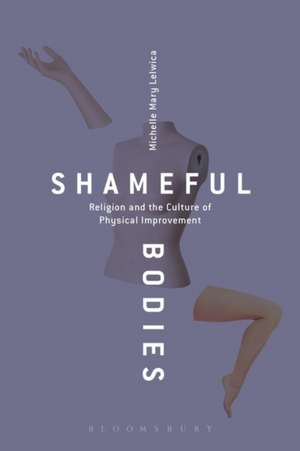
Shameful Bodies: Religion and the Culture of Physical Improvement
Autor Michelle Mary Lelwicaen Limba Engleză Paperback – 12 ian 2017
Shameful Bodies: Religion and the Culture of Physical Improvement explores these questions by examining how traditional religious narratives and modern philosophical assumptions come together in the construction and pursuit of a better body in contemporary western societies. Drawing on examples from popular culture such as self-help books, magazines, and advertisements, Michelle Mary Lelwica shows how these narratives and assumptions encourage us to go to war against our bodies-to fight fat, triumph over disability, conquer chronic pain and illness, and defy aging. Through an ethic of conquest and conformity, the culture of physical improvement trains us not only to believe that all bodily processes are under our control, but to feel ashamed about those parts of our flesh that refuse to comply with the cultural ideal. Lelwica argues that such shame is not a natural response to being fat, physically impaired, chronically sick, or old. Rather, body shame is a religiously and culturally conditioned reaction to a commercially-fabricated fantasy of physical perfection.
While Shameful Bodies critiques the religious and cultural norms and narratives that perpetuate external and internalized judgment and aggression toward "shameful" bodies, it also engages the resources of religions, especially feminist theologies and Buddhist thought/practice, to construct a more affirming approach to health and healing-an approach that affirms the diversity, fragility, interdependence, and impermanence of embodied life.
Preț: 169.63 lei
Puncte Express: 254
Carte tipărită la comandă
Livrare economică 16-30 noiembrie
Livrare prin curier în România Termenul estimat este afișat lângă disponibilitate.
Transport gratuit de la 400.00 lei Plată online sau ramburs, în funcție de opțiunile comenzii.
Retur gratuit în 14 zile Comandă securizată și suport în română.
Specificații
ISBN-13: 9781472594938
ISBN-10: 1472594932
Pagini: 288
Ilustrații: 25 bw illus
Dimensiuni: 156 x 234 x 25 mm
Greutate: 0.41 kg
Editura: Bloomsbury Publishing
Colecția Bloomsbury Academic
Locul publicării:London, United Kingdom
ISBN-10: 1472594932
Pagini: 288
Ilustrații: 25 bw illus
Dimensiuni: 156 x 234 x 25 mm
Greutate: 0.41 kg
Editura: Bloomsbury Publishing
Colecția Bloomsbury Academic
Locul publicării:London, United Kingdom
V-ar putea interesa
-
 Humanism: A Very Short IntroductionStephen Law-20%Preț: 55.78 lei70.14 lei
 -
 Agnosticism: A Very Short IntroductionRobin Le Poidevin-21%Preț: 55.59 lei70.02 lei
 -
 Violence and New Religious MovementsJames R. Lewis-28%Preț: 489.60 lei680.54 lei
 -
 The Book of Atheist SpiritualityAndre Comte-SponvillePreț: 112.69 lei
 -
 Gunning for GodJohn LennoxPreț: 99.17 lei
 -
 The New AtheismMichael PoolePreț: 35.13 lei
 -
 The Secular OutlookPaul CliteurPreț: 221.26 lei
 -
 Christianity Is Not GreatJohn W. LoftusPreț: 179.43 lei
 -
 Everybody Is Wrong about GodJames A. LindsayPreț: 107.29 lei
 -
 The Twilight Of AtheismAlister McgrathPreț: 114.25 lei
 -
 Christian Atheist - Belonging without BelievingBrian MountfordPreț: 75.52 lei
 -
 A Short History of AtheismDr Gavin Hyman-17%Preț: 185.15 lei222.29 lei
Cuprins
List of illustrations
Preface
Acknowledgements
Introduction
Part One
1. Deconstructing the "Better Body" Story
2. Christianity's Hidden Contributions to the Culture of Physical Improvement
3. Religious-like Features of the Culture of Physical Improvement
4. An Alternative Approach to Embodied Life
Part Two
5. Disability Shame
6. Fat Shame
7. The Shame of Chronic Pain and Illness
8. The Shame of Getting Old
Epilogue
Notes
Selected bibliography
Index
Preface
Acknowledgements
Introduction
Part One
1. Deconstructing the "Better Body" Story
2. Christianity's Hidden Contributions to the Culture of Physical Improvement
3. Religious-like Features of the Culture of Physical Improvement
4. An Alternative Approach to Embodied Life
Part Two
5. Disability Shame
6. Fat Shame
7. The Shame of Chronic Pain and Illness
8. The Shame of Getting Old
Epilogue
Notes
Selected bibliography
Index
Recenzii
Lelwica (Concordia College) explores how the fascination with better bodies articulates contemporary priorities and social anxieties. While deftly analyzing the capitalist imperatives driving pop culture, Lelwica draws attention to the implicit religiosity of this fascination, in at least two senses. The first sense suggests how sacred texts and traditions impact how one perceives embodiment; the second sense argues for the quasi-religious functioning of perfecting one's physique. Here the author contends that exercise or beauty regimens operate like religious ritual, and the rhetoric of somatic improvement acts like a "salvation myth." This intriguing premise is only partially borne out in her readings of biblical texts and historical examples. Direct influences from religious discourses, such as theologies of Incarnation or Buddhist notions of impermanence, remain frustratingly vague, such that the enterprise begs the question of what is meant by "secular." Yet Lelwica is, as she writes in chapter 2, "more interested in intersections than causes," and her explication of the underlying connections between ableism, ageism, and fat (and other forms of body) shaming are both clear and convincing. The author integrates autobiographical passages with the ease of an experienced teacher. Summing Up: Recommended. Lower- and upper-division undergraduates; graduate students.
Shameful Bodies takes us on a wonderful journey of renewed understanding of the traps of our dominant culture regarding our bodies. It opens a new creative understanding based on freedom and mutual respect.
This excellent exploration is of interest not only to readers in Religious Studies, but also in Disability, Postcolonial and Feminist Studies. I highly recommend this exceptional work.
. [a] wide-ranging, insightful, and very instructive analysis of Western culture's obsession with bodily perfection ... A book that should appeal to anyone, including high school and college students, interested in the profound impact religion and culture have in shaping our identities and deepest sense of self.
Shameful Bodies takes us on a wonderful journey of renewed understanding of the traps of our dominant culture regarding our bodies. It opens a new creative understanding based on freedom and mutual respect.
This excellent exploration is of interest not only to readers in Religious Studies, but also in Disability, Postcolonial and Feminist Studies. I highly recommend this exceptional work.
. [a] wide-ranging, insightful, and very instructive analysis of Western culture's obsession with bodily perfection ... A book that should appeal to anyone, including high school and college students, interested in the profound impact religion and culture have in shaping our identities and deepest sense of self.