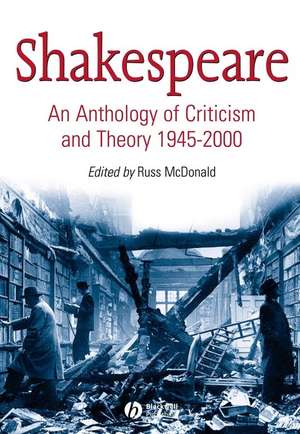
Shakespeare
Editat de Russ Mcdonalden Limba Engleză Paperback – 2 dec 2003
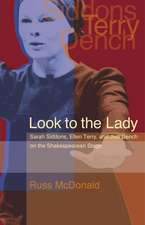
În literatura academică dedicată marelui dramaturg, se resimțea nevoia unei sinteze care să cartografieze transformările radicale ale criticii literare din a doua jumătate a secolului al XX-lea. Suntem de părere că volumul Shakespeare, editat de Russ Mcdonald, reușește să completeze această lacună, oferind o panoramă a celor mai influente 49 de texte critice apărute între 1945 și 2000. Reținem modul în care antologia documentează tranziția de la abordările tradiționale ale unor autori precum E. M. W. Tillyard, către perspectivele contemporane semnate de Stephen Greenblatt sau Catherine Belsey. Această ediție masivă de 960 de pagini nu este doar o colecție de texte, ci o cronică a modului în care s-au schimbat instrumentele noastre de analiză literară. Putem afirma că lucrarea acoperă o arie similară cu Shakespeare Criticism in the Twentieth Century de Michael Taylor, însă Shakespeare adoptă o abordare mai aplicată, oferind textele sursă integrale sau capitole extinse, spre deosebire de o prezentare sintetică a recepției critice. În contextul operei editorului, acest volum continuă efortul pedagogic început în The Bedford Companion to Shakespeare, unde Russ Mcdonald punea accentul pe contextul istoric. Dacă în Look to the Lady autorul se concentra pe istoria interpretării scenice prin prisma actrițelor celebre, aici accentul se mută pe rigoarea teoretică și pe dezbaterea conceptuală, oferind studenților un fundament solid pentru înțelegerea peisajului critic actual.
Preț: 430.40 lei
Carte disponibilă
Livrare economică 29 octombrie-12 noiembrie
Livrare express 14-20 octombrie pentru 95.62 lei
Specificații
ISBN-10: 0631234888
Pagini: 960
Dimensiuni: 170 x 244 x 50 mm
Greutate: 1.61 kg
Editura: John Wiley and Sons Ltd
Locul publicării:Chichester, United Kingdom
V-ar putea interesa
-
 The Merry Wives of WindsorWilliam ShakespearePreț: 76.82 lei
 -
 Shakespeare and the Arts of LanguageRuss McDonald-18%Preț: 211.10 lei256.10 lei
 -
 Shakespearean Tragedy and Its DoubleKent CartwrightPreț: 275.68 lei
 -
 The Bedford Companion to ShakespeareRuss Mcdonald-39%Preț: 228.60 lei375.11 lei
 -
 Hamlet and OedipusErnest JonesPreț: 104.91 lei
 -
 Shakespeare's WordplayProfessor M M MahoodPreț: 407.04 lei
 -
 Shakespeare and the Rival Playwrights, 1600-1606David Farley-Hills-18%Preț: 1150.69 lei1403.28 lei
 -
 Is Shakespeare Still Our Contemporary?John ElsomPreț: 370.01 lei
 -
 Meaning by ShakespeareTerence HawkesPreț: 450.95 lei
 -
 Shakespeare Lexicon and Quotation Dictionary, Vol. 2Alexander SchmidtPreț: 269.06 lei
 -
 Shakespeare's Late StyleRuss McdonaldPreț: 375.28 lei
 -
 William ShakespeareEagletonPreț: 389.85 lei
 -
 Shakespeare and Popular VoiceAnnabel PattersonPreț: 396.96 lei
 -
 Preț: 539.00 lei
 -
 Shakespeares ComediesSmithPreț: 513.56 lei
 -
 Preț: 409.68 lei
 -
 Preț: 428.39 lei
 -
 -18%Preț: 1247.42 lei1521.24 lei
 -
 Remarks on Some of the Characters of Shakespeare: Volume 17Thomas Whately-18%Preț: 1411.65 lei1721.53 lei
 -
 -18%Preț: 1130.69 lei1378.89 lei
 -
 Look to the LadyRuss McdonaldPreț: 235.72 lei
 -
 The Life of William ShakespeareLois PotterPreț: 279.04 lei
 -
 Thinking About ShakespeareKay StockholderPreț: 223.33 lei
 -
 Shakespeare Up Close: Reading Early Modern TextsNicholas D. Nace-14%Preț: 236.99 lei274.38 lei
Public țintă
students of Shakespeare or critical theoryDe ce să citești această carte
Această antologie este un instrument de lucru indispensabil pentru studenții la litere și pentru cei interesați de teoria criticii. Cititorul câștigă acces la jumătate de secol de gândire intelectuală concentrată într-un singur volum, economisind timp de cercetare bibliografică. Este recomandată deoarece explică clar terminologia complexă și oferă contextul necesar pentru a înțelege cum s-au născut marile curente de interpretare shakespeariană modernă.
Despre autor
Russ Mcdonald este un distins specialist în studiile shakespeariene, cunoscut pentru abilitatea sa de a face textele complexe accesibile publicului academic. Activitatea sa editorială și de cercetare se concentrează pe intersecția dintre textul dramatic și contextul său cultural. Prin lucrări precum The Bedford Companion to Shakespeare, a demonstrat un angajament constant față de educația studenților, oferindu-le resurse documentare riguroase. Expertiza sa în analiza performanței scenice și a criticii literare îl poziționează ca o autoritate în domeniu, capabilă să selecteze și să organizeze cele mai relevante contribuții intelectuale ale secolului trecut.
Notă biografică
Descriere scurtă
- An anthology of about 50 of the most significant essays and book chapters published on Shakespeare in the second half of the twentieth century.
- Introduces students to the variety of theoretical positions, thematic claims, methodologies, and modes of argument in Shakespeare criticism over the last 50 years.
- Critical views represented range from the old style historicism of E.M.W. Tillyard and the new criticism of William Empson to the new historicism of Stephen Greenblatt and the feminist perspective of Catherine Belsey.
- Pieces are organised into categories of critical thought and introduced in clear language.
- Most pieces are reproduced in their entirety.
Cuprins
Acknowledgments xiv
Part I Authorship 1
1 Looney and the Oxfordians 4
S. Schoenbaum
Part II New Criticism 15
2 The Naked Babe and the Cloak of Manliness 19
Cleanth Brooks
3 ''Honest'' in Othello 35
William Empson
4 ''Introductory'' Chapter About the Tragedies 50
Wolfgang Clemen
5 The ''New Criticism'' and King Lear 63
William R. Keast
Part III Dramatic Kinds 89
6 The Argument of Comedy 93
Northrop Frye
7 Ambivalence: The Dialectic of the Histories 100
A. P. Rossiter
8 The Saturnalian Pattern 116
C. L. Barber
9 The Jacobean Shakespeare: Some Observations on the Construction of the Tragedies 125
Maynard Mack
Part IV The 1950s and 1960s: Theme, Character, Structure 149
10 Reflections on the Sentimentalist's Othello 152
Barbara Everett
11 Form and Formality in Romeo and Juliet 164
Harry Levin
12 King Lear or Endgame 174
Jan Kott
13 The Cheapening of the Stage 191
Anne Righter [Barton]
14 How Not to Murder Caesar 209
Sigurd Burckhardt
Part V Reader-Response Criticism 221
15 On the Value of Hamlet 225
Stephen Booth
16 Rabbits, Ducks, and Henry V 245
Norman Rabkin
Part VI Textual Criticism and Bibliography 265
17 The New Textual Criticism of Shakespeare 269
Fredson Bowers
18 Revising Shakespeare 280
Gary Taylor
19 Narratives About Printed Shakespeare Texts: ''Foul Papers'' and ''Bad Quartos'' 296
Paul Werstine
Part VII Psychoanalytic Criticism 319
20 ''Anger's my meat'': Feeding, Dependency, and Aggression in Coriolanus 323
Janet Adelman
21 The Avoidance of Love: A Reading of King Lear 338
Stanley Cavell
22 To Entrap the Wisest: Sacrificial Ambivalence in The Merchant of Venice and Richard III 353
René Girard
23 What Did the King Know and When Did He Know It? Shakespearean Discourses and Psychoanalysis 365
Harry Berger, Jr.
24 The Turn of the Shrew 399
Joel Fineman
Part VIII Historicism and New Historicism 417
25 The Cosmic Background 422
E. M. W. Tillyard
26 Invisible Bullets: Renaissance Authority and its Subversion, Henry IV and Henry V 435
Stephen Greenblatt
27 The New Historicism in Renaissance Studies 458
Jean E. Howard
28 ''Shaping Fantasies'': Figurations of Gender and Power in Elizabethan Culture 481
Louis Adrian Montrose
Part IX Materialist Criticism 511
29 Shakespeare's Theater: Tradition and Experiment 515
Robert Weimann
30 King Lear (ca. 1605-1606) and Essentialist Humanism 535
Jonathan Dollimore
31 Give an Account of Shakespeare and Education, Showing Why You Think They Are Effective and What You Have Appreciated About Them. Support Your Comments with Precise References 547
Alan Sinfield
Part X Feminist Criticism 565
32 Egyptian Queens and Male Reviewers: Sexist Attitudes in Antony and Cleopatra Criticism 570
L. T. Fitz [Linda Woodbridge]
33 ''I wooed thee with my sword'': Shakespeare's Tragic Paradigms 591
Madelon Gohlke Sprengnether
34 The Family in Shakespeare Studies; or Studies in the Family of Shakespeareans; or The Politics of Politics 606
Lynda E. Boose
35 Disrupting Sexual Difference: Meaning and Gender in the Comedies 633
Catherine Belsey
Part XI Studies in Gender and Sexuality 651
36 ''This that you call love'': Sexual and Social Tragedy in Othello 655
Gayle Greene
37 The Performance of Desire 669
Stephen Orgel
38 The Secret Sharer 684
Bruce R. Smith
39 The Homoerotics of Shakespearean Comedy 704
Valerie Traub
Part XII Performance Criticism 727
40 Shakespeare and the Blackfriars Theatre 732
Gerald Eades Bentley
41 The Critical Revolution 745
J. L. Styan
42 William Shakespeare's Romeo þ Juliet : Everything's Nice in America? 750
Barbara Hodgdon
43 Deeper Meanings and Theatrical Technique: The Rhetoric of Performance Criticism 762
William B. Worthen
Part XIII Postcolonial Shakespeare 777
44 Nymphs and Reapers Heavily Vanish: The Discursive Con-texts of The Tempest 781
Francis Barker and Peter Hulme
45 Sexuality and Racial Difference 794
Ania Loomba
46 Discourse and the Individual: The Case of Colonialism in The Tempest 817
Meredith Anne Skura
Part XIV Reading Closely 845
47 Shakespeare's Prose 848
Jonas A. Barish
48 The Play of Phrase and Line 861
George T. Wright
49 Transfigurations: Shakespeare and Rhetoric 880
Patricia Parker
Index 908