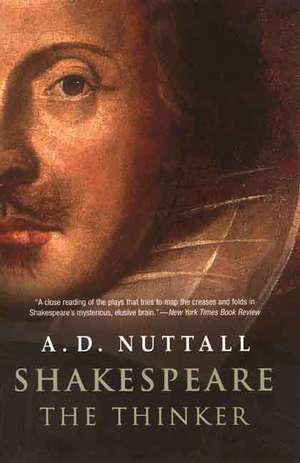
Shakespeare the Thinker
Autor A. D. Nuttallen Limba Engleză Paperback – apr 2008
"A close reading of the plays that tries to map the creases and folds in Shakespeare's mysterious, elusive brain."— New York Times Book Review
A. D. Nuttall’s study of Shakespeare’s intellectual preoccupations is a literary tour de force and comes to crown the distinguished career of a Shakespeare scholar. Certain questions engross Shakespeare from his early plays to the late romances: the nature of motive, cause, personal identity and relation, the proper status of imagination, ethics and subjectivity, language and its capacity to occlude and to communicate. Yet Shakespeare’s thought, Nuttall demonstrates, is anything but static. The plays keep returning to, modifying, and complicating his creative preoccupations. Nuttall allows us to hear and appreciate the emergent cathedral choir of play speaking to play. By the later stages of Nuttall’s book this choir is nearly overwhelming in its power and dimensions. The author does not limit discussion to moments of crucial intellection but gives himself ample space in which to get at the distinctive essence of each work.
Much recent historicist criticism has tended to “flatten” Shakespeare by confining him to the thought-clichés of his time, and this in its turn has led to an implicitly patronizing view of him as unthinkingly racist, sexist, and so on. Nuttall shows us that, on the contrary, Shakespeare proves again and again to be more intelligent and perceptive than his 21st-century readers. This book challenges us to reconsider the relation of great literature to its social and historical matrix. It is also, perhaps, the best guide to Shakespeare’s plays available in English.
A. D. Nuttall’s study of Shakespeare’s intellectual preoccupations is a literary tour de force and comes to crown the distinguished career of a Shakespeare scholar. Certain questions engross Shakespeare from his early plays to the late romances: the nature of motive, cause, personal identity and relation, the proper status of imagination, ethics and subjectivity, language and its capacity to occlude and to communicate. Yet Shakespeare’s thought, Nuttall demonstrates, is anything but static. The plays keep returning to, modifying, and complicating his creative preoccupations. Nuttall allows us to hear and appreciate the emergent cathedral choir of play speaking to play. By the later stages of Nuttall’s book this choir is nearly overwhelming in its power and dimensions. The author does not limit discussion to moments of crucial intellection but gives himself ample space in which to get at the distinctive essence of each work.
Much recent historicist criticism has tended to “flatten” Shakespeare by confining him to the thought-clichés of his time, and this in its turn has led to an implicitly patronizing view of him as unthinkingly racist, sexist, and so on. Nuttall shows us that, on the contrary, Shakespeare proves again and again to be more intelligent and perceptive than his 21st-century readers. This book challenges us to reconsider the relation of great literature to its social and historical matrix. It is also, perhaps, the best guide to Shakespeare’s plays available in English.
Preț: 128.39 lei
Puncte Express: 193
Preț estimativ în valută:
22.70€ • 27.06$ • 19.69£
22.70€ • 27.06$ • 19.69£
Carte disponibilă
Livrare economică 23 februarie-09 martie
Livrare express 07-13 februarie pentru 32.62 lei
Specificații
ISBN-13: 9780300136296
ISBN-10: 0300136293
Pagini: 448
Ilustrații: 1 illus.
Dimensiuni: 156 x 235 x 30 mm
Greutate: 0.54 kg
Editura: Yale University Press
Colecția Yale University Press
ISBN-10: 0300136293
Pagini: 448
Ilustrații: 1 illus.
Dimensiuni: 156 x 235 x 30 mm
Greutate: 0.54 kg
Editura: Yale University Press
Colecția Yale University Press
V-ar putea interesa
-
 ShakespeareHarold BloomPreț: 141.16 lei
 -
 SonnetsWilliam ShakespearePreț: 27.81 lei
 -
 Shakespearean TragedyA. Bradley-20%Preț: 71.87 lei89.70 lei
 -
 Soul of the AgeJonathan BatePreț: 89.87 lei
 -
 -31%Preț: 449.18 lei653.20 lei
 -
 The Complete Sonnets and Poems: The Oxford ShakespeareWilliam Shakespeare-11%Preț: 61.45 lei69.19 lei
 -
 This Is ShakespeareEmma Smith-21%Preț: 59.82 lei75.29 lei
 -
 All the World's Your Stage Shakespeare for TodayFarah Karim-CooperPreț: 119.70 lei
 -
 She Speaks!: What Shakespeare's Women Might Have SaidHarriet WalterPreț: 75.16 lei
 -
 The Taming Of The ShrewWilliam ShakespearePreț: 22.88 lei
 -
 The PoemsWilliam ShakespearePreț: 56.40 lei
 -
 Contested WillJames ShapiroPreț: 102.71 lei
 -
 The Great White BardFarah Karim-CooperPreț: 83.21 lei
 -
 What Was Shakespeare Really Like?Stanley WellsPreț: 102.71 lei
 -
 Preț: 351.45 leiRecomandat
 -
 Shakespeare is Hard, but so is LifeFintan O'Toole-29%Preț: 48.46 lei67.92 lei
 -
 Essential Shakespeare: The Arden Guide to Text and InterpretationDr. Pamela Bickley-6%Preț: 154.69 lei164.92 lei
 -
 King JohnWilliam ShakespearePreț: 37.70 lei
 -
 Characters of Shakespeare's PlaysWilliam HazlittPreț: 67.21 lei
Notă biografică
A. D. Nuttall was professor of English at Oxford University and the author of numerous books, including A Common Sky: Philosophy and the Literary Imagination and Why Does Tragedy Give Pleasure? His books Two Concepts of Allegory and A New Mimesis: Shakespeare and the Representation of Reality are published by Yale University Press.