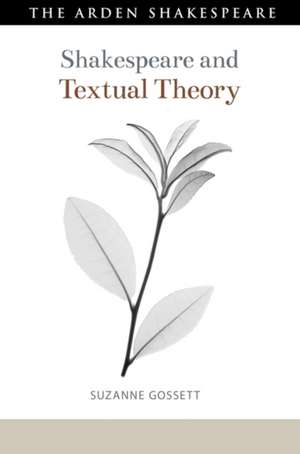
Shakespeare and Textual Theory: Shakespeare and Theory
Autor Prof. Suzanne Gossett Dr Evelyn Gajowskien Limba Engleză Paperback – 10 feb 2022
After providing an introduction to early modern printing practices, Suzanne Gossett describes the original quartos and folios as well as the first collected editions. Subsequent sections summarize the work of the 'New Bibliographers' and the radical challenge to their technical analysis posed by poststructuralist theory, which undermined the presumed stability of author and text. Shakespeare and Textual Theory presents a balanced view of the current theoretical debates, which include the nature of the surviving texts we call Shakespeare's; the relationship of the author 'Shakespeare' and of authorial intentions to any of these texts; the extent and nature of Shakespeare's collaboration with others; and the best or most desirable way to present the texts - in editions or performances. The book is illustrated throughout with examples showing how theoretical decisions affect the text of Shakespeare's plays, and case studies of Hamlet and Pericles demonstrate how different theories complicate both text and meaning, whether a play survives in one version or several. The conclusion summarizes the many ways in which beliefs about Shakespeare's texts have changed over the centuries.
Din seria Shakespeare and Theory
- 28%
 Preț: 170.40 lei
 - 26%
 Preț: 183.18 lei
 - nou
 Preț: 482.97 lei
 - 26%
 Preț: 673.77 lei
 -
 Preț: 170.40 lei
 - 26%
 Preț: 183.58 lei
 - 19%
 Preț: 181.37 lei
 - 30%
 Preț: 175.67 lei
 - 26%
 Preț: 236.53 lei
 - 19%
 Preț: 181.83 lei
 - 30%
 Preț: 181.83 lei
 - 27%
 Preț: 169.14 lei
 - 32%
 Preț: 201.10 lei
 - 31%
 Preț: 511.69 lei
 - 31%
 Preț: 512.45 lei
Preț: 156.82 lei
Preț vechi: 187.13 lei
-16%
Puncte Express: 235
Carte disponibilă
Livrare economică 19 mai-02 iunie
Livrare express 05-09 mai pentru 53.69 lei
Specificații
ISBN-13: 9781350121232
ISBN-10: 1350121231
Pagini: 272
Ilustrații: 6 bw illus
Dimensiuni: 128 x 196 x 16 mm
Greutate: 0.3 kg
Editura: Bloomsbury Publishing
Colecția The Arden Shakespeare
Seria Shakespeare and Theory
Locul publicării:London, United Kingdom
ISBN-10: 1350121231
Pagini: 272
Ilustrații: 6 bw illus
Dimensiuni: 128 x 196 x 16 mm
Greutate: 0.3 kg
Editura: Bloomsbury Publishing
Colecția The Arden Shakespeare
Seria Shakespeare and Theory
Locul publicării:London, United Kingdom
Cuprins
Series Editor's Preface
Acknowledgements
Introduction
Part One: Textual Studies Before 'Theory'
1 Shakespeare's Texts From the Sixteenth to the
Nineteenth Century
The progress of an early modern play
The First Folio
Successive Folios
Early editions
Part Two: Twentieth-Century Theories
2 The New Bibliography
3 The Advent of Poststructuralism
4 Textual and Other Theories
Part Three: Current Debates
5 Authorship, Agency, and Intentionality
6 Attribution and Collaboration
External evidence
Internal evidence
Enlarging the canon
Theoretical implications
7 The (In)Stability of the Text
What if the printer went to lunch?
Why are some texts bad?
Why - and how and when - do some texts change?
8 Editing and Unediting
Editing Shakespeare
Editing collaborations
Unediting Shakespeare
Deciding on intervention
9 Book History and the Text
Shakespeare as literary dramatist
The creation of 'Shakespeare' through books
Readers, commonplacers and collectors
Women and Shakespeare books
Two material texts
10 Performance and the Text
Traces of early performance
Editing for performance
11 Textual Theories and Difficult Cases: Hamlet
and Pericles
Shakespeare's texts and early editions
Enter the New Bibliography
The challenge of post-structuralism, or authorship,
authority, and intention
Textual and other theories
Attribution and collaboration
Printing unstable texts
Editing and unediting
Book history and the text
Performance and the text
Coda: The Immaterial Text
12 Textual Studies After the Digital Turn
References
Index
Acknowledgements
Introduction
Part One: Textual Studies Before 'Theory'
1 Shakespeare's Texts From the Sixteenth to the
Nineteenth Century
The progress of an early modern play
The First Folio
Successive Folios
Early editions
Part Two: Twentieth-Century Theories
2 The New Bibliography
3 The Advent of Poststructuralism
4 Textual and Other Theories
Part Three: Current Debates
5 Authorship, Agency, and Intentionality
6 Attribution and Collaboration
External evidence
Internal evidence
Enlarging the canon
Theoretical implications
7 The (In)Stability of the Text
What if the printer went to lunch?
Why are some texts bad?
Why - and how and when - do some texts change?
8 Editing and Unediting
Editing Shakespeare
Editing collaborations
Unediting Shakespeare
Deciding on intervention
9 Book History and the Text
Shakespeare as literary dramatist
The creation of 'Shakespeare' through books
Readers, commonplacers and collectors
Women and Shakespeare books
Two material texts
10 Performance and the Text
Traces of early performance
Editing for performance
11 Textual Theories and Difficult Cases: Hamlet
and Pericles
Shakespeare's texts and early editions
Enter the New Bibliography
The challenge of post-structuralism, or authorship,
authority, and intention
Textual and other theories
Attribution and collaboration
Printing unstable texts
Editing and unediting
Book history and the text
Performance and the text
Coda: The Immaterial Text
12 Textual Studies After the Digital Turn
References
Index
Recenzii
[A] clearly written and useful explanation of the state of Shakespeare and Textual Theory.
Gossett's breadth of knowledge allows readers to move easily between Shakespeare's time and the last two centuries of criticism . She treats the reader to stylistic clarity, grace in advancing her
ideas, and economy of exposition.
The breadth of [Gossett's] scholarly knowledge, the depth of her editorial experience, and the quality of her pedagogical aptitude are all strongly evident in the book and, combined, produce a text that serves as a useful reference for the seasoned Shakespearean as well as an invaluable tool for the neophyte textual scholar.
Gossett's breadth of knowledge allows readers to move easily between Shakespeare's time and the last two centuries of criticism . She treats the reader to stylistic clarity, grace in advancing her
ideas, and economy of exposition.
The breadth of [Gossett's] scholarly knowledge, the depth of her editorial experience, and the quality of her pedagogical aptitude are all strongly evident in the book and, combined, produce a text that serves as a useful reference for the seasoned Shakespearean as well as an invaluable tool for the neophyte textual scholar.