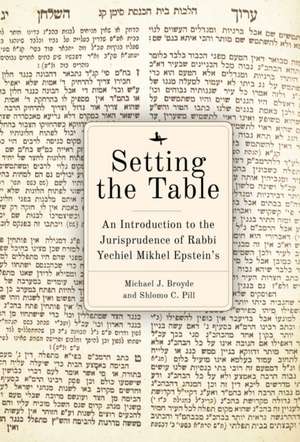
Setting the Table: An Introduction to the Jurisprudence of Rabbi Yechiel Mikhel Epstein’s Arukh HaShulhan
Autor Michael J. Broyde, Shlomo C. Pillen Limba Engleză Paperback – 20 iun 2023
Preț: 264.70 lei
Puncte Express: 397
Carte disponibilă
Livrare economică 05-19 noiembrie
Livrare express 21-27 octombrie pentru 39.61 lei
Livrare prin curier în România Termenul estimat este afișat lângă disponibilitate.
Transport gratuit de la 400.00 lei Plată online sau ramburs, în funcție de opțiunile comenzii.
Retur gratuit în 14 zile Comandă securizată și suport în română.
Specificații
ISBN-13: 9781644695173
ISBN-10: 1644695170
Pagini: 428
Dimensiuni: 156 x 234 x 22 mm
Greutate: 0.59 kg
Editura: Academic Studies Press
Colecția Academic Studies Press
Locul publicării:Boston, MA, United States
ISBN-10: 1644695170
Pagini: 428
Dimensiuni: 156 x 234 x 22 mm
Greutate: 0.59 kg
Editura: Academic Studies Press
Colecția Academic Studies Press
Locul publicării:Boston, MA, United States
Cuprins
Table of Contents
IntroductionPart One: Setting the Table: The Codification of Jewish Law
1. Codifying Jewish Law
2. Rabbi Yechiel Mikhel Epstein’s Arukh HaShulhan
3. Competing Models: The Arukh HaShulhan and Mishnah Berurah
Part Two: The Methodological Principles of the Arukh HaShulhan
Introduction
4. The Rule of the Talmud
5. Rabbinic Consensus
6. Resolving Doubtful Cases
7. Non-Normative Opinions
8. Superogatory Religious Conduct
9. Law and Mysticism
10. Law and Custom
11. Temporal Rationalization of Halakhic Rules
12. Law and Pragmatism
Conclusion
Part Three: Illustrative Examples from the Arukh HaShulhan
The Arukh HaShulhan’s Methodological Principles for Reaching Halakhic Conclusions
Bibliography
Index
Recenzii
“Broyde and Pill’s book is an immensely informative and illuminating read. By taking a traditional jurist seriously as a legal writer and thinker, they have done a real service, especially to the academic communities of Jewish studies and jurisprudence. If it can help bring these, and other similarly inclined constituencies, into conversation, their work has done more than enough.”
— Joshua Schwartz, University of Toronto Faculty of Law, Reading Religion
“Since the Bible, there are three codes that can lay claim to covering the gamut of Jewish law, including laws whose relevance is dependent on the existence of a Temple in Jerusalem: The third-century redaction of the oral tradition Mishna, Maimonides’s twelfth-century magnum opus Mishne torah, and the comprehensive code penned by Rabbi Yehiel Mikhel Halevi Epstein (1829–1908). … Of the three codes, Epstein’s writings have attracted the least attention… In light of the paucity of research on Epstein’s code, Michael J. Broyde and Shlomo C. Pill have made a significant contribution with their volume Setting the Table. Setting the Table complements other recent efforts to recount Epstein’s biography, explore his literary oeuvre, and plumb his legal writings.”
— Levi Cooper, Journal of Law and Religion
“In this fascinating work, Broyde and Pill … bring to life the intellectual choices made by the Arukh Hashulkhan, situating their work within the long history of attempts to codify Jewish law. … This is an invaluable contribution to our understanding of rabbinic jurisprudence.”
—Suzanne Last Stone, Professor of Law, Cardozo Law School, University Professor of Jewish Law and Contemporary Civilization, Yeshiva University
— Joshua Schwartz, University of Toronto Faculty of Law, Reading Religion
“Since the Bible, there are three codes that can lay claim to covering the gamut of Jewish law, including laws whose relevance is dependent on the existence of a Temple in Jerusalem: The third-century redaction of the oral tradition Mishna, Maimonides’s twelfth-century magnum opus Mishne torah, and the comprehensive code penned by Rabbi Yehiel Mikhel Halevi Epstein (1829–1908). … Of the three codes, Epstein’s writings have attracted the least attention… In light of the paucity of research on Epstein’s code, Michael J. Broyde and Shlomo C. Pill have made a significant contribution with their volume Setting the Table. Setting the Table complements other recent efforts to recount Epstein’s biography, explore his literary oeuvre, and plumb his legal writings.”
— Levi Cooper, Journal of Law and Religion
“In this fascinating work, Broyde and Pill … bring to life the intellectual choices made by the Arukh Hashulkhan, situating their work within the long history of attempts to codify Jewish law. … This is an invaluable contribution to our understanding of rabbinic jurisprudence.”
—Suzanne Last Stone, Professor of Law, Cardozo Law School, University Professor of Jewish Law and Contemporary Civilization, Yeshiva University
“Rabbis Broyde and Pill not only analyze the principles used by the author, but they systematically demonstrate how they were applied to specific laws. This work is … valuable both to the outsider and the Talmudic scholar.”
—Rabbi Yosef Blau, Senior Mashgiach Ruchani and Rosh Yeshiva, Rabbi Isaac Elchanan Theological Seminary
“Too often, discussions of halakhic methodology proceed from a few high-profile examples. In this exciting new book, Rabbis Broyde and Pill offer an account of how one of the most important poskim of our era functioned both when the social and religious stakes were high and when they were not. This book not only presents a data-based analysis of the Arukh Hashulchan’s decision making, but a set of tools that can be applied to other works to enhance our understanding of the formation of p’sak more broadly.”
—Chaim Saiman, Professor of Law, Villanova University School of Law & author of Halakha: The Rabbnic Idea of Law (2018)
—Rabbi Yosef Blau, Senior Mashgiach Ruchani and Rosh Yeshiva, Rabbi Isaac Elchanan Theological Seminary
“Too often, discussions of halakhic methodology proceed from a few high-profile examples. In this exciting new book, Rabbis Broyde and Pill offer an account of how one of the most important poskim of our era functioned both when the social and religious stakes were high and when they were not. This book not only presents a data-based analysis of the Arukh Hashulchan’s decision making, but a set of tools that can be applied to other works to enhance our understanding of the formation of p’sak more broadly.”
—Chaim Saiman, Professor of Law, Villanova University School of Law & author of Halakha: The Rabbnic Idea of Law (2018)
Notă biografică
Michael J. Broyde is a law professor at Emory University in Atlanta who has served in a variety of rabbinic positions throughout the United States.
Reuven Travis taught a wide range of classes over his twenty-year career as an educator, including Jewish law, Bible, and Jewish history.