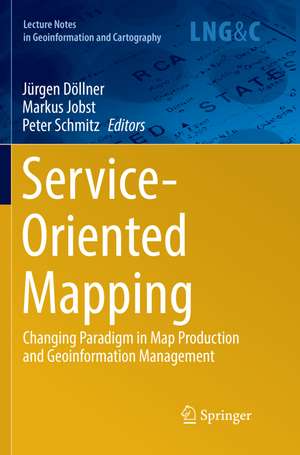
Service-Oriented Mapping: Lecture Notes in Geoinformation and Cartography
Editat de Jürgen Döllner, Markus Jobst, Peter Schmitzen Limba Engleză Paperback – 4 ian 2019
Service-Oriented Mapping is one of the main paradigms used to embed big data and distributed sources in modern map production, without the need to own the sources. To be stable and reliable, this architecture requires specific frameworks, tools and procedures. In addition to the technological structures, organizational aspects and geographic information system (GIS) capabilities provide powerful tools to make modern geoinformation management successful.
Addressing a range of aspects, including the implementation of the semantic web in geoinformatics, using big data for geospatial visualization, standardization initiatives, and the European spatial data infrastructure, the book offers a comprehensive introduction to decentralized map production.
.
Din seria Lecture Notes in Geoinformation and Cartography
- 18%
 Preț: 927.11 lei
 - 18%
 Preț: 1642.58 lei
 - 20%
 Preț: 635.03 lei
 - 18%
 Preț: 995.02 lei
 - 18%
 Preț: 1278.48 lei
 - 18%
 Preț: 1279.56 lei
 - 18%
 Preț: 979.85 lei
 - 18%
 Preț: 987.20 lei
 - 18%
 Preț: 1281.73 lei
 - 18%
 Preț: 984.66 lei
 - 18%
 Preț: 1280.26 lei
 - 18%
 Preț: 988.19 lei
 - 18%
 Preț: 1908.23 lei
 - 18%
 Preț: 982.91 lei
 - 18%
 Preț: 978.23 lei
 - 18%
 Preț: 1232.41 lei
 - 18%
 Preț: 1285.90 lei
 - 18%
 Preț: 1230.57 lei
 - 18%
 Preț: 993.74 lei
 - 15%
 Preț: 663.72 lei
 - 18%
 Preț: 979.66 lei
 - 18%
 Preț: 993.84 lei
 - 5%
 Preț: 1142.98 lei
 - 18%
 Preț: 1269.85 lei
 - 18%
 Preț: 1457.76 lei
 - 18%
 Preț: 957.33 lei
 - 18%
 Preț: 984.17 lei
 - 18%
 Preț: 989.29 lei
 - 18%
 Preț: 983.79 lei
 - 18%
 Preț: 987.83 lei
 - 15%
 Preț: 669.16 lei
 - 18%
 Preț: 913.62 lei
 - 18%
 Preț: 983.90 lei
 - 18%
 Preț: 980.13 lei
 - 18%
 Preț: 988.90 lei
 - 18%
 Preț: 952.24 lei
 - 18%
 Preț: 1276.16 lei
 - 18%
 Preț: 1285.68 lei
 - 18%
 Preț: 1266.91 lei
 - 18%
 Preț: 1279.32 lei
 - 38%
 Preț: 1143.52 lei
 - 18%
 Preț: 1719.95 lei
 - 18%
 Preț: 1286.47 lei
 - 18%
 Preț: 986.75 lei
Preț: 741.39 lei
Preț vechi: 904.14 lei
-18%
Puncte Express: 1112
Carte tipărită la comandă
Livrare economică 01-15 decembrie
Livrare prin curier în România Termenul estimat este afișat lângă disponibilitate.
Transport gratuit pentru acest produs Plată online sau ramburs, în funcție de opțiunile comenzii.
Retur gratuit în 14 zile Comandă securizată și suport în română.
Specificații
ISBN-13: 9783030101992
ISBN-10: 3030101991
Pagini: 464
Ilustrații: XXX, 434 p.
Dimensiuni: 155 x 235 x 25 mm
Greutate: 0.7 kg
Ediția:Softcover reprint of the original 1st edition 2019
Editura: Springer
Colecția Lecture Notes in Geoinformation and Cartography
Seria Lecture Notes in Geoinformation and Cartography
Locul publicării:Cham, Switzerland
ISBN-10: 3030101991
Pagini: 464
Ilustrații: XXX, 434 p.
Dimensiuni: 155 x 235 x 25 mm
Greutate: 0.7 kg
Ediția:Softcover reprint of the original 1st edition 2019
Editura: Springer
Colecția Lecture Notes in Geoinformation and Cartography
Seria Lecture Notes in Geoinformation and Cartography
Locul publicării:Cham, Switzerland
V-ar putea interesa
-
 Community Participation and Geographical Information SystemsWilliam J. Craig-18%Preț: 1429.10 lei1742.81 lei
 -
 Spatial Data QualityWenzhong Shi-18%Preț: 1260.75 lei1537.49 lei
 -
 Developing Spatial Data Infrastructures: From Concept to RealityIan P. Williamson-18%Preț: 1424.91 lei1737.69 lei
 -
 GIS in Public Health PracticeMassimo Craglia-5%Preț: 1648.78 lei1735.56 lei
 -
 Expert Systems and Geographic Information Systems for Impact AssessmentAgustin Rodriguez-Bachiller-15%Preț: 609.13 lei716.63 lei
 -
 Progress in CartographyGeorg Gartner-18%Preț: 1447.08 lei1764.73 lei
 -
 -18%Preț: 1194.00 lei1456.11 lei
 -
 Geographic Information Metadata for Spatial Data InfrastructuresJavier Nogueras-Iso-18%Preț: 979.41 lei1194.40 lei
 -
 -18%Preț: 982.72 lei1198.43 lei
 -
 -15%Preț: 618.19 lei727.28 lei
 -
 -18%Preț: 2415.36 lei2945.56 lei
 -
 Advances in GeoinformaticsAntonio M. V. Monteiro-18%Preț: 987.18 lei1203.87 lei
 -
 Earth Observation Data Policy and EuropeR. Harris-18%Preț: 1252.93 lei1527.97 lei
Cuprins
Changing Paradigm in Map Production and Geoinformation Management – an Introduction.- Service-Oriented Processing and Analysis of Massive Point Clouds in Geoinformation Management.- Establishing Common Ground through INSPIRE: the Legally- Driven European Spatial Data Infrastructure.- Developing a Statistical Geospatial Framework for the European Statistical System.- Vizzuality: Designing Purposeful Maps to Achieve SDGs.- Geospatial Data Mining and Analytics for Real-Estate Ap-plications.- How Standards Help the Geospatial Industry Keep Pace with Advancing Technology.- Standards – Making Geographic Information Discoverable,Accessible and Usable for Modern Cartography.- From Maps to Apps – Entering another Technological Di- mension within the Geological Survey of Austria.
Recenzii
“The articles range in tone from a highly accessible white-paper style—useful to those planning for the use or provisioning of data or maps—to highly technical pieces clearly targeted at those who might be designing the delivery systems.” (Amy Rock, Cartographic Perspectives, Issue 92, 2019)
Textul de pe ultima copertă
This book gathers various perspectives on modern map production. Its primary focus is on the new paradigm of “sharing and reuse,” which is based on decentralized, service-oriented access to spatial data sources.
Service-Oriented Mapping is one of the main paradigms used to embed big data and distributed sources in modern map production, without the need to own the sources. To be stable and reliable, this architecture requires specific frameworks, tools and procedures. In addition to the technological structures, organizational aspects and geographic information system (GIS) capabilities provide powerful tools to make modern geoinformation management successful.
Addressing a range of aspects, including the implementation of the semantic web in geoinformatics, using big data for geospatial visualization, standardization initiatives, and the European spatial data infrastructure, the book offers a comprehensive introduction to decentralized map production.
Service-Oriented Mapping is one of the main paradigms used to embed big data and distributed sources in modern map production, without the need to own the sources. To be stable and reliable, this architecture requires specific frameworks, tools and procedures. In addition to the technological structures, organizational aspects and geographic information system (GIS) capabilities provide powerful tools to make modern geoinformation management successful.
Addressing a range of aspects, including the implementation of the semantic web in geoinformatics, using big data for geospatial visualization, standardization initiatives, and the European spatial data infrastructure, the book offers a comprehensive introduction to decentralized map production.
Caracteristici
Offers a comprehensive introduction to decentralized map production Includes chapters on standardization initiatives spearheaded by the Open Geospatial Consortium (OGC) and International Organization for Standardization (ISO) Features a special chapter on the European spatial data infrastructure, providing essential background information on the initial requirements and challenges Includes a chapter addressing the implementation of the semantic web in geoinformatics Gathers numerous contributions that report on using big data for geospatial visualization Describes recent efforts in statistical geospatial framework integration