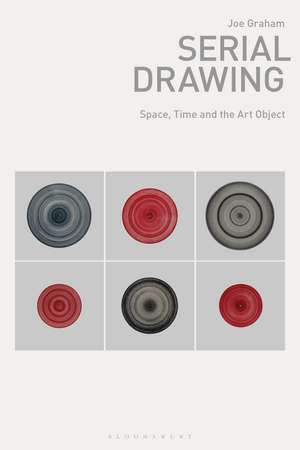
Serial Drawing: Drawing In
Autor Joe Grahamen Limba Engleză Paperback – 11 iul 2024
Inspired by the quadruple framework of Graham Harman's object-oriented ontology, Joe Graham explores a variety of serial drawings according to the idea that, in being serially arrayed, such artworks constitute a rather particular form of art object: one which is both unified yet pluralised, visible yet withdrawn. Examining works by artists such as Alexei Jawlensky, Ellsworth Kelly, Hanne Darboven, Jill Baroff and Stefana McClure, Graham interrogates the manner in which serial drawings are able to be appreciated by the viewer who beholds them in object-oriented terms. This task is carried out by paying attention to the manner in which three tensions - space, time and seriality -emerge for consideration within the beholders performative encounter with the work: an encounter which is 'seen serially', and which the medium of drawing specifically directs their attention towards.





Preț: 203.10 lei
Preț vechi: 259.10 lei
-22%
Puncte Express: 305
Carte disponibilă
Livrare economică 06-17 noiembrie
Livrare express 24-30 octombrie pentru 90.12 lei
Livrare prin curier în România Termenul estimat este afișat lângă disponibilitate.
Transport gratuit de la 400.00 lei Plată online sau ramburs, în funcție de opțiunile comenzii.
Retur gratuit în 14 zile Comandă securizată și suport în română.
Specificații
ISBN-13: 9781350464117
ISBN-10: 1350464112
Pagini: 216
Ilustrații: 21 bw illus
Dimensiuni: 156 x 232 x 14 mm
Greutate: 0.49 kg
Editura: Bloomsbury Publishing
Colecția Drawing In
Seria Drawing In
Locul publicării:London, United Kingdom
ISBN-10: 1350464112
Pagini: 216
Ilustrații: 21 bw illus
Dimensiuni: 156 x 232 x 14 mm
Greutate: 0.49 kg
Editura: Bloomsbury Publishing
Colecția Drawing In
Seria Drawing In
Locul publicării:London, United Kingdom
V-ar putea interesa
-
 Object-Oriented OntologyGraham Harman-31%Preț: 63.54 lei92.51 lei
 -
 Waves and StonesGraham HarmanPreț: 230.87 lei
 -
 Ways of DrawingJulian Bell-16%Preț: 200.38 lei238.00 lei
 -
 The Meaning of Branded ObjectsTom Guarriello-19%Preț: 109.50 lei135.96 lei
 -
 Visual Narrative and Lacanian PsychoanalysisEfrat BibermanPreț: 313.49 lei
 -
 -21%Preț: 209.51 lei264.61 lei
 -
 Drawing Analogies: Diagrams in Art, Theory and PracticeDavid Burrows-33%Preț: 549.59 lei821.20 lei
 -
 Art and ObjectsGraham HarmanPreț: 159.20 lei
 -
 Objects Untimely - Object-Oriented Philosophy and ArchaeologyChristopher WitmorePreț: 156.71 lei
 -
 If You Have Never Thought Gray - A Theory of ColorPeter SloterdijkPreț: 156.79 lei
 -
 Forms of the VisiblePhilippe DescolaPreț: 290.51 lei
 -
 Slow LookingOlivia Meehan-15%Preț: 274.67 lei324.03 lei
 -
 Drawing ArchitectureHelen ThomasPreț: 347.63 lei
 -
 Architecture through DrawingDesley Luscombe-15%Preț: 424.85 lei499.82 lei
 -
 Towards the Ethical Art MuseumGareth HarrisPreț: 161.52 lei
 -
 Preț: 206.30 lei
 -
 Drawing Proper/Drawing ImproperKevin HirthPreț: 205.51 lei
 -
 -24%Preț: 156.80 lei205.53 lei
 -
 Preț: 109.90 lei
 -
 Art & Beauty: Drawings by R. CrumbR. Crumb-23%Preț: 161.18 lei209.20 lei
Cuprins
List of Figures
Introduction
1. A History of Definitions
2. An Object-Oriented Approach
3. Serial Drawing
Conclusion: Seeing Serially
Introduction
1. A History of Definitions
2. An Object-Oriented Approach
3. Serial Drawing
Conclusion: Seeing Serially
Recenzii
Although object-oriented ontology (OOO) has put a great deal of effort into discussing problems of aesthetics, what Joe Graham does in this book is something completely new: he develops the first theory of object-oriented seriality in art. Better yet, he does so with one of the most lucid treatments ever seen of OOO's fourfold object model. I'll be sifting through the implications of this book for a long time to come.
This is a rewarding read and a much needed contribution to debates within the field of serial art. Graham asks what kind of an art object is a serially developed drawing and how is it seen and understood? Through a focussed consideration of serial drawings by Ellsworth Kelly, Alexei Jawlesky, Hanne Darboven and Jill Baroff, Joe Graham deftly leads us into the concept of 'seeing serially' in order to contemplate the performative nature of encounters between viewers and serial artworks.
This book revitalizes drawing as a prime means of developing an intelligence of seeing. Drawing practices, traditionally constrained between representationalism and expressionism, are here articulated through the author's theory of object-oriented seriality, a means to realising the visual potential of the dialectic between objectivity and subjectivity over the passage of time.
Serial art, one may assume, invites little variation in definition, form or theoretical premise. Joe Graham proves differently. After discussing a surprisingly varied range of philosophical definitions of seriality, he establishes grounds for a theoretical position for an embodied mode of serially seeing. As such, (art) objects presenting themselves as serial teach us rather than letting us impose content. This act of seeing privileges an understanding of systems and structures over meaning. Graham's investigation leads us to understand why Harman's object-oriented ontology is indispensable as an aesthetic mode for the 21st century, making us appreciate what emerges and simultaneously withdraws when contemplating art. Nothing is better suited to test this mode than drawing, as (to quote the author) it uniquely combines 'visible material and formal qualities [.] with a conceptual underpinning [.] inherent to serial structure and order'. To which end Graham modifies Harman's ontology and reconfigures it, to correspond to the serial character of drawing, challenging the viewer to overcome passive consumption with the embodiment of active perception.
This is a rewarding read and a much needed contribution to debates within the field of serial art. Graham asks what kind of an art object is a serially developed drawing and how is it seen and understood? Through a focussed consideration of serial drawings by Ellsworth Kelly, Alexei Jawlesky, Hanne Darboven and Jill Baroff, Joe Graham deftly leads us into the concept of 'seeing serially' in order to contemplate the performative nature of encounters between viewers and serial artworks.
This book revitalizes drawing as a prime means of developing an intelligence of seeing. Drawing practices, traditionally constrained between representationalism and expressionism, are here articulated through the author's theory of object-oriented seriality, a means to realising the visual potential of the dialectic between objectivity and subjectivity over the passage of time.
Serial art, one may assume, invites little variation in definition, form or theoretical premise. Joe Graham proves differently. After discussing a surprisingly varied range of philosophical definitions of seriality, he establishes grounds for a theoretical position for an embodied mode of serially seeing. As such, (art) objects presenting themselves as serial teach us rather than letting us impose content. This act of seeing privileges an understanding of systems and structures over meaning. Graham's investigation leads us to understand why Harman's object-oriented ontology is indispensable as an aesthetic mode for the 21st century, making us appreciate what emerges and simultaneously withdraws when contemplating art. Nothing is better suited to test this mode than drawing, as (to quote the author) it uniquely combines 'visible material and formal qualities [.] with a conceptual underpinning [.] inherent to serial structure and order'. To which end Graham modifies Harman's ontology and reconfigures it, to correspond to the serial character of drawing, challenging the viewer to overcome passive consumption with the embodiment of active perception.