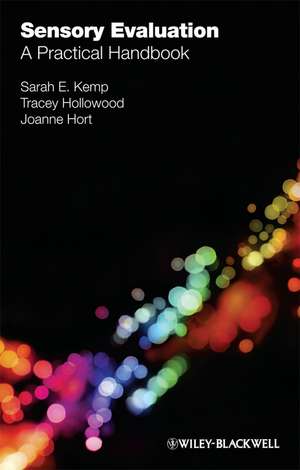
Sensory Evaluation
Autor Sarah E Kempen Limba Engleză Paperback – mai 2009
Preț: 563.79 lei
Preț vechi: 696.04 lei
-19%
Puncte Express: 846
Carte disponibilă
Livrare economică 09-23 noiembrie
Livrare express 24-30 octombrie pentru 30.70 lei
Livrare prin curier în România Termenul estimat este afișat lângă disponibilitate.
Transport gratuit pentru acest produs Plată online sau ramburs, în funcție de opțiunile comenzii.
Retur gratuit în 14 zile Comandă securizată și suport în română.
Specificații
ISBN-13: 9781405162104
ISBN-10: 1405162104
Pagini: 208
Dimensiuni: 150 x 213 x 18 mm
Greutate: 0.41 kg
Ediția:New.
Editura: Wiley
Locul publicării:Chichester, United Kingdom
ISBN-10: 1405162104
Pagini: 208
Dimensiuni: 150 x 213 x 18 mm
Greutate: 0.41 kg
Ediția:New.
Editura: Wiley
Locul publicării:Chichester, United Kingdom
V-ar putea interesa
-
 Scaleup of Chemical ProcessesAttilio Bisio-9%Preț: 2319.00 lei2548.35 lei
 -
 -9%Preț: 3656.06 lei4017.66 lei
 -
 Introduction to Industrial ChemistryHoward L White-9%Preț: 1660.68 lei1824.93 lei
 -
 NMR of Proteins and Nucleic AcidsKurt Wuthrich-9%Preț: 1434.26 lei1576.11 lei
 -
 ChemometricsMuhammad A Sharaf-9%Preț: 1648.57 lei1811.62 lei
 -
 -35%Preț: 1526.68 lei2336.84 lei
 -
 -27%Preț: 1194.77 lei1636.67 lei
 -
 A Handbook of Computational ChemistryTim Clark-9%Preț: 1581.25 lei1737.64 lei
 -
 Organotransition Metal ChemistryAkio Yamamoto-9%Preț: 1889.52 lei2076.40 lei
 -
 -9%Preț: 823.95 lei905.44 lei
 -
 Organosilicon ChemistryStephan Pawlenko-23%Preț: 1353.59 lei1757.91 lei
 -
 Praktikum der Technischen ChemieDegruyter-23%Preț: 736.66 lei956.71 lei
 -
 -23%Preț: 1370.88 lei1780.37 lei
Public țintă
Sensory scientists in industry and academia; sensory science lecturers and industry–based trainers; students undertaking courses involving sensory science.Notă biografică
Dr Sarah E. Kemp was formerly Head of Global Sensory and Consumer Guidance, Cadbury Schweppes plc, Reading, UK.
Dr Tracey Hollowood is Associate Director: Sensory and Consumer Research, Sensory Dimensions Ltd, Bulwell, Nottinghamshire, UK.
Dr Joanne Hort is Associate Professor in Sensory Science, Nottingham University, UK.
Dr Tracey Hollowood is Associate Director: Sensory and Consumer Research, Sensory Dimensions Ltd, Bulwell, Nottinghamshire, UK.
Dr Joanne Hort is Associate Professor in Sensory Science, Nottingham University, UK.
Cuprins
Preface vii Author biographies ix
Acknowledgements xi
1 Introduction 1
1.1 What is sensory evaluation? 1
1.2 What is the role of sensory evaluation? 2
1.3 What drives successful sensory testing? 3
2 Sensory perception 4
2.1 The human senses 4
2.2 Factors affecting sensory measurements 6
3 Planning your sensory project 11
3.1 Setting objectives 11
3.2 Product type 11
3.3 Budget 12
3.4 Timings 12
3.5 Selecting the test method 12
3.6 Setting action standards 13
3.7 Experimental design 14
3.8 Data analysis 19
4 Requirements for sensory testing 30
4.1 Professional conduct in sensory testing: health, safety, ethical and legal considerations 30
4.2 Good working and laboratory practices 37
4.3 Resources needed for sensory testing 41
4.4 Samples 49
4.5 Assessors 54
4.6 Data capture 63
5 Sensory test methods 66
5.1 Selecting the test 66
5.2 Discrimination tests 66
5.3 Descriptive analysis tests 96
5.4 Affective/consumer tests 118
5.5 Linking consumer, sensory and product data 136
6 Completing the project 138
6.1 Reporting 138
6.2 Documentation and data storage 140
6.3 Dos and don'ts 141
7 Appendices 142
Appendix 1: Examples of Latin Square and Williams Latin Square designs for selected number of samples 142
Appendix 2: IFST PFSG professional code of conduct for sensory professionals 143
Appendix 3: Critical values table for triangle test 147
Appendix 4: Critical values table for duo-trio test and paired comparison test for difference (one tailed) 149
Appendix 5: ANOVA explained 151
Appendix 6: Critical values table for chi-squared 156
Appendix 7: Critical values table for paired comparison and paired difference test (two tailed) 157
Appendix 8: Critical values table for Friedman test 159
Appendix 9: Types of scales 160
Appendix 10: Case study: modified quantitative descriptive analysis of chocolate texture 163
Appendix 11: R index explained 174
8 Glossary 178
9 References 185
Index 189
Acknowledgements xi
1 Introduction 1
1.1 What is sensory evaluation? 1
1.2 What is the role of sensory evaluation? 2
1.3 What drives successful sensory testing? 3
2 Sensory perception 4
2.1 The human senses 4
2.2 Factors affecting sensory measurements 6
3 Planning your sensory project 11
3.1 Setting objectives 11
3.2 Product type 11
3.3 Budget 12
3.4 Timings 12
3.5 Selecting the test method 12
3.6 Setting action standards 13
3.7 Experimental design 14
3.8 Data analysis 19
4 Requirements for sensory testing 30
4.1 Professional conduct in sensory testing: health, safety, ethical and legal considerations 30
4.2 Good working and laboratory practices 37
4.3 Resources needed for sensory testing 41
4.4 Samples 49
4.5 Assessors 54
4.6 Data capture 63
5 Sensory test methods 66
5.1 Selecting the test 66
5.2 Discrimination tests 66
5.3 Descriptive analysis tests 96
5.4 Affective/consumer tests 118
5.5 Linking consumer, sensory and product data 136
6 Completing the project 138
6.1 Reporting 138
6.2 Documentation and data storage 140
6.3 Dos and don'ts 141
7 Appendices 142
Appendix 1: Examples of Latin Square and Williams Latin Square designs for selected number of samples 142
Appendix 2: IFST PFSG professional code of conduct for sensory professionals 143
Appendix 3: Critical values table for triangle test 147
Appendix 4: Critical values table for duo-trio test and paired comparison test for difference (one tailed) 149
Appendix 5: ANOVA explained 151
Appendix 6: Critical values table for chi-squared 156
Appendix 7: Critical values table for paired comparison and paired difference test (two tailed) 157
Appendix 8: Critical values table for Friedman test 159
Appendix 9: Types of scales 160
Appendix 10: Case study: modified quantitative descriptive analysis of chocolate texture 163
Appendix 11: R index explained 174
8 Glossary 178
9 References 185
Index 189
Descriere
- Covers the "why" and "how to" of basic sensory evaluation techniques via step-by-step instructions - Unusually, covers a broad range of applications including food, beverages and personal care and household products - Spiral bound for ease of use in the testing environment.